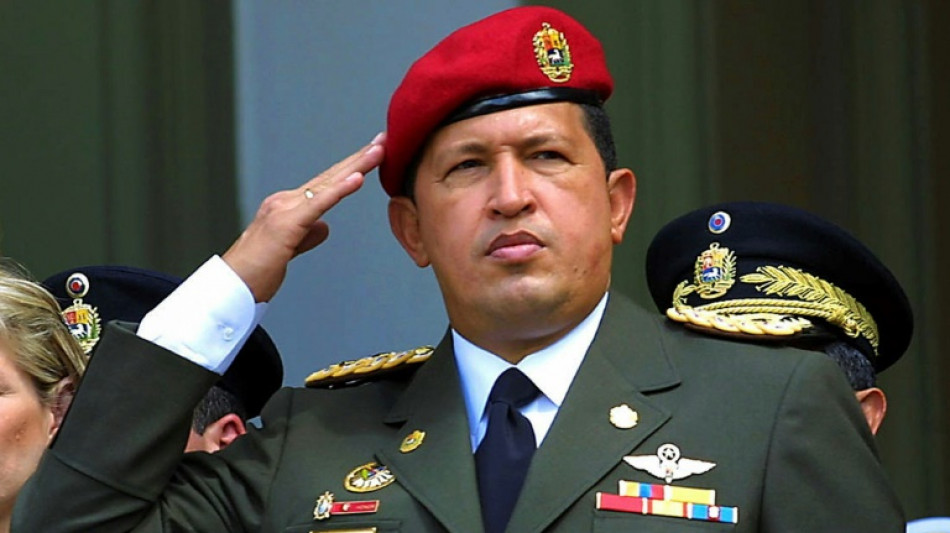
Chavez legacy looms large, and divides Venezuela, 25 years on / Photo: Juan BARRETO - AFP/File

 Crisis-wracked Volkswagen warns of 10-bn-euro hit to profits

 Shakira to cap off world tour with Madrid 12-gig run

 Isolated Syrian-Druze city shortages

 UNESCO can be 'moderator' in AI debate: chief to AFP

 Russia seizes assets of Nestle, French firms

 Anthropic says AI systems moving towards building themselves

 Asian stocks boosted by falling oil, yen weakens after BoJ rate hike

 Afghan medical students in Pakistan hope court stops college expulsions

 Australia to detain tourists who overstay visa, minister says

 Asian stocks track Wall St rally as oil prices drop

 Prized Mexican relic returns on loan, two centuries on

 'In our lane': Fed's Warsh defies Trump but still fighting for credibility

 Trump admin makes major cut to endangered species protections

 GM delivers first components for US interceptor missiles

 Travis Scott and Keith Richards feature on GTA VI soundtrack

 King Charles warns tech bosses of 'existential dangers' of AI

 French fishermen block ports over petrol prices

 Micron's Taiwan workers say 68 months' bonus not enough

 Canada's Carney pushes 'new alliance' with EU despite Trump threats

 Beyond Investment Returns: Families Are Measuring Wealth by Freedom, Continuity, and Legacy, According to Nour Private Wealth

 King Charles disputes claims in book by Princess Diana's brother

 Nepal floods among 'most challenging' disasters: WFP

 Kids and social media: what would change under new EU law

 King Charles to call on tech giants for 'reassurances' over AI

 STARPRIME Responds to Diverging Gold Market Demand with AM/PM Fixing and XAU24/7

"Chavez lives, damn it!" a soldier cries out every day at the same time outside the tomb of Venezuela's late leftist leader Hugo Chavez, who remains omnipresent and divisive 25 years after he took power.
The charismatic revolutionary, who became the symbolic leader of the left in Latin America, died in 2013, but his "Chavismo" political movement lives on under his anointed heir Nicolas Maduro, who is mired in political and economic crisis.
"Chavismo has been a real tragedy for the country," said Benigno Alarcon, a political scientist at the Andres Bello Catholic University.
Chavez is hailed for championing the poor. He used the country's oil wealth to develop social programs which earned him their devotion, but was criticized for his authoritarian style and failure to diversify the economy.
However, a quarter of a century after he took power, Venezuela's economy is on its knees, and some seven million of the country's 30 million citizens have fled the country.
Gross domestic product has shrunk 80 percent in the past decade, and hyperinflation forced the government to dollarize the economy.
Oil production has been devastated since the glory days of three million barrels a day, which fell to 300,000 before recovering to 900,000.
"Money has been wasted on cronyism. There has been no investment in what is important for a country to progress," said Alarcon.
He accused Chavismo of having "killed the goose that laid the golden eggs", in reference to state oil giant PDVSA.
Alarcon said bad management, such as the replacement of thousands of executives with "people who know little about oil," lack of investment, corruption and use of company resources for public spending drove PDVSA into ruin.
"Venezuela has one of the highest poverty rates in Latin America," soaring to over 90 percent between 2018 and 2021 before dropping to 81.5 percent in 2022, according to a UCAB survey.
- Maduro's 'great excuse' -
Rodrigo Cabezas, who was finance minister under Chavez, defends the late socialist, blaming the country's downward spiral on his successor Maduro, who blames Venezuela's woes on US sanctions.
He said Maduro was using confrontation with the United States as a "great excuse... to justify his immense incompetence in managing the country, the economy, and his terribly authoritarian drift and violations of human rights."
Chavez too demonized the United States, embracing its enemies, and portraying it as an evil colonial power.
"The success of Chavez, who had placed... the fight against poverty at the center of public management, has disappeared in a socially destroyed country," said Cabezas.
"No one can say that the economy was destroyed under Chavez," he said, adding that the economy grew between 2004 and 2012 and poverty levels at one point hit 27 percent.
Chavez represented "hope for change," said Cabezas.
For his part, Alarcon highlighted "human rights violations which began under Chavez," from the crackdown after a failed coup against him in 2002 to a student protest movement of 2007.
The International Criminal Court has opened an investigation into the repression of protests in 2017 which left around a hundred dead.
The country is also regularly accused of extrajudicial killings, torture and arbitrary arrests.
- 'Right side of history' -
Under Chavez, presidential term limits were scrapped, allowing him to be elected three times, while Maduro is now seeking a third term in 2024.
Maduro has blocked his main opposition rival Maria Corina Machado from the election race, is engaged in a new sanctions battle with the United States, and has rattled his saber in a territorial dispute with neighboring Guyana.
Meanwhile, Chavez's personality cult has not diminished, his image is splashed onto walls, and his name appears in Maduro's speeches, on television shows and elsewhere.
At the Caracas Mountain Barracks, foreign and local visitors flock to his mausoleum which is also a museum where his entire life is on display, from photos of his youth to personal objects such as a baseball outfit, uniforms and weapons.
His tomb is guarded by four motionless guards, dressed in red and with sabers in hand, who are relieved every two hours in a martial ceremony. Before a sad trumpet blast, each of the soldiers recites a part of Chavez's life.
At 16:25 every day a soldier shouts out: "Chavez lives, damn it!"
"Chavez lives every time we see a child in a free school. Chavez lives when we go to a neighborhood... and people have social rights. When we as a people have patriotic pride," said Ana Sofia Cabezas, Chavez Foundation vice president.
"The people woke up with Chavez and never slept again," she said. "We are on the right side of history."
H.Müller--CPN