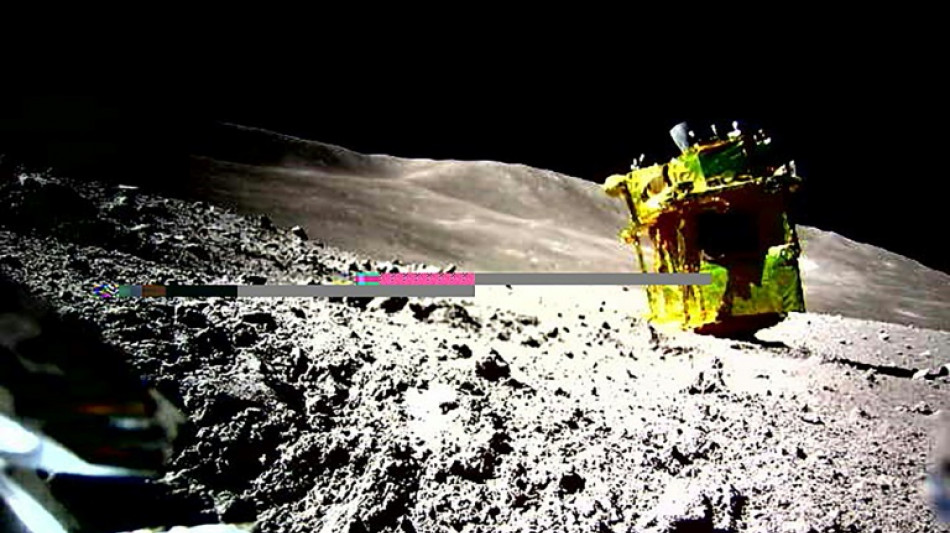
Lunar night puts Japan's lander back to sleep / Photo: Handout - JAPAN AEROSPACE EXPLORATION AGENCY (JAXA)/AFP

 Crisis-wracked Volkswagen warns of 10-bn-euro hit to profits

 Shakira to cap off world tour with Madrid 12-gig run

 Isolated Syrian-Druze city shortages

 UNESCO can be 'moderator' in AI debate: chief to AFP

 Russia seizes assets of Nestle, French firms

 Anthropic says AI systems moving towards building themselves

 Asian stocks boosted by falling oil, yen weakens after BoJ rate hike

 Afghan medical students in Pakistan hope court stops college expulsions

 Australia to detain tourists who overstay visa, minister says

 Asian stocks track Wall St rally as oil prices drop

 Prized Mexican relic returns on loan, two centuries on

 'In our lane': Fed's Warsh defies Trump but still fighting for credibility

 Trump admin makes major cut to endangered species protections

 GM delivers first components for US interceptor missiles

 Travis Scott and Keith Richards feature on GTA VI soundtrack

 King Charles warns tech bosses of 'existential dangers' of AI

 French fishermen block ports over petrol prices

 Micron's Taiwan workers say 68 months' bonus not enough

 Canada's Carney pushes 'new alliance' with EU despite Trump threats

 Beyond Investment Returns: Families Are Measuring Wealth by Freedom, Continuity, and Legacy, According to Nour Private Wealth

 King Charles disputes claims in book by Princess Diana's brother

 Nepal floods among 'most challenging' disasters: WFP

 Kids and social media: what would change under new EU law

 King Charles to call on tech giants for 'reassurances' over AI

 STARPRIME Responds to Diverging Gold Market Demand with AM/PM Fixing and XAU24/7

After a brief awakening, Japan's Moon lander is out of action again but will resume its mission if it survives the two-week lunar night, the space agency said Thursday.
The unmanned Smart Lander for Investigating Moon (SLIM) touched down last month at a wonky angle that left its solar panels facing the wrong way.
As the sun's angle shifted, it came back to life for two days this week and carried out scientific observations of a crater with its high-spec camera.
"After completing operation from 1/30 (to) 1/31, #SLIM entered a two week dormancy period during the long lunar night," space agency JAXA said on X, formerly Twitter.
"Although SLIM was not designed for the harsh lunar nights, we plan to try to operate again from mid-February, when the Sun will shine again on SLIM's solar cells."
JAXA said SLIM was able to "successfully complete observations... as originally planned" with its multiband spectroscopic camera and could study more target areas than initially expected.
The space agency also on Thursday posted a black-and-white photo of the rocky surface taken by the spacecraft.
It followed other grainy images sent back from the mission to investigate an exposed area of the Moon's mantle, the inner layer usually deep beneath its crust.
SLIM, dubbed the "Moon Sniper" for its precision landing technology, touched down within its target landing zone on January 20.
The feat was a boon for Japan's space programme after a string of recent failures, making the nation only the fifth to achieve a "soft landing" on the Moon, after the United States, the Soviet Union, China and India.
But during its descent, the craft suffered engine problems and ended up on its side, meaning the solar panels were facing west instead of up.
Russia, China and other countries from South Korea to the United Arab Emirates are also trying their luck to reach the Moon.
US firm Astrobotic's Peregrine lunar lander began leaking fuel after takeoff in January, dooming its mission. It likely burned up in the Earth's atmosphere on its return.
NASA has also postponed plans for crewed lunar missions under its Artemis programme.
C.Smith--CPN