Japan's Moon lander comes back to life / Photo: Kazuhiro NOGI - AFP

 Crisis-wracked Volkswagen warns of 10-bn-euro hit to profits

 Shakira to cap off world tour with Madrid 12-gig run

 Isolated Syrian-Druze city shortages

 UNESCO can be 'moderator' in AI debate: chief to AFP

 Russia seizes assets of Nestle, French firms

 Anthropic says AI systems moving towards building themselves

 Asian stocks boosted by falling oil, yen weakens after BoJ rate hike

 Afghan medical students in Pakistan hope court stops college expulsions

 Australia to detain tourists who overstay visa, minister says

 Asian stocks track Wall St rally as oil prices drop

 Prized Mexican relic returns on loan, two centuries on

 'In our lane': Fed's Warsh defies Trump but still fighting for credibility

 Trump admin makes major cut to endangered species protections

 GM delivers first components for US interceptor missiles

 Travis Scott and Keith Richards feature on GTA VI soundtrack

 King Charles warns tech bosses of 'existential dangers' of AI

 French fishermen block ports over petrol prices

 Micron's Taiwan workers say 68 months' bonus not enough

 Canada's Carney pushes 'new alliance' with EU despite Trump threats

 Beyond Investment Returns: Families Are Measuring Wealth by Freedom, Continuity, and Legacy, According to Nour Private Wealth

 King Charles disputes claims in book by Princess Diana's brother

 Nepal floods among 'most challenging' disasters: WFP

 Kids and social media: what would change under new EU law

 King Charles to call on tech giants for 'reassurances' over AI

 STARPRIME Responds to Diverging Gold Market Demand with AM/PM Fixing and XAU24/7

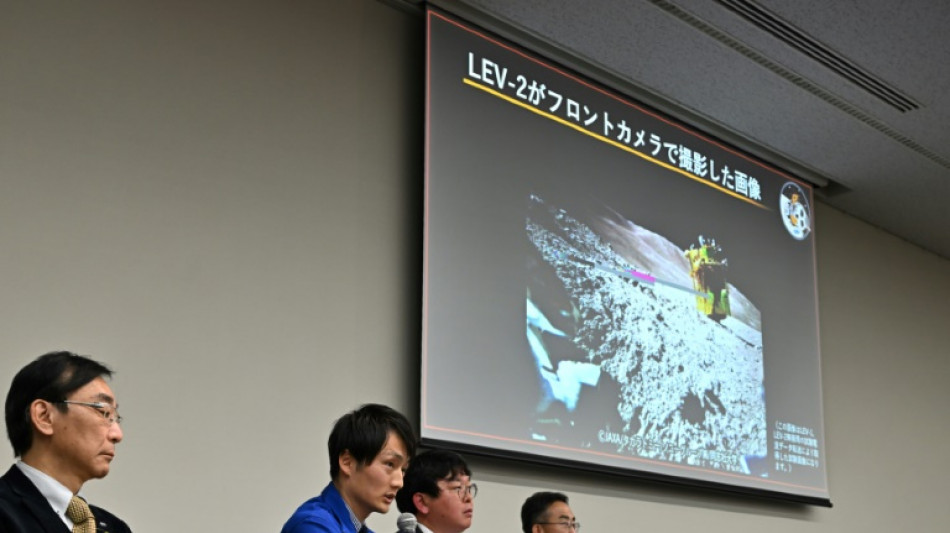
Japan's Moon lander has come back to life, the space agency said Monday, enabling the craft to proceed with its mission of investigating the lunar surface despite its rocky start.
The surprise announcement was a boost to Japan's space programme, nine days after the Smart Lander for Investigating Moon (SLIM) touched down at a wonky angle that left its solar panels facing the wrong way.
"Last evening we succeeded in establishing communication with SLIM, and resumed operations!" JAXA said on social media platform X, posting a grainy image of a lunar rock known as "toy poodle".
"We immediately started scientific observations with MBC, and have successfully obtained first light for 10-band observation," it said, referring to the lander's multiband spectroscopic camera.
- Terrifying minutes -
SLIM's January 20 touchdown made Japan only the fifth nation to achieve a "soft landing" on the Moon after the United States, the Soviet Union, China and India.
But on its descent, dubbed the "20 minutes of terror", the craft suffered engine problems and ended up at a skewed angle, images released by JAXA showed.
This meant the solar panels were facing west instead of up, and it was uncertain if they would still get enough sunlight to function.
Last week JAXA said it had switched the elevator-sized SLIM off with 12 percent power remaining, hoping that the craft would wake up this week.
A JAXA spokesman told AFP on Monday that the SLIM operation resumed "presumably because power generation resumed in its solar battery as it received sunlight".
"We will prioritise what we can do now -- observing and collecting information -- rather than adjusting SLIM's position since adjusting the position could lead to a worse situation," he said.
"The daytime (where SLIM is on the Moon) will last until around the end of January and it will be at night from around February," he said.
- Pinpoint -
Helping to repair its reputation after a number of recent mishaps, JAXA said last week that SLIM had landed 55 metres (yards) from its target.
This meant that the "Moon Sniper" lived up to its nickname and landed within the 100-metre landing zone, much more precise than the usual range of several kilometres (miles).
Before powering the craft off, mission control was able to download technical and image data from SLIM's descent and of the lunar crater where it landed.
Assuming it has enough juice, SLIM can now tackle its main mission of investigating an exposed area of the Moon's mantle, the inner layer usually deep beneath its crust.
Two probes also detached successfully, JAXA said -- one with a transmitter and another designed to trundle around the lunar surface beaming images to Earth.
- Transformers -
This shape-shifting mini-rover, slightly bigger than a tennis ball, was co-developed by the firm behind the Transformer toys.
Russia, China and other countries from South Korea to the United Arab Emirates are also trying their luck to reach the Moon.
US firm Astrobotic's Peregrine lunar lander began leaking fuel after takeoff this month, dooming its mission. It likely burned up in the Earth's atmosphere on its return.
NASA has also postponed plans for crewed lunar missions under its Artemis programme.
Two previous Japanese lunar missions -- one public and one private -- have failed.
In 2022, the country unsuccessfully sent a lunar probe named Omotenashi as part of the United States' Artemis 1 mission.
In April, Japanese startup ispace tried in vain to become the first private company to land on the Moon, losing communication with its craft after what it described as a "hard landing".
A.Zimmermann--CPN