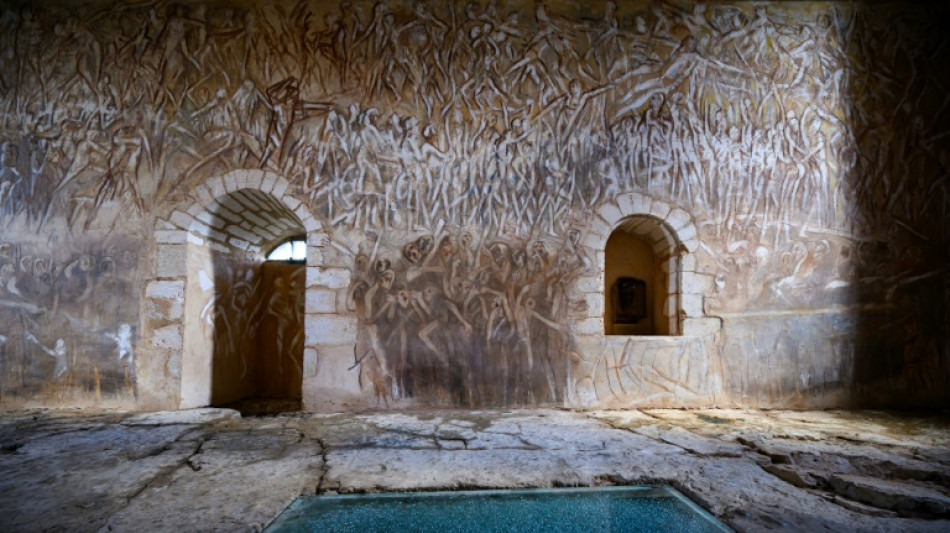
Around 245,000 Holocaust survivors alive: study / Photo: Lionel BONAVENTURE - AFP

 Warren Buffett steps down as Berkshire Hathaway chairman

 Isolated Syrian-Druze city blames Damascus for shortages

 Kerry James Marshall: American 'blackness' painter celebrated in Europe

 Infantino 'must go', says German FA vice-president

 Japan's busiest rail station tests robot bins

 Backpackers fret over Australian visa crackdown

 Bank of Japan hikes rates to 31-year high to battle inflation

 AI doomsday warnings unlikely to slow IPOs but questions linger

 In Brazil's Amazon, the hunt for oil fuels hopes and fears

 Baby orangutans in India expose 'frightening' scale of trafficking

 Oversight Board blasts 'inadequate' Meta safeguards for AI deepfakes

 Harry makes first public appearance since return to UK

 Princess Diana's brother makes new explosive claims against Charles

 Trump admin overhauls key protection for endangered species

 Mbappe draws political fire over Ceuta t-shirt controversy

 Third malaria death in Germany from outbreak tied to Frankfurt airport

 AtlasClear Holdings Reports Preliminary Fiscal 2026 Revenue of Approximately $20.1 Million, Up 85%; Revenue Plus Interest Income of Approximately $21.9 Million

 'Another arrow to the quiver': World Bank posts record private capital mobilization

 Ireland to boycott Eurovision 2027 over Gaza

 India's Tata Sons reappoints N. Chandrasekaran as chairman

 Germany urges EU action against China to defend carmakers

 Japan eyes changing prostitution law to punish sex buyers

 Modi pitches India as global chipmaking hub

 Ukraine plans record defence spending in 2027

 NASA scan discovers new, 'once in a century' Moon crater

Nearly 80 years after the end of World War II, there are still about 245,000 Holocaust survivors alive across more than 90 countries, a study showed Tuesday.
According to the Claims Conference, an organisation that seeks damages for Holocaust survivors, 119,300 of them live in Israel, 38,400 in the United States, 21,900 in France and 14,200 in Germany.
"Nearly all of the current population of survivors were children at the time of Nazi persecution, having survived camps, ghettos, flight and living in hiding," said the report, underlining that children had the "slimmest chances of surviving".
With a median age of 86 now, they are "at a period of life where their need for care and services is growing," said Gideon Taylor, president of the Claims Conference, adding that it was "time to double down on our attention to this waning population".
The report is the most comprehensive in recent years, drawing on "an unprecedented worldwide database of survivors", the conference said.
Founded in 1951, the Claims Conference has been the main organisation seeking damages for Holocaust survivors, and was a signatory to the Luxembourg Agreement under which West Germany assumed responsibility for Nazi atrocities and paid reparations.
The signing of the accord by West Germany was widely seen as its first major step back into the community of nations after World War II in which six million Jews were murdered in the Holocaust.
Since then, Germany has paid more than $90 billion as a result of negotiations with the Claims Conference, according to the group.
Some survivors -- such as those incarcerated in concentration camps -- remain eligible for ongoing payments, while others -- including those who fled from the Nazi regime -- get one-off payouts.
O.Ignatyev--CPN