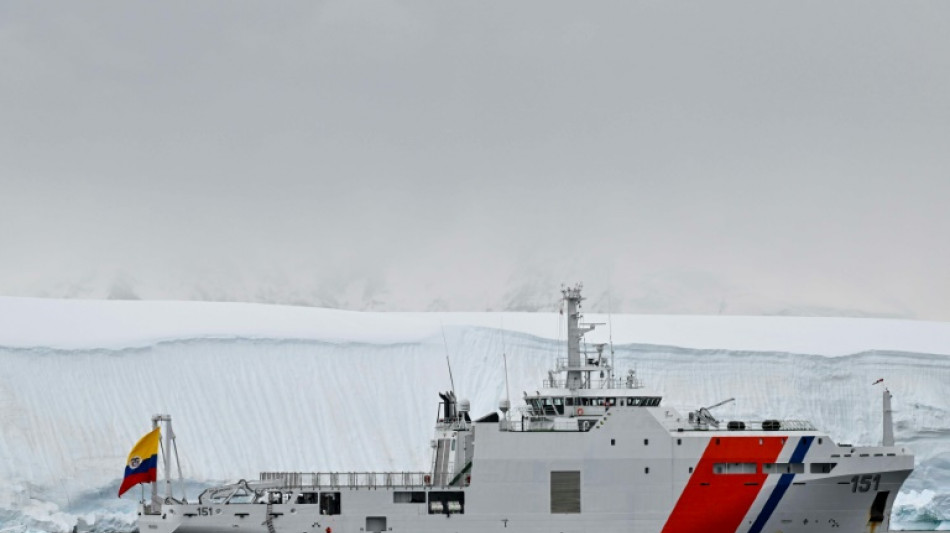
Colombian mission to Antarctica analyzes climate change footprints / Photo: JUAN BARRETO - AFP

 Warren Buffett steps down as Berkshire Hathaway chairman

 Isolated Syrian-Druze city blames Damascus for shortages

 Kerry James Marshall: American 'blackness' painter celebrated in Europe

 Infantino 'must go', says German FA vice-president

 Japan's busiest rail station tests robot bins

 Backpackers fret over Australian visa crackdown

 Bank of Japan hikes rates to 31-year high to battle inflation

 AI doomsday warnings unlikely to slow IPOs but questions linger

 In Brazil's Amazon, the hunt for oil fuels hopes and fears

 Baby orangutans in India expose 'frightening' scale of trafficking

 Oversight Board blasts 'inadequate' Meta safeguards for AI deepfakes

 Harry makes first public appearance since return to UK

 Princess Diana's brother makes new explosive claims against Charles

 Trump admin overhauls key protection for endangered species

 Mbappe draws political fire over Ceuta t-shirt controversy

 Third malaria death in Germany from outbreak tied to Frankfurt airport

 AtlasClear Holdings Reports Preliminary Fiscal 2026 Revenue of Approximately $20.1 Million, Up 85%; Revenue Plus Interest Income of Approximately $21.9 Million

 'Another arrow to the quiver': World Bank posts record private capital mobilization

 Ireland to boycott Eurovision 2027 over Gaza

 India's Tata Sons reappoints N. Chandrasekaran as chairman

 Germany urges EU action against China to defend carmakers

 Japan eyes changing prostitution law to punish sex buyers

 Modi pitches India as global chipmaking hub

 Ukraine plans record defence spending in 2027

 NASA scan discovers new, 'once in a century' Moon crater

Colombia's 10th Antarctic Expedition is making its way to the far reaches of the continent, exploring remote and almost untouched places inhabited by penguins, whales and the occasional seal.
The Colombian Navy's ARC Simon Bolivar is taking aquatic samples in Antarctica and advancing scientific research on climate change amid huge blocks of ice and frost.
"Antarctica is the world's refrigerator," Pablo Araujo, a researcher at the Central University of Ecuador, told AFP on board the ship, which is home to 39 researchers, 11 Colombian projects and nine international cooperation projects with four countries.
"What we want to see is how climate change is affecting the world's refrigerator and how that affects the whole quantity of nutrients (in the sea)," says the white-coated scientist.
On board the ship, the Ecuadoran researcher is carrying out a project to model Antarctic ecosystems using machine learning techniques, a branch of artificial intelligence focused on the study of statistical algorithms.
With the application of these models and the use of satellite images, researchers are studying the dynamics of greenhouse gas fluxes in Antarctic ecosystems.
One Colombian team is launching a battery of Niskin bottles, used to take water samples, into the ocean.
"Once (they) come to the surface, we proceed to take these samples for later analysis," said Alexis Grattz, a researcher from the Directorate General of Maritime Affairs, wearing a thick red mackintosh, gloves and a hat.
At the Ecuadoran scientific station, located at Punta Fort Williams on Greenwich Island, the maritime authority installed a portable weather station to record atmospheric pressure oscillations in the area.
These measurements are taken to "determine and help us understand more about these variations in sea level, understanding it as... an important indicator in the evolution of climate change," said Maritza Moreno, another researcher at the Directorate General of Maritime Affairs.
A Turkish mission, meanwhile, is studying the levels of polycyclic aromatic hydrocarbons (PAHs) -- which result from burning fossil fuels, wood, trash and tobacco -- in Antarctic soil.
Burak Karacik, a professor at Istanbul Technical University, said he is collecting sediment samples.
"I will analyze these sediment samples for persistent organic pollutants, and we will look at the effects of humans, here, in this environment," he added.
S.F.Lacroix--CPN