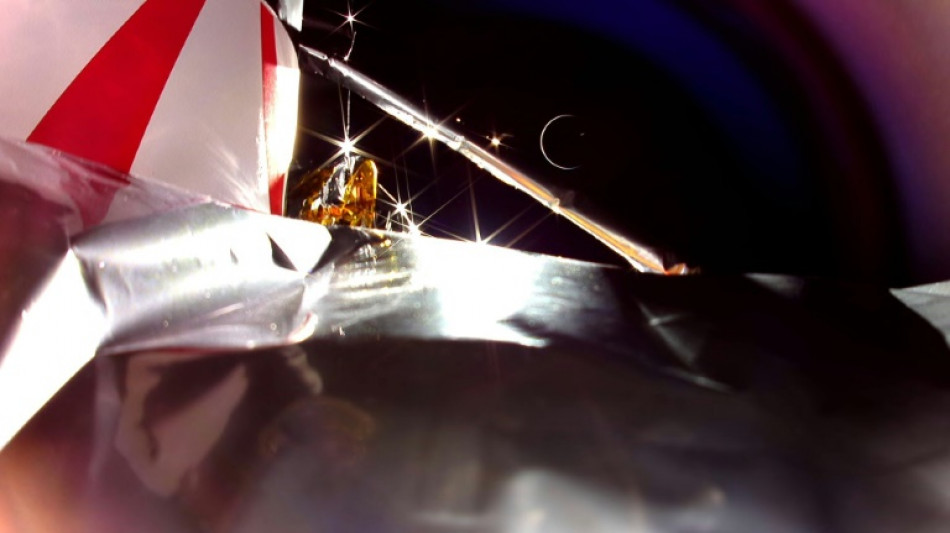
US spaceship lost over S. Pacific following failed Moon mission / Photo: - - Astrobotic/AFP

 Warren Buffett steps down as Berkshire Hathaway chairman

 Isolated Syrian-Druze city blames Damascus for shortages

 Kerry James Marshall: American 'blackness' painter celebrated in Europe

 Infantino 'must go', says German FA vice-president

 Japan's busiest rail station tests robot bins

 Backpackers fret over Australian visa crackdown

 Bank of Japan hikes rates to 31-year high to battle inflation

 AI doomsday warnings unlikely to slow IPOs but questions linger

 In Brazil's Amazon, the hunt for oil fuels hopes and fears

 Baby orangutans in India expose 'frightening' scale of trafficking

 Oversight Board blasts 'inadequate' Meta safeguards for AI deepfakes

 Harry makes first public appearance since return to UK
 Princess Diana's brother makes new explosive claims against Charles

 Trump admin overhauls key protection for endangered species

 Mbappe draws political fire over Ceuta t-shirt controversy

 Third malaria death in Germany from outbreak tied to Frankfurt airport

 AtlasClear Holdings Reports Preliminary Fiscal 2026 Revenue of Approximately $20.1 Million, Up 85%; Revenue Plus Interest Income of Approximately $21.9 Million

 'Another arrow to the quiver': World Bank posts record private capital mobilization

 Ireland to boycott Eurovision 2027 over Gaza

 India's Tata Sons reappoints N. Chandrasekaran as chairman

 Germany urges EU action against China to defend carmakers

 Japan eyes changing prostitution law to punish sex buyers

 Modi pitches India as global chipmaking hub

 Ukraine plans record defence spending in 2027

 NASA scan discovers new, 'once in a century' Moon crater

A crippled American spaceship has been lost over a remote region of the South Pacific, probably burning up in the atmosphere in a fiery end to its failed mission to land on the Moon.
Astrobotic's Peregrine lander was launched on January 8 under an experimental new partnership between NASA and private industry intended to reduce costs for American taxpayers and seed a lunar economy.
But it experienced an explosion shortly after separating from its rocket and had been leaking fuel, damaging its outer shell as well as making it impossible to reach its destination.
In its latest update, Astrobotic posted on X that it had lost contact with its spacecraft shortly before 2100 GMT Thursday, mid-morning on Friday in the local time zone, indicating a "controlled re-entry over open water" as it had predicted.
The Pittsburgh-based company added it would await independent confirmation of Peregrine's fate from the relevant government authorities. A previous update provided atmospheric re-entry coordinates a few hundred miles (kilometers) south of Fiji, albeit with a wide margin of error.
Engineers had executed a series of small engine burns to position the boxy, golf cart-sized robot over the ocean to "minimize the risk of debris reaching land."
Astrobotic also tweeted a photograph taken by the spaceship on its final day, revealing the Earth's crescent as it positioned itself between the Sun and our planet.
Peregrine operated for over 10 days in space, exciting enthusiasts even after it became clear Astrobotic would not succeed in its goal to be the first company to achieve a controlled touchdown on the Moon -- and the first American soft landing since the end of the Apollo era, more than five decades ago.
NASA had paid the company more than $100 million under the Commercial Lunar Payload Services (CLPS) program to ship its science instruments to the Moon, as it prepares to send American astronauts back to the barren world later this decade under the Artemis program.
Astrobotic also carried more colorful cargo on behalf of private clients, such as the DNA and cremated remains of some 70 people, including Star Trek creator Gene Roddenberry and sci-fi author Arthur C. Clarke.
Though it hasn't worked out this time, NASA officials have made clear their strategy of "more shots on goal" means more chances to score. The next attempt under CLPS, by Houston-based Intuitive Machines, launches in February.
The Japanese space agency's "Moon Sniper," which launched in September, will be the next spaceship to attempt a soft lunar touchdown, a notoriously difficult feat, shortly after midnight Japan time on Saturday (1500 GMT on Friday).
If it succeeds, Japan will be the fifth nation to complete the achievement, after the Soviet Union, United States, China and India.
H.Meyer--CPN