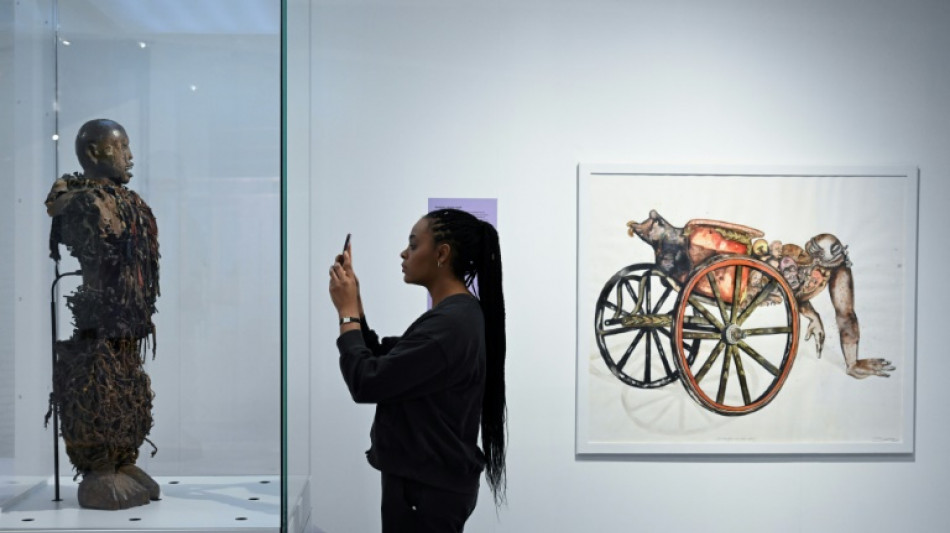
Belgium's Africa museum pores over colonial-era collection / Photo: JOHN THYS - AFP

 Warren Buffett steps down as Berkshire Hathaway chairman

 Isolated Syrian-Druze city blames Damascus for shortages

 Kerry James Marshall: American 'blackness' painter celebrated in Europe

 Infantino 'must go', says German FA vice-president

 Japan's busiest rail station tests robot bins

 Backpackers fret over Australian visa crackdown

 Bank of Japan hikes rates to 31-year high to battle inflation

 AI doomsday warnings unlikely to slow IPOs but questions linger

 In Brazil's Amazon, the hunt for oil fuels hopes and fears

 Baby orangutans in India expose 'frightening' scale of trafficking

 Oversight Board blasts 'inadequate' Meta safeguards for AI deepfakes

 Harry makes first public appearance since return to UK

 Princess Diana's brother makes new explosive claims against Charles

 Trump admin overhauls key protection for endangered species

 Mbappe draws political fire over Ceuta t-shirt controversy

 Third malaria death in Germany from outbreak tied to Frankfurt airport

 AtlasClear Holdings Reports Preliminary Fiscal 2026 Revenue of Approximately $20.1 Million, Up 85%; Revenue Plus Interest Income of Approximately $21.9 Million

 'Another arrow to the quiver': World Bank posts record private capital mobilization

 Ireland to boycott Eurovision 2027 over Gaza

 India's Tata Sons reappoints N. Chandrasekaran as chairman

 Germany urges EU action against China to defend carmakers

 Japan eyes changing prostitution law to punish sex buyers

 Modi pitches India as global chipmaking hub

 Ukraine plans record defence spending in 2027

 NASA scan discovers new, 'once in a century' Moon crater

Belgium's main museum dedicated to Africa has started delving into the origins of its enormous collection, as a first step towards possible restitution of items that were obtained in violent ways during colonial times.
"We want to get a better idea of the origin of the pieces and see if we can establish which were obtained through theft, violence or manipulation," Bart Ouvry, director of the Royal Museum for Central Africa on Brussels' outskirts, told AFP.
An inventory of 80,000 objects -- sculptures, masks, utensils, musical instruments -- from the Democratic Republic of Congo (DRC) was already handed over to Kinshasa authorities two years ago.
Shortly after, in 2022, Belgium adopted a law setting out how it would hand back works that were despoiled between 1885 and 1960, when Belgium ruled over the DRC, known then as Congo, first as King Leopold II's private property then as a Belgian colony.
So far, Kinshasa has not made a formal return request, said Thomas Dermine, the Belgian minister in charge of the matter.
He said a joint committee of Belgian and DRC experts would be set up to determine which objects were legitimately obtained and which were not.
To mark the process, a new exhibition, "ReThinking Collections", opened at the museum on Thursday with a statue that once belonged to a Congolese chief, Ne Kuko of Boma, presented as "A Symbol of Stolen Art".
"The Congolese diasporas view this statue as an emblem of the need for restitution," noted Agnes Lacaille, one of the exhibition's curators.
The Nkisi Nkonde Statue was taken by a Belgian officer and explorer, Alexandre Delcommune, during an 1878 expedition in western Congo as punishment for the region hiking taxes on Belgian trade routes.
A historian, Didier Gondola, said that colonial soldiers, administrative officials and missionaries "collected" such artefacts, often using "violence" or "coercion".
Though Belgium is plunging into the issue now, restitution requests were sent starting in the late 1960s by Mobutu Sese Seko, dictator of the country that at that time was known as Zaire.
A decade later, the museum handed over 114 pieces, but not its most prized ones.
"In Mobutu's time, for example, the Europeans said 'We are doing you a favour, because we are conserving your objects. If we gave them to you, they would end up on the international art market, would be sold on, because the government is corrupt, or they'd be ruined because you don't have the means to conserve them'," Gondola said.
- 'National heritage' -
But times have changed, he stressed.
"In Kinshasa, there is a very beautiful museum, just as modern as this one, and there is enough space that these objects can be brought back into the national heritage," he said.
As a halfway measure, Belgium's King Philippe delivered a giant ritual "kakuungu" mask to the DRC's national museum as an "unlimited" loan. The monarch expressed "deep regret" for Belgium's colonial period.
Belgium's plunder did more than erode the DRC's physical heritage, explained another exhibition curator, Sarah Van Beurden, as she stood before a "manza" xylophone taken in 1911-1912.
"When you take an object like this xylophone, you take away the ability for a community to maintain its cultural customs," she said.
"You can return the object. But you can't return what the community has lost."
In a gesture to repair that loss, a project has been mounted with DRC youth from the community where the instrument was taken to recreate -- "in a different way" -- music that it produces, she said.
P.Gonzales--CPN