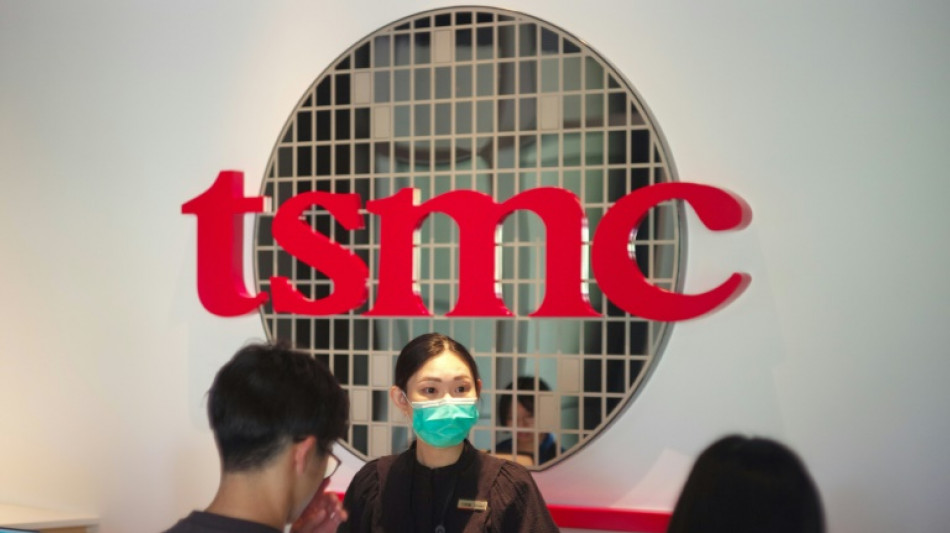
Taiwan's TSMC to launch Japan chipmaking plant in February / Photo: Sam Yeh - AFP

 Warren Buffett steps down as Berkshire Hathaway chairman

 Isolated Syrian-Druze city blames Damascus for shortages

 Kerry James Marshall: American 'blackness' painter celebrated in Europe

 Infantino 'must go', says German FA vice-president

 Japan's busiest rail station tests robot bins

 Backpackers fret over Australian visa crackdown

 Bank of Japan hikes rates to 31-year high to battle inflation

 AI doomsday warnings unlikely to slow IPOs but questions linger

 In Brazil's Amazon, the hunt for oil fuels hopes and fears

 Baby orangutans in India expose 'frightening' scale of trafficking

 Oversight Board blasts 'inadequate' Meta safeguards for AI deepfakes

 Harry makes first public appearance since return to UK

 Princess Diana's brother makes new explosive claims against Charles

 Trump admin overhauls key protection for endangered species

 Mbappe draws political fire over Ceuta t-shirt controversy

 Third malaria death in Germany from outbreak tied to Frankfurt airport

 AtlasClear Holdings Reports Preliminary Fiscal 2026 Revenue of Approximately $20.1 Million, Up 85%; Revenue Plus Interest Income of Approximately $21.9 Million

 'Another arrow to the quiver': World Bank posts record private capital mobilization

 Ireland to boycott Eurovision 2027 over Gaza

 India's Tata Sons reappoints N. Chandrasekaran as chairman

 Germany urges EU action against China to defend carmakers

 Japan eyes changing prostitution law to punish sex buyers

 Modi pitches India as global chipmaking hub

 Ukraine plans record defence spending in 2027

 NASA scan discovers new, 'once in a century' Moon crater

Taiwan's TSMC will open its latest chipmaking foundry on Japan's Kyushu island on February 24, its chairman said Thursday, part of the semiconductor giant's plan to expand its global manufacturing footprint.
Taiwan Semiconductor Manufacturing Company -- which counts Apple and Nvidia as clients -- controls more than half the world's output of silicon wafers, used in everything from smartphones to cars and missiles.
In recent years, the company has had to navigate geopolitical tussles between the United States and China as the two face off over technology import restrictions, trade and Taiwan -- the primary manufacturing base for TSMC.
On Thursday, during an investors' call over fourth-quarter earnings, chairman Mark Liu announced the official date of the long-awaited Japan foundry's opening ceremony would be February 24.
"In Japan, we are building a special technology fab(rication plant) in Kumamoto which will utilise 12- and 16-nanometre and 28- and 22-nanometre process technology," Liu said.
"We will hold an opening ceremony for this fab on February 24 next month and volume production is on track for fourth quarter of 2024."
He added that TSMC's expansion overseas is "based on our customers' needs and a necessary level of government subsidies for support".
"In today's fractured globalisation environment, our strategy is to expand our global manufacturing footprint to increase our customers' trust, expand our future growth potential, and reach for more global talents," Liu said.
Japan's government said last year it plans to spend $13 billion to boost domestic production of strategically important semiconductors and generative AI technology.
Part of that spending would be to support the construction of a second TSMC plant in Kumamoto, a Japanese trade ministry official had said in November.
But Liu said Thursday that the second plant is still in the "serious evaluation stage".
"We are still discussing with the Japanese government, they are very cooperative," he said. "Nothing is definitive."
- 'Challenging year' -
Besides a plant in Japan, TSMC also has a planned fab in Germany, which would be its first in Europe.
Liu said Thursday the fab construction in Germany, in Saxony's capital Dresden, "is scheduled to begin in Q4 (the fourth quarter) this year".
The company also reported a 19.3 percent drop in net profits in the October-December period to Tw$238.7 billion ($7.6 billion), while its revenues were "essentially flat".
CEO C.C. Wei said that while 2023 was a "challenging year" for the global semiconductor industry, the rising demand for generative AI technology also means "we expect 2024 to be a healthy growth year for TSMC".
The chip industry has seen sluggish performance, which companies attribute to high inflation and slowing global economic growth caused in part by geopolitical tensions.
TSMC had sought to quell investor fears in the past by pointing to the increasing demand for AI-related products, like ChatGPT, which needs high-performing silicon wafers to function.
D.Philippon--CPN