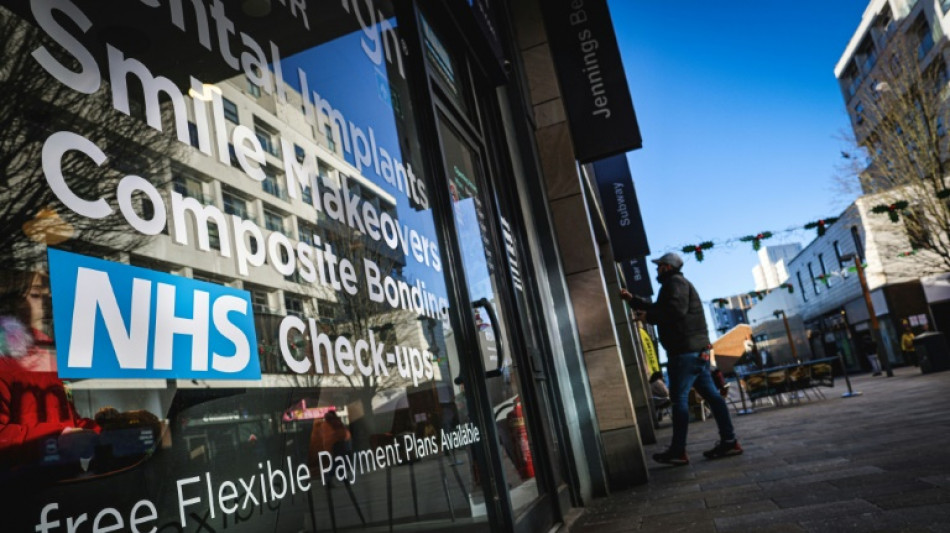
Decay in state dental care leaves UK patients down in the mouth / Photo: Adrian DENNIS - AFP

 Warren Buffett steps down as Berkshire Hathaway chairman

 Isolated Syrian-Druze city blames Damascus for shortages

 Kerry James Marshall: American 'blackness' painter celebrated in Europe

 Infantino 'must go', says German FA vice-president

 Japan's busiest rail station tests robot bins

 Backpackers fret over Australian visa crackdown

 Bank of Japan hikes rates to 31-year high to battle inflation

 AI doomsday warnings unlikely to slow IPOs but questions linger

 In Brazil's Amazon, the hunt for oil fuels hopes and fears

 Baby orangutans in India expose 'frightening' scale of trafficking

 Oversight Board blasts 'inadequate' Meta safeguards for AI deepfakes

 Harry makes first public appearance since return to UK

 Princess Diana's brother makes new explosive claims against Charles

 Trump admin overhauls key protection for endangered species

 Mbappe draws political fire over Ceuta t-shirt controversy

 Third malaria death in Germany from outbreak tied to Frankfurt airport

 AtlasClear Holdings Reports Preliminary Fiscal 2026 Revenue of Approximately $20.1 Million, Up 85%; Revenue Plus Interest Income of Approximately $21.9 Million

 'Another arrow to the quiver': World Bank posts record private capital mobilization

 Ireland to boycott Eurovision 2027 over Gaza

 India's Tata Sons reappoints N. Chandrasekaran as chairman

 Germany urges EU action against China to defend carmakers

 Japan eyes changing prostitution law to punish sex buyers

 Modi pitches India as global chipmaking hub

 Ukraine plans record defence spending in 2027

 NASA scan discovers new, 'once in a century' Moon crater

Finding a state-funded dentist is becoming increasingly difficult in the UK, forcing those who can pay to the private sector, and those who cannot to avoid treatment altogether -- or take matters into their own hands.
Increasing numbers of dentists are turning their backs on the National Health Service (NHS) in favour of more lucrative private practice.
The British Dental Association (BDA) said the number of active NHS dentists in England is at its lowest level in a decade.
"It's easier to get your hands on Taylor Swift tickets in 2024 than it is to get an NHS dental appointment," said Labour MP Ashley Dalton last week.
The NHS, funded through general taxation and national insurance contributions, was designed to allow free healthcare for all or, in the case of dentistry, at minimal cost.
But according to a YouGov poll in March last year, one in five Britons were unable to register with an NHS or private dentist.
- Nightmare -
Danny White has been struggling to find a dentist for himself, his wife, who suffers from recurring abscesses, and his two daughters.
One of his daughters has a tooth growing behind her baby teeth and needs an appointment while the other requires braces.
But all three dental practices where they live in Bury St Edmunds, eastern England, are no longer accepting NHS patients and only offer private care.
"It's an absolute nightmare," he told AFP. "We've been trying so hard to try and get her appointment. They took everyone off their NHS list"
White estimated it would cost £400 ($500) for the family just to have an initial consultation -- an unaffordable sum when they are already struggling to pay off a car loan.
The situation has seen tales of people travelling hundreds of miles (kilometres) to find a dentist, getting into debt to pay for treatment or even travelling overseas just to have a tooth out.
In Bridlington, in northern England, locals have been told that it will take around eight to nine years to get an appointment at the seaside town's only dentist.
Some have turned to self-dentistry kits and superglue bought off Amazon, while another told the Daily Mail he pulled out six teeth with pliers.
Others flew to Turkey for treatment, paying a fraction of what they would have paid privately in the UK.
"People have been admitted to hospital having overdosed on painkillers," said Mark Jones, founder of the "Toothless in England" campaign group.
"People have died from sepsis through abscesses in the mouth or from oral cancer because it's not been picked up by regular checkups.
"People are pulling out their own teeth."
According to OECD data, the UK has 49 dentists per 100,000 inhabitants -- the lowest rate among G7 countries.
"There's not a shortage of dentists," said Jones. "What there is a shortage of is dentists choosing to work in the NHS."
In a mid-December report on the issue, The Nuffield Trust health think-tank warned that NHS dental services were "nearly at a terminal stage".
A two-tier system is gradually taking its place: one for those who can afford to seek treatment and pay, and another for those who cannot and as a result see their oral health deteriorate.
The Oral Health Foundation charity said that has already had tragic consequences: in 2021 more than 3,000 people in England died from mouth cancer -- up 46 percent in a decade.
- Plan -
BDA president Eddie Crouch called the situation "quite shocking in a civilised country" and blamed under-investment for at least the last decade, forcing patients to pay more for NHS treatments.
Cancelled treatment during the coronavirus pandemic has also created a backlog, he said.
He also pinpoints a 2006 reform which changed remuneration for dental procedures, making them less attractive for dentists.
Currently, just over 70 percent of dentists offer NHS treatments -- and even then the service is limited -- a recent parliamentary report noted.
The Conservative government, in power since 2010, has promised to put in place a plan for publicly funded dental treatment, which has a £3 billion budget in England alone.
"What we're expecting in the recovery plan is possibly some incentives for dentists to take on new patients... an additional payment to actually fill in the void of how much money it actually costs to take on people who are presenting with high need."
But according to Jones, a plan for emergency dental care is also needed such as mobile clinics or hospital outpatient treatment.
L.K.Baumgartner--CPN