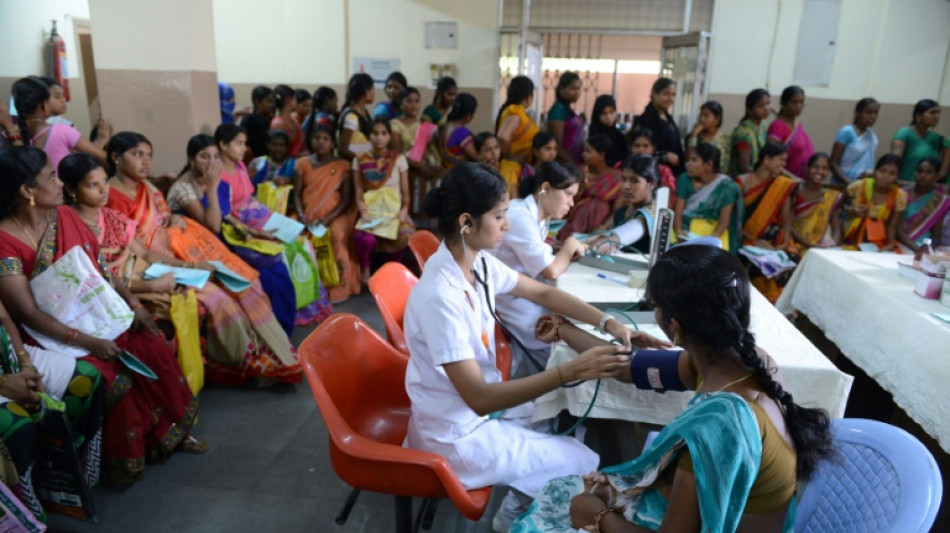
Women's health gap costs $1 trillion worldwide: report / Photo: NOAH SEELAM - AFP/File

 Warren Buffett steps down as Berkshire Hathaway chairman

 Isolated Syrian-Druze city blames Damascus for shortages

 Kerry James Marshall: American 'blackness' painter celebrated in Europe

 Infantino 'must go', says German FA vice-president

 Japan's busiest rail station tests robot bins

 Backpackers fret over Australian visa crackdown

 Bank of Japan hikes rates to 31-year high to battle inflation

 AI doomsday warnings unlikely to slow IPOs but questions linger

 In Brazil's Amazon, the hunt for oil fuels hopes and fears

 Baby orangutans in India expose 'frightening' scale of trafficking

 Oversight Board blasts 'inadequate' Meta safeguards for AI deepfakes

 Harry makes first public appearance since return to UK

 Princess Diana's brother makes new explosive claims against Charles

 Trump admin overhauls key protection for endangered species

 Mbappe draws political fire over Ceuta t-shirt controversy

 Third malaria death in Germany from outbreak tied to Frankfurt airport

 AtlasClear Holdings Reports Preliminary Fiscal 2026 Revenue of Approximately $20.1 Million, Up 85%; Revenue Plus Interest Income of Approximately $21.9 Million

 'Another arrow to the quiver': World Bank posts record private capital mobilization

 Ireland to boycott Eurovision 2027 over Gaza

 India's Tata Sons reappoints N. Chandrasekaran as chairman

 Germany urges EU action against China to defend carmakers

 Japan eyes changing prostitution law to punish sex buyers

 Modi pitches India as global chipmaking hub

 Ukraine plans record defence spending in 2027

 NASA scan discovers new, 'once in a century' Moon crater

The huge gap between how women and men's health are treated costs $1 trillion a year worldwide, the World Economic Forum said on Wednesday.
Women spend a quarter more of their lives suffering from poor health than men, a disparity that includes an unequal focus on men across medical research, diagnosis and treatment, the report said.
Closing this gap would boost the global economy by $1 trillion annually by 2040 -- a 1.7 percent increase in per capita GDP driven by women, it added.
The report was released as the WEF hosts its 54th annual conference in Davos, Switzerland.
The Swiss firm Ferring Pharmaceuticals and McKinsey Health Institute also contributed to the 42-page report.
Every US dollar invested in women's health would return three dollars in projected economic growth, the report said.
A large part of this growth would come from sick women getting back into the workforce.
The gender health gap causes around 75 million years of life lost due to poor health annually, equating to a week per woman every year, the report said.
For example, addressing the inequities related to endometriosis and menopause -- which only affect women and have long been considered under-studied -- could contribute $130 billion to global GDP by 2040, it estimated.
Research also suggests that fewer than half the women living with endometriosis have been properly diagnosed, the report added.
The study also looked at how treatment and diagnosis has benefitted men more than women.
Asthma inhalers, for example, have been found to be significantly less effective for women than men.
Women are diagnosed later than men for 700 different diseases, previous research has shown. It also takes women two and a half years longer to be diagnosed with cancer.
WEF healthcare head Shyam Bishen said the analysis demonstrates that "investing in women's health must be a priority for every country".
"Beyond improving women's quality of life, ensuring women have access to innovations in healthcare is one of the best investments that countries can make for their societies and their economies," he said in a statement.
The WEF announced it was launching the Global Alliance for Women's Health, with $55 million pledged for women's health.
C.Smith--CPN