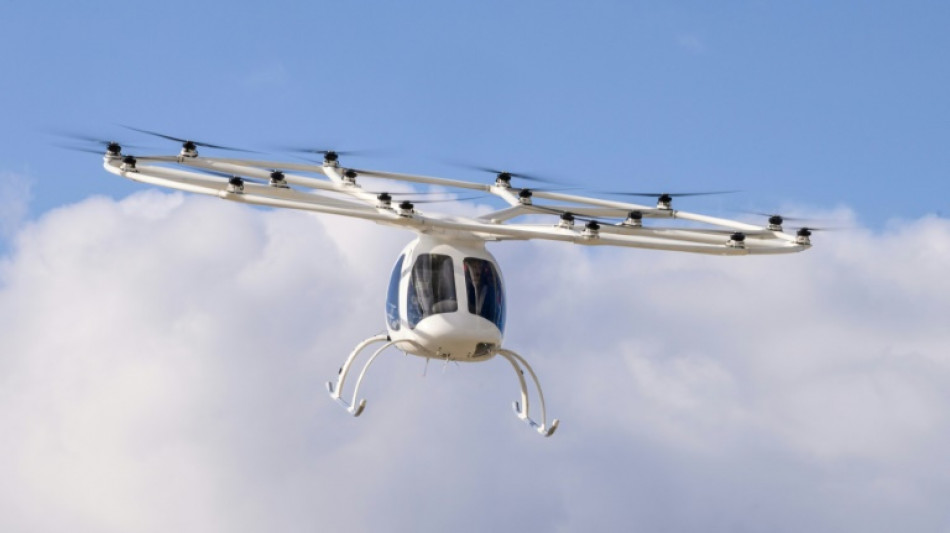
Volocopter flying taxi seeks to seduce Paris / Photo: Anthony WALLACE - AFP

 Warren Buffett steps down as Berkshire Hathaway chairman

 Isolated Syrian-Druze city blames Damascus for shortages

 Kerry James Marshall: American 'blackness' painter celebrated in Europe

 Infantino 'must go', says German FA vice-president

 Japan's busiest rail station tests robot bins

 Backpackers fret over Australian visa crackdown

 Bank of Japan hikes rates to 31-year high to battle inflation

 AI doomsday warnings unlikely to slow IPOs but questions linger

 In Brazil's Amazon, the hunt for oil fuels hopes and fears

 Baby orangutans in India expose 'frightening' scale of trafficking

 Oversight Board blasts 'inadequate' Meta safeguards for AI deepfakes

 Harry makes first public appearance since return to UK

 Princess Diana's brother makes new explosive claims against Charles

 Trump admin overhauls key protection for endangered species

 Mbappe draws political fire over Ceuta t-shirt controversy

 Third malaria death in Germany from outbreak tied to Frankfurt airport

 AtlasClear Holdings Reports Preliminary Fiscal 2026 Revenue of Approximately $20.1 Million, Up 85%; Revenue Plus Interest Income of Approximately $21.9 Million

 'Another arrow to the quiver': World Bank posts record private capital mobilization

 Ireland to boycott Eurovision 2027 over Gaza

 India's Tata Sons reappoints N. Chandrasekaran as chairman

 Germany urges EU action against China to defend carmakers

 Japan eyes changing prostitution law to punish sex buyers

 Modi pitches India as global chipmaking hub

 Ukraine plans record defence spending in 2027

 NASA scan discovers new, 'once in a century' Moon crater

A German company is seeking to use the exposure generated by the Paris Olympics to overcome the opposition of local politicians and demonstrate that flying taxis can serve the French capital.
Volocopter hopes that by being certified in Paris -- which has some of the strictest regulations for over-flights -- it can prove that flying taxis aren't just science fiction gimmicks.
"If you can fly in Paris, you can fly in any city in the world," Volocopter's CEO Dirk Hoke told AFP.
The company's "VoloCity" is a two-seat electric vertical take-off and landing aircraft that resembles a gigantic insect crowned with 18 rotors.
Volocopter wants it to be the first such aircraft certified by both EASA and the FAA, the European and US civil aviation security agencies.
In the meantime, the aircraft is conducting test flights to be certified to fly over Paris, which requires showing that it has the same level of safety as a commercial aircraft, which is 100 times more than that of a helicopter.
Statistically, that means one accident every billion flight hours, which is longer than the lifespan of any aircraft.
- "Building confidence" -
Hoke says he's hopeful to receive a special permit from EASA to carry out demonstration flights without paying passengers during the Olympics.
Following the Olympics, VoloCity will carry out two years of test flights in the Paris region.
A "learning period", Hoke says, to show that "these systems are not just fiction" and to win the public's confidence.
"Noise, safety and durability are the most important criteria for flying above a city," he explains.
In September, French environmental regulators judged as "incomplete" a study on the impact of taxi flights along the Seine, noting visual and sound disturbances.
Paris' municipal council issued a non-binding negative verdict on plans to build a "vertiport" near the Austerlitz train station, with some calling the project "absurd" or an "ecological aberration".
"We have to take these views seriously and respond to these concerns, because what's important to us is not just the certification, but public acceptance," he said.
He insists the noise, which is 55 à 60 decibels at 75 to 100 metres, is nothing like a helicopter and is about the level of a conversation.
"We will have support when people see and hear the flights and realise that they don't disturb city life," Hoke said.
Volocopter needs 25 million to 30 million euros ($28 million to $33 million) for the two years of demonstration flights around Paris, and between 200 million to 300 million euros to prepare the next step.
The current configuration, with just one seat besides the pilot, will never be profitable. But a new aircraft with four seats should be ready by late 2026, early 2027. "That's when there will be a real business case," he said.
As to claims that flying taxis are elitist, Hoke recalls that the first Telsa was a two-seater electric roadster.
M.Anderson--CPN