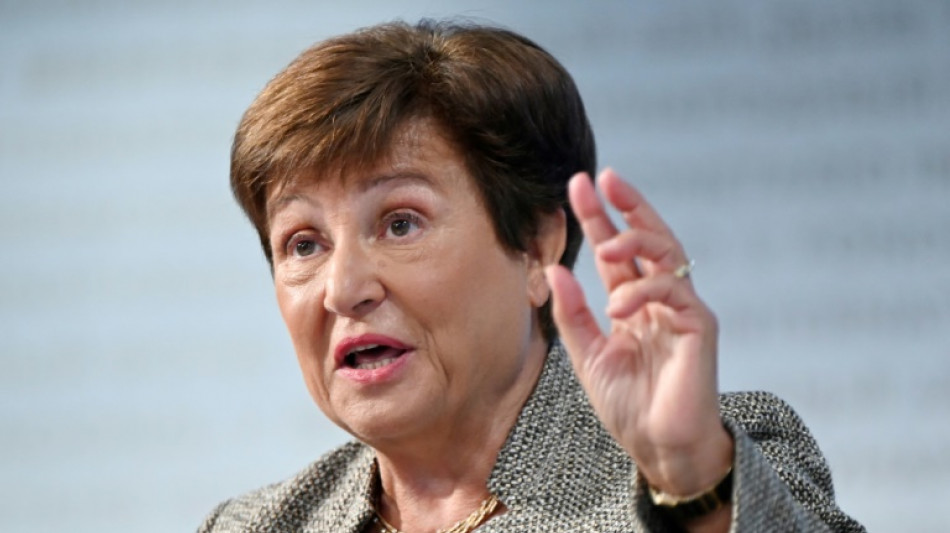
IMF chief says AI holds risks, 'tremendous opportunity' for global economy / Photo: OLIVIER DOULIERY - AFP

 Warren Buffett steps down as Berkshire Hathaway chairman

 Isolated Syrian-Druze city blames Damascus for shortages

 Kerry James Marshall: American 'blackness' painter celebrated in Europe

 Infantino 'must go', says German FA vice-president

 Japan's busiest rail station tests robot bins

 Backpackers fret over Australian visa crackdown

 Bank of Japan hikes rates to 31-year high to battle inflation

 AI doomsday warnings unlikely to slow IPOs but questions linger

 In Brazil's Amazon, the hunt for oil fuels hopes and fears

 Baby orangutans in India expose 'frightening' scale of trafficking

 Oversight Board blasts 'inadequate' Meta safeguards for AI deepfakes

 Harry makes first public appearance since return to UK

 Princess Diana's brother makes new explosive claims against Charles

 Trump admin overhauls key protection for endangered species

 Mbappe draws political fire over Ceuta t-shirt controversy

 Third malaria death in Germany from outbreak tied to Frankfurt airport

 AtlasClear Holdings Reports Preliminary Fiscal 2026 Revenue of Approximately $20.1 Million, Up 85%; Revenue Plus Interest Income of Approximately $21.9 Million

 'Another arrow to the quiver': World Bank posts record private capital mobilization

 Ireland to boycott Eurovision 2027 over Gaza

 India's Tata Sons reappoints N. Chandrasekaran as chairman

 Germany urges EU action against China to defend carmakers

 Japan eyes changing prostitution law to punish sex buyers

 Modi pitches India as global chipmaking hub

 Ukraine plans record defence spending in 2027

 NASA scan discovers new, 'once in a century' Moon crater

Artificial intelligence poses risks to job security around the world but also offers a "tremendous opportunity" to boost flagging productivity levels and fuel global growth, the IMF chief told AFP.
AI will affect 60 percent of jobs in advanced economies, the International Monetary Fund's managing director, Kristalina Georgieva, said in an interview in Washington, shortly before departing for the annual World Economic Forum in Davos, Switzerland.
With AI expected to have less effect in developing countries, around "40 percent of jobs globally are likely to be impacted," she said, citing a new IMF report.
"And the more you have higher skilled jobs, the higher the impact," she added.
However, the IMF report published Sunday evening notes that only half of the jobs impacted by AI will be negatively affected; the rest may actually benefit from enhanced productivity gains due to AI.
"Your job may disappear altogether -– not good –- or artificial intelligence may enhance your job, so you actually will be more productive and your income level may go up," Georgieva said.
- Uneven effects -
The IMF report predicted that, while labor markets in emerging markets and developing economies will see a smaller initial impact from AI, they are also less likely to benefit from the enhanced productivity that will arise through its integration in the workplace.
"We must focus on helping low income countries in particular to move faster to be able to catch the opportunities that artificial intelligence will present," Georgieva told AFP.
"So artificial intelligence, yes, a little scary. But it is also a tremendous opportunity for everyone," she said.
The IMF is due to publish updated economic forecasts later this month which will show the global economy is broadly on track to meet its previous forecasts, she said.
It is "poised for a soft landing," she said, adding that "monetary policy is doing a good job, inflation is going down, but the job is not quite done."
"So we are in this trickiest place of not easing too fast or too slow," she said.
The global economy could use an AI-related productivity boost, as the IMF predicts it will continue growing at historically muted levels over the medium term.
"God, how much we need it," Georgieva said. "Unless we figure out a way to unlock productivity, we as the world are not for a great story."
- 'Tough' year ahead -
Georgieva said 2024 is likely to be "a very tough year" for fiscal policy worldwide, as countries look to tackle debt burdens accumulated during the Covid-19 pandemic, and rebuild depleted buffers.
Billions of people are also due to go to the polls this year, putting additional pressure on governments to either raise spending or cut taxes to win popular support.
"About 80 countries are going to have elections, and we know what happens with pressure on spending during election cycles," she added.
The concern at the IMF, Georgieva said, is that governments around the world spend big this year and undermine the hard-won progress they have made in the fight against high inflation.
"If monetary policy tightens and fiscal policy expands, going against the objective of bringing inflation down, we might be for a longer ride," she added.
- Concentrating on the job -
Georgieva, whose five-year term at the IMF's helm is set to end this year, refused to be drawn on whether she intends to run for a second stint leading the international financial institution.
"I have a job to do right now and my concentration is on doing that job," she said.
"It has been a tremendous privilege to be the head of the IMF during a very turbulent time, and I can tell you I'm quite proud of how the institution coped," she continued.
"But let me do what is in front of me right now."
H.Meyer--CPN