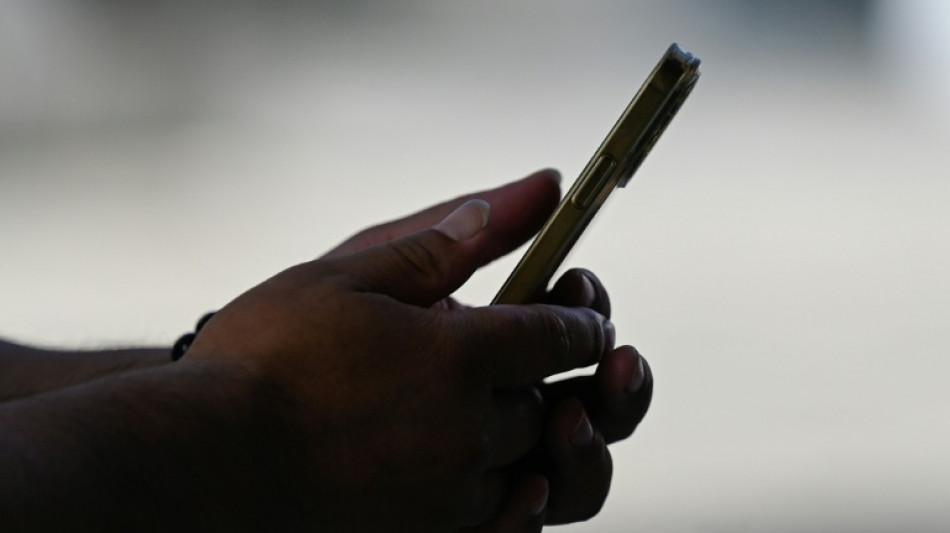
China says state-backed experts crack Apple's AirDrop / Photo: Pedro PARDO - AFP/File

 Warren Buffett steps down as Berkshire Hathaway chairman

 Isolated Syrian-Druze city blames Damascus for shortages

 Kerry James Marshall: American 'blackness' painter celebrated in Europe

 Infantino 'must go', says German FA vice-president

 Japan's busiest rail station tests robot bins

 Backpackers fret over Australian visa crackdown

 Bank of Japan hikes rates to 31-year high to battle inflation

 AI doomsday warnings unlikely to slow IPOs but questions linger

 In Brazil's Amazon, the hunt for oil fuels hopes and fears

 Baby orangutans in India expose 'frightening' scale of trafficking

 Oversight Board blasts 'inadequate' Meta safeguards for AI deepfakes

 Harry makes first public appearance since return to UK

 Princess Diana's brother makes new explosive claims against Charles

 Trump admin overhauls key protection for endangered species

 Mbappe draws political fire over Ceuta t-shirt controversy

 Third malaria death in Germany from outbreak tied to Frankfurt airport

 AtlasClear Holdings Reports Preliminary Fiscal 2026 Revenue of Approximately $20.1 Million, Up 85%; Revenue Plus Interest Income of Approximately $21.9 Million

 'Another arrow to the quiver': World Bank posts record private capital mobilization

 Ireland to boycott Eurovision 2027 over Gaza

 India's Tata Sons reappoints N. Chandrasekaran as chairman

 Germany urges EU action against China to defend carmakers

 Japan eyes changing prostitution law to punish sex buyers

 Modi pitches India as global chipmaking hub

 Ukraine plans record defence spending in 2027

 NASA scan discovers new, 'once in a century' Moon crater

Chinese state-backed experts have found a way to identify people who use Apple's encrypted AirDrop messaging service, according to the Beijing municipal government.
AirDrop allows users to send content to Apple devices in close proximity without an internet connection, encoded so they cannot be viewed by other people.
The service was widely used by participants in pro-democracy protests in Hong Kong in 2019 that China's central government eventually quelled.
Apple also limited file-sharing for Chinese iPhone users in 2022 following protests against the ruling Communist Party's stringent zero-Covid policy.
The Beijing municipal government's justice bureau said experts at the Beijing Wangshen Dongjian Justice Appraisal Institute in the capital had devised a way to reveal an iPhone's encrypted device log.
From there, they could identify an AirDrop user's phone number and email accounts, the Monday statement on the bureau's website said.
It said the technique "cracked the tough technological problem of the transmission of inappropriate information with anonymous traceability via AirDrop".
The method also "raised the efficacy and accuracy of case detection and resolution, and has effectively helped police ascertain several case suspects".
The statement did not mention whether the technique had led to any arrests or convictions.
Apple did not immediately respond to a request for comment from AFP.
There were widespread reports in late 2022 that people in China were using AirDrop to spread digital leaflets critical of the government.
The transmissions were believed to be partly inspired by a protest in Beijing in which a man hung banners calling for the removal of President Xi Jinping.
In November of that year, Apple released an AirDrop update that meant users of Apple smartphones in China could only opt-in to receive files from unknown contacts during a 10-minute window before it automatically shuts off. The feature did not previously have a time limit.
The update made it virtually impossible to receive unexpected files from strangers.
Apple has long faced criticism for making perceived concessions to Xi's increasingly repressive China.
Beijing imposed a sweeping national security law in Hong Kong in 2020 that has all but quashed public dissent in the former British colony.
D.Goldberg--CPN