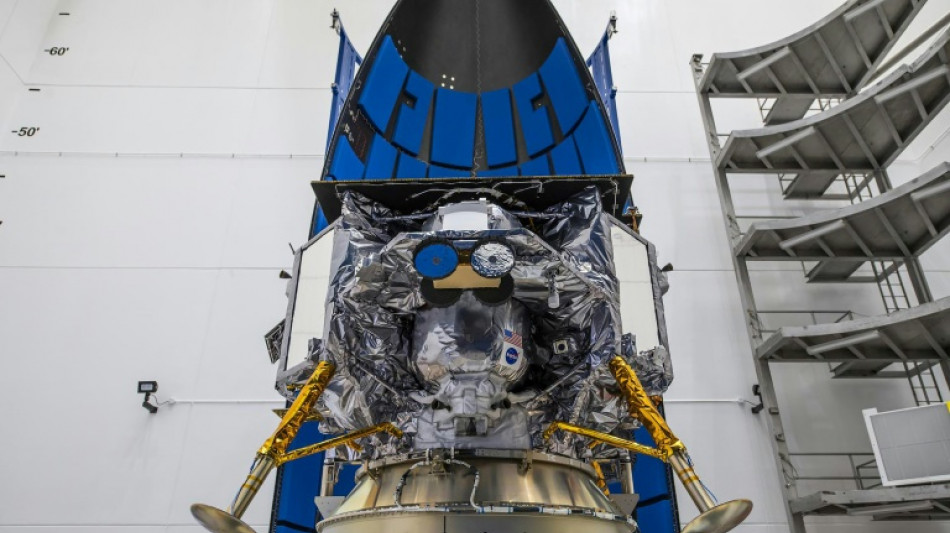
New US lunar lander runs into technical problem: company / Photo: - - NASA/AFP/File

 Warren Buffett steps down as Berkshire Hathaway chairman

 Isolated Syrian-Druze city blames Damascus for shortages

 Kerry James Marshall: American 'blackness' painter celebrated in Europe

 Infantino 'must go', says German FA vice-president

 Japan's busiest rail station tests robot bins

 Backpackers fret over Australian visa crackdown

 Bank of Japan hikes rates to 31-year high to battle inflation

 AI doomsday warnings unlikely to slow IPOs but questions linger

 In Brazil's Amazon, the hunt for oil fuels hopes and fears

 Baby orangutans in India expose 'frightening' scale of trafficking

 Oversight Board blasts 'inadequate' Meta safeguards for AI deepfakes

 Harry makes first public appearance since return to UK

 Princess Diana's brother makes new explosive claims against Charles

 Trump admin overhauls key protection for endangered species

 Mbappe draws political fire over Ceuta t-shirt controversy

 Third malaria death in Germany from outbreak tied to Frankfurt airport

 AtlasClear Holdings Reports Preliminary Fiscal 2026 Revenue of Approximately $20.1 Million, Up 85%; Revenue Plus Interest Income of Approximately $21.9 Million

 'Another arrow to the quiver': World Bank posts record private capital mobilization

 Ireland to boycott Eurovision 2027 over Gaza

 India's Tata Sons reappoints N. Chandrasekaran as chairman

 Germany urges EU action against China to defend carmakers

 Japan eyes changing prostitution law to punish sex buyers

 Modi pitches India as global chipmaking hub

 Ukraine plans record defence spending in 2027

 NASA scan discovers new, 'once in a century' Moon crater

The first US lunar lander launched in more than five decades has experienced an anomaly preventing it from pointing its solar panels towards the Sun, the company that built the robot said Monday.
Astrobotic's Peregrine lunar lander separated successfully from United Launch Alliance's new Vulcan rocket overnight from the Cape Canaveral Space Force Base, and quickly established communications with NASA's Deep Space Network of ground-based radio antennas.
All its systems powered on as expected, and it "entered a fully operational state," Astrobotic said in a tweet.
But "unfortunately, an anomaly occurred which prevented Astrobotic from achieving a stable sun-pointing orientation.
"The team is responding in real time as the situation unfolds and will be providing updates as data is obtained and analyzed."
The lander's documentation, available online, says that while in orbit, Peregrine's top mounted solar panel stays pointed at the Sun to enable maximum power generation.
"The solar panel is utilized to provide battery charge and maintain lander and payload operations. After descent to the lunar surface the power system continues to provide reliable power services to payloads through the end of mission," it says.
Peregrine is on its way to the Moon and is supposed to hold its orbit before finally landing on a mid-latitude region called Sinus Viscositatis, or Bay of Stickiness, on February 23.
Until now, a soft landing on Earth's nearest celestial neighbor has only been accomplished by a handful of nations. But the United States and others are increasingly turning to the commercial sector to carry out routine missions and ship hardware at a fraction of the cost.
M.P.Jacobs--CPN