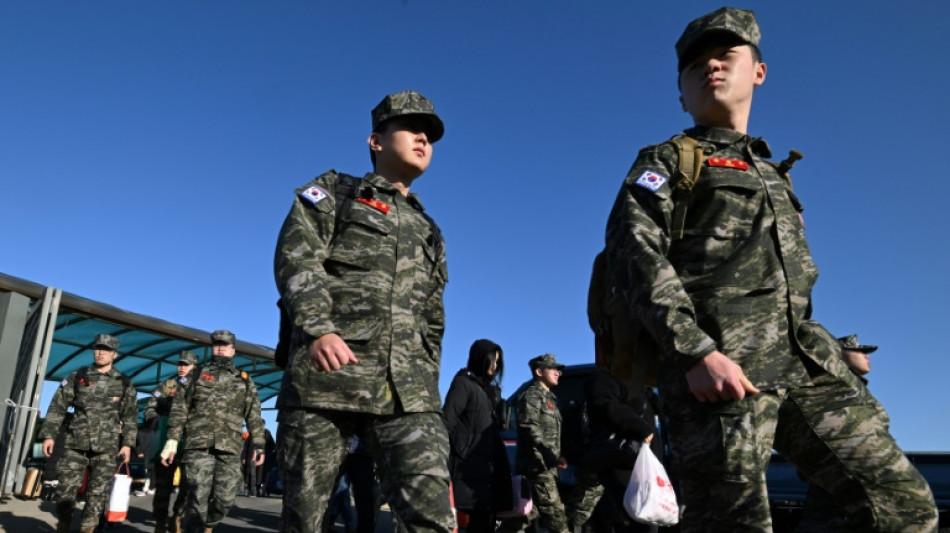
Life on the frontline: fear, camaraderie on S. Korean border island / Photo: Jung Yeon-je - AFP

 Warren Buffett steps down as Berkshire Hathaway chairman

 Isolated Syrian-Druze city blames Damascus for shortages

 Kerry James Marshall: American 'blackness' painter celebrated in Europe

 Infantino 'must go', says German FA vice-president

 Japan's busiest rail station tests robot bins

 Backpackers fret over Australian visa crackdown

 Bank of Japan hikes rates to 31-year high to battle inflation

 AI doomsday warnings unlikely to slow IPOs but questions linger

 In Brazil's Amazon, the hunt for oil fuels hopes and fears

 Baby orangutans in India expose 'frightening' scale of trafficking

 Oversight Board blasts 'inadequate' Meta safeguards for AI deepfakes

 Harry makes first public appearance since return to UK

 Princess Diana's brother makes new explosive claims against Charles

 Trump admin overhauls key protection for endangered species

 Mbappe draws political fire over Ceuta t-shirt controversy

 Third malaria death in Germany from outbreak tied to Frankfurt airport

 AtlasClear Holdings Reports Preliminary Fiscal 2026 Revenue of Approximately $20.1 Million, Up 85%; Revenue Plus Interest Income of Approximately $21.9 Million

 'Another arrow to the quiver': World Bank posts record private capital mobilization

 Ireland to boycott Eurovision 2027 over Gaza

 India's Tata Sons reappoints N. Chandrasekaran as chairman

 Germany urges EU action against China to defend carmakers

 Japan eyes changing prostitution law to punish sex buyers

 Modi pitches India as global chipmaking hub

 Ukraine plans record defence spending in 2027

 NASA scan discovers new, 'once in a century' Moon crater

When a North Korean artillery shell slammed into his house and burned it to the ground in 2010, Jung Chang-kuan thought that war had broken out again.
That attack was a North Korean artillery barrage on Jung's home, the remote South Korean border island of Yeongpeong, which killed four people in the first such incident since the 1950-53 Korean War.
And on Friday, that previous attack was on Jung's mind as he fled to a shelter with his family after North Korea fired artillery shells near his island, prompting a South Korean live-fire exercise in response.
"There wasn't that much fear inside the shelter. Rather, all the residents came and it was just a chatting atmosphere because they had not seen each other in a long time," he said of the Friday evacuation.
In contrast, in 2010, Jung said his family was unable to salvage any of their belongings from their burning house and had no choice but to run.
"The shells rained down, smoke billowed, and everything was engulfed in flames and destroyed, there was no time to think about anything else," he told AFP.
Having to flee again on Friday, 70-year-old Jung said it felt both strange and "reminiscent" of the 2010 incident.
But "I wasn't too shocked," he said.
"I've even experienced (my house) being directly hit by artillery fire before."
On Saturday, North Korea fired another 60 artillery shells in the area, Seoul's military said, urging Pyongyang to immediately cease "actions that increase tension" along the maritime border.
- Shelters always open -
Yeonpyeong is extremely close -- less than two kilometres (1.5 miles) -- to the de facto maritime border between the two Koreas known as the Northern Limit Line (NLL).
Although it is controlled by Seoul and on the southern side of the de facto maritime border, the sparsely populated island is much closer to North Korea.
It is only around 42 kilometres away from the North Korean city of Haeju, while being situated about 115 kilometres west of the South Korean capital Seoul.
On a clear day in autumn months, the train station in Haeju, as well as the plumes of smoke rising from the city's factories, can be seen from a hilltop on Yeonpyeong.
Yeonpyeong operates around 10 shelters across the island equipped with medical beds, children's books and gas masks, among other materials.
"We always keep the shelter doors open," an official from the Yeonpyeong district office told AFP at one of the shelters where around 200 residents stayed on Friday.
"Our aim is to ensure that people can seek refuge here whenever necessary."
- Compassion for North Koreans -
The streets and residents of Yeonpyeong remained peaceful early on Saturday, with military soldiers visiting hair salons and people enjoying bike rides on quiet roads.
"I always have this understanding in my mind that... (Yeonpyeong Island) is a tense place in the West Sea," a hairdresser and island resident, who asked not to be named, told AFP.
"If we're told to go to a shelter, we should follow the instructions, since we live in this place.
"There's no need to worry excessively. Tomorrow is tomorrow, and today is today."
But resident Kim Na-yeon, 69, said she suffered from trauma stemming from the 2010 incident, and said many elderly women on the island were deeply shaken and filled with fear -- both on Friday and during the 2010 shelling.
Fourteen years ago, Kim said that people sought refuge in a poorly built, rudimentary shelter where they could see dead mice, anxiously awaiting private and public ferries to evacuate them from the area.
On Friday, "I was anxious and didn't know if I should go to sleep or not, so I left a bag by the door without even unpacking it", she told AFP.
Due to its location, around 30 percent of the island's residents are war refugees who hail from Hwanghae Province in North Korea.
"I long to step on the land of my hometown, where my mother rests," reads a sculpture erected on the island in remembrance of the families separated by the Korean War.
For such reasons, resident Jung said he harbours no personal grudge against North Koreans, despite having his house destroyed by Pyongyang's shells.
"Even now, I feel compassion towards the North Korean people."
"I even have this willingness to help them."
P.Petrenko--CPN