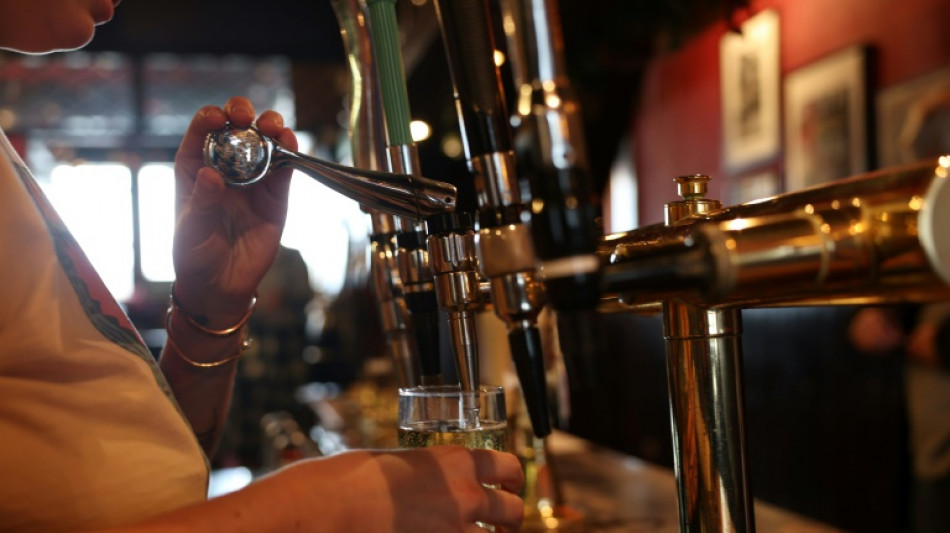
Last orders? UK pubs hit by rising costs and changing tastes / Photo: Daniel LEAL - AFP

 Warren Buffett steps down as Berkshire Hathaway chairman

 Isolated Syrian-Druze city blames Damascus for shortages

 Kerry James Marshall: American 'blackness' painter celebrated in Europe

 Infantino 'must go', says German FA vice-president

 Japan's busiest rail station tests robot bins

 Backpackers fret over Australian visa crackdown

 Bank of Japan hikes rates to 31-year high to battle inflation

 AI doomsday warnings unlikely to slow IPOs but questions linger

 In Brazil's Amazon, the hunt for oil fuels hopes and fears

 Baby orangutans in India expose 'frightening' scale of trafficking

 Oversight Board blasts 'inadequate' Meta safeguards for AI deepfakes

 Harry makes first public appearance since return to UK

 Princess Diana's brother makes new explosive claims against Charles

 Trump admin overhauls key protection for endangered species

 Mbappe draws political fire over Ceuta t-shirt controversy

 Third malaria death in Germany from outbreak tied to Frankfurt airport

 AtlasClear Holdings Reports Preliminary Fiscal 2026 Revenue of Approximately $20.1 Million, Up 85%; Revenue Plus Interest Income of Approximately $21.9 Million

 'Another arrow to the quiver': World Bank posts record private capital mobilization

 Ireland to boycott Eurovision 2027 over Gaza

 India's Tata Sons reappoints N. Chandrasekaran as chairman

 Germany urges EU action against China to defend carmakers

 Japan eyes changing prostitution law to punish sex buyers

 Modi pitches India as global chipmaking hub

 Ukraine plans record defence spending in 2027

 NASA scan discovers new, 'once in a century' Moon crater

They've served Roman soldiers, knights and poets and have been a gathering place for communities to enjoy a brew beside a crackling fire for centuries.
Now many of Britain's watering holes are calling "last orders" for good because of soaring costs and as people adopt healthier, alcohol-free lifestyles.
The British Beer and Pub Association (BBPA), an industry body, said the number of pubs fell from 60,800 in 2000 to 45,800 in 2022.
The trend continued this year as a result of high inflation, energy bills and business rates, which cut into increasingly stretched earnings.
The Altus Group, a commercial real estate analyst which monitors pub closures, says 386 pubs in England and Wales closed in 2022.
Nearly the same number again (383) were demolished or converted into other types of use in the first six months of this year alone.
The BBPA reckons 2024 will be "decisive" for the industry, which supports some 936,000 jobs, and wants cuts on beer duties, business rates and sales taxes.
Social historian Paul Jennings, who has written extensively about British pubs, is not surprised that so many have called "time".
"People drink less as there are many other ways to spend leisure time and money," he told AFP.
"Many people go to the supermarket and drink at home, paying less than at a pub."
- Slum clearance -
The rate of pub closures first gathered pace in the 1800s and early 1900s, when high levels of alcohol consumption and public drunkenness gave rise to the temperance movement.
The religious and social movement, which campaigned against the recreational use and sale of liquor, earned government support.
By the end of the 19th century, it is estimated that about one in 10 adults shunned alcohol and rowdy public houses.
The next significant blow came after the 1930 Housing Act, which required local councils to demolish slums, leading to the demolition of many street corner "locals".
Just last year, planners were permitted to demolish the 200-year-old Still and Star opposite Aldgate tube station in London, despite a campaign by the Victorian Society.
Described by the heritage body as "one of the last surviving relics of the City of London's working-class past", it has now made way for a new high-rise office block.
"Hopefully, at some point, the decline will stabilise as we approach the minimum number of pubs needed to satisfy demand in each area," said Nick Fish, head of statistics at the BBPA.
Other contributing factors to closures include a ban on smoking indoors in England imposed in 2007, high rates of beer tax and discounted alcohol sales by supermarkets, in addition to closures during the Covid-19 pandemic.
- Attempts to preserve -
Attempts are being made to preserve Britain's pub culture, which stretches back 2,000 years to the Roman era, when wine-serving "tabernae" were set up to quench the thirst of soldiers and travellers.
The National Trust heritage conservation body has taken ownership of 39 pubs and inns in Britain, including the George Inn in south London.
The current building dates back to 1676. It is said to have been frequented by Charles Dickens and mentioned in his novel "Little Dorrit".
Despite the closures, pubs and pub culture are still a draw, particularly for tourists.
"A pub might have to amend how it (adapts) to the changing world around them but there will always be a place in society for a classic British pub," said John Warland, the director of Liquid History Tours, which offers dedicated pub tours of London.
"What would London be without them?"
For Historic England, another heritage body, pubs have always had to adapt to the shifting tastes of their changing clientele, from wine-drinking Romans to mead-sipping Vikings and ale-sipping locals.
Food and drink author Pete Brown says many pubs are owned by real estate companies, which will gladly sell up if they believe they can make more money by erecting a supermarket or apartment block.
But Brown, author of "Man Walks into a Pub: A Sociable History of Beer", still has a sense of optimism.
"Pubs will never completely disappear," he said. "They are part of British identity. We will simply have fewer."
A.Samuel--CPN