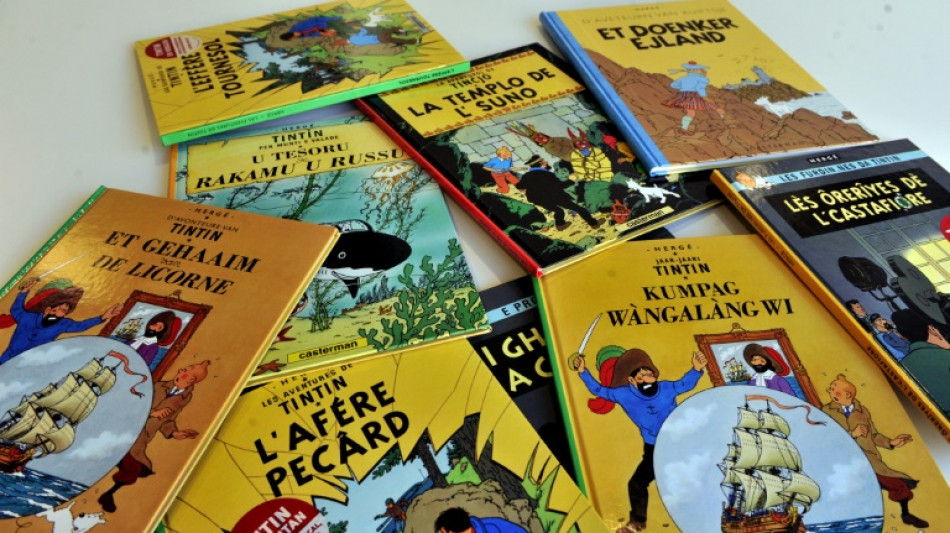
Tintin comic new edition addresses racism controversy / Photo: GEORGES GOBET - AFP

 Warren Buffett steps down as Berkshire Hathaway chairman

 Isolated Syrian-Druze city blames Damascus for shortages

 Kerry James Marshall: American 'blackness' painter celebrated in Europe

 Infantino 'must go', says German FA vice-president

 Japan's busiest rail station tests robot bins

 Backpackers fret over Australian visa crackdown

 Bank of Japan hikes rates to 31-year high to battle inflation

 AI doomsday warnings unlikely to slow IPOs but questions linger

 In Brazil's Amazon, the hunt for oil fuels hopes and fears

 Baby orangutans in India expose 'frightening' scale of trafficking

 Oversight Board blasts 'inadequate' Meta safeguards for AI deepfakes

 Harry makes first public appearance since return to UK

 Princess Diana's brother makes new explosive claims against Charles

 Trump admin overhauls key protection for endangered species

 Mbappe draws political fire over Ceuta t-shirt controversy

 Third malaria death in Germany from outbreak tied to Frankfurt airport

 AtlasClear Holdings Reports Preliminary Fiscal 2026 Revenue of Approximately $20.1 Million, Up 85%; Revenue Plus Interest Income of Approximately $21.9 Million

 'Another arrow to the quiver': World Bank posts record private capital mobilization

 Ireland to boycott Eurovision 2027 over Gaza

 India's Tata Sons reappoints N. Chandrasekaran as chairman

 Germany urges EU action against China to defend carmakers

 Japan eyes changing prostitution law to punish sex buyers

 Modi pitches India as global chipmaking hub

 Ukraine plans record defence spending in 2027

 NASA scan discovers new, 'once in a century' Moon crater

There has been a mixed response from anti-racism groups over a newly modified version of the Tintin comic books, after it was widely criticised over its colonialist depiction of Africans.
"Tintin in the Congo" by Belgian comic strip artist Herge, the second volume of "The Adventures of Tintin", was first published in 1931.
The Belgian Congo -- comprising most of present-day Republic of Congo -- was then a colony of the European country, becoming independent in 1960.
In the comic Tintin, an intrepid reporter, travels to Belgian Congo to report on events there leading to encounters with native people, wild animals and an American diamond-smuggling gangster.
Over recent decades, the comic strip has become increasingly controversial, with critics pointing to its racist and colonialist treatment of the local population.
The new edition, launched in November together with two other books in the Tintin series, carries a preface explaining the colonial context of the time.
It also contains tweaks to the story. At one point, Tintin teaches an African child mathematics, whereas in the original he teaches the child that its home nation is Belgium.
The cover was also changed from the original, showing Tintin facing off against a lion, whereas before he was sitting with a black child.
"This volume goes back to a time, that is thankfully over, where it was acceptable to consider blacks as inferior," said Patrick Lozes, founder of CRAN, a federation of anti-racism associations.
He welcomed the addition of the preface, which he said went "in the right direction".
The preface, written by Philippe Goddin -- head of the Friends of Herge association -- is mostly concerned with defending the record of Tintin's creator in terms of racism.
"He defended himself vigorously against that charge," he wrote. "He happily mocked everybody, whites and blacks."
In an interview with AFP Goddin said "there is a thin line between caricature and racism, he did not cross that line".
Pascal Blanchard, a historian of colonialist propaganda, said he was "surprised" that the publishers did not make a special announcement of the changes, and that the new preface was not mentioned on the cover.
He called the preface "highly debatable".
Claims that Herge's work had simply been a reflection of his time were "facile and false", he said.
Herge himself admitted in 1975 that all he knew about the Belgian Congo was "what people talked about" at the time, saying: "I drew Africans in the pure spirit of paternalism that was prevalent back then."
Herge is considered as one of the leading cartoonists of the 20th century, with a unique style that influenced many artists, including pop artists Andy Warhol and Roy Lichtenstein.
Tintin's adventures have been translated into 130 languages, sold 260 million copies and been made into TV shows and a Hollywood film.
P.Gonzales--CPN