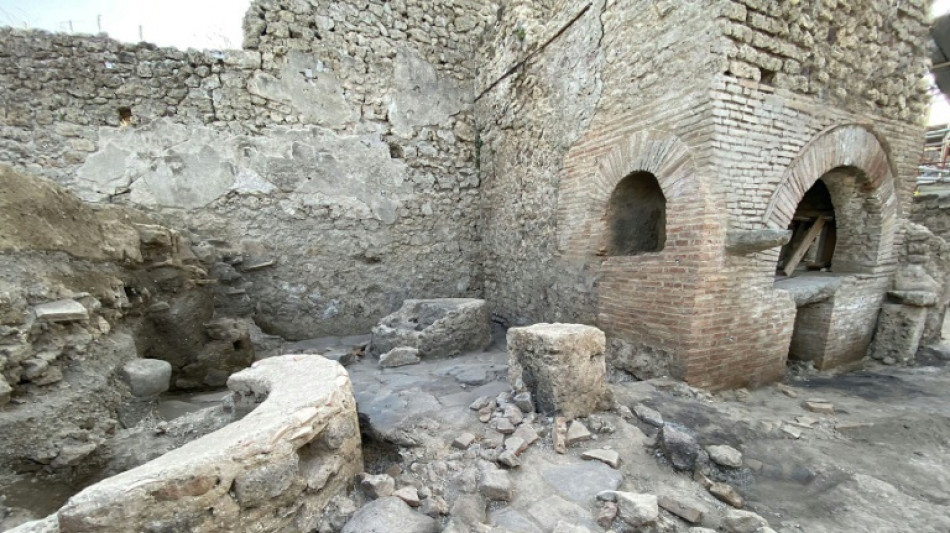
Archaeologists discover 'prison bakery' in ancient Pompeii / Photo: Handout - POMPEII ARCHAEOLOGICAL PARK/AFP

 Warren Buffett steps down as Berkshire Hathaway chairman

 Isolated Syrian-Druze city blames Damascus for shortages

 Kerry James Marshall: American 'blackness' painter celebrated in Europe

 Infantino 'must go', says German FA vice-president

 Japan's busiest rail station tests robot bins

 Backpackers fret over Australian visa crackdown

 Bank of Japan hikes rates to 31-year high to battle inflation

 AI doomsday warnings unlikely to slow IPOs but questions linger

 In Brazil's Amazon, the hunt for oil fuels hopes and fears

 Baby orangutans in India expose 'frightening' scale of trafficking

 Oversight Board blasts 'inadequate' Meta safeguards for AI deepfakes

 Harry makes first public appearance since return to UK

 Princess Diana's brother makes new explosive claims against Charles

 Trump admin overhauls key protection for endangered species

 Mbappe draws political fire over Ceuta t-shirt controversy

 Third malaria death in Germany from outbreak tied to Frankfurt airport

 AtlasClear Holdings Reports Preliminary Fiscal 2026 Revenue of Approximately $20.1 Million, Up 85%; Revenue Plus Interest Income of Approximately $21.9 Million

 'Another arrow to the quiver': World Bank posts record private capital mobilization

 Ireland to boycott Eurovision 2027 over Gaza

 India's Tata Sons reappoints N. Chandrasekaran as chairman

 Germany urges EU action against China to defend carmakers

 Japan eyes changing prostitution law to punish sex buyers

 Modi pitches India as global chipmaking hub

 Ukraine plans record defence spending in 2027

 NASA scan discovers new, 'once in a century' Moon crater

Archaeologists excavating the ancient Roman city of Pompeii have uncovered a "prison bakery" where slaves and blindfolded donkeys were kept locked up underground to grind grain for bread, officials said this week.
Underneath a house in the ruins they found "a cramped room with no view of the outside world and with small windows high in the wall, with iron bars, to let the light in", the Archaeological Park of Pompeii announced on Friday.
Archaeologists deduced they had found a "prison bakery", the UNESCO World Heritage Site near Naples, southern Italy, said on its website.
They also discovered "indentations" in the floor "to coordinate the movement of the animals, forced to walk around for hours, blindfolded".
The house, on the 44-hectare site that is currently under excavation, was divided into a residential area "decorated with exquisite Fourth Style frescoes" and a "productive quarter", the bakery.
Three skeletons were discovered in one room of the bakery, showing that the house was inhabited.
The bakery, where slaves and animals were forced to perform the backbreaking task of turning the millstones, had no doors or communication with the outside world.
- 'Shocking' side of ancient world -
"It is, in other words, a space in which we have to imagine the presence of people of servile status whose freedom of movement the owner felt the need to restrict," wrote Pompeii director Gabriel Zuchtreigel in a scholarly article.
"It is the most shocking side of ancient slavery, the one devoid of both trusting relationships and promises of manumission, where we were reduced to brute violence, an impression that is entirely confirmed by the securing of the few windows with iron bars."
The public can view more evidence of this harsh daily life in an exhibition called "The Other Pompeii: Ordinary Lives in the Shadow of Vesuvius" which opens at the Palestra Grande in Pompeii on December 15.
"(The exhibition is) dedicated to that myriad of individuals often forgotten by the historical sources, such as the slaves, who constituted the majority of the population and whose labour contributed in an important way not only to the economy, but also to the culture and social fabric of Roman civilization," the Pompeii authorities said.
Pompeii was devastated when nearby Mount Vesuvius erupted almost 2,000 years ago in 79 AD.
The ash and rock helped preserve many buildings almost in their original state, as well as forming eery shapes around the curled-up corpses of victims of the disaster, thought to number around 3,000.
Pompeii is the second most visited tourist destination in Italy after the Colosseum in Rome.
H.Meyer--CPN