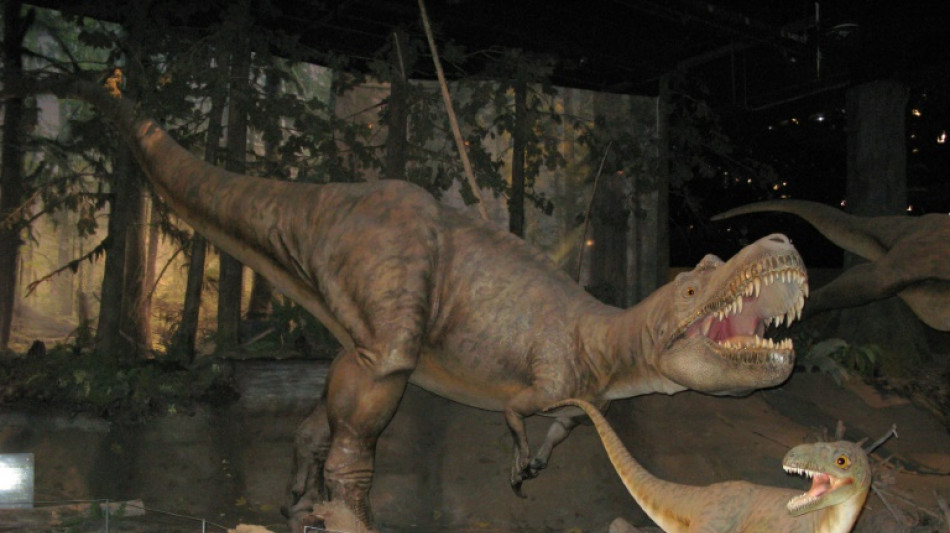
'Appetite for drumsticks': First prey found in a tyrannosaur stomach / Photo: Handout - University of Calgary/AFP

 Warren Buffett steps down as Berkshire Hathaway chairman

 Isolated Syrian-Druze city blames Damascus for shortages

 Kerry James Marshall: American 'blackness' painter celebrated in Europe

 Infantino 'must go', says German FA vice-president

 Japan's busiest rail station tests robot bins

 Backpackers fret over Australian visa crackdown

 Bank of Japan hikes rates to 31-year high to battle inflation

 AI doomsday warnings unlikely to slow IPOs but questions linger

 In Brazil's Amazon, the hunt for oil fuels hopes and fears

 Baby orangutans in India expose 'frightening' scale of trafficking

 Oversight Board blasts 'inadequate' Meta safeguards for AI deepfakes

 Harry makes first public appearance since return to UK

 Princess Diana's brother makes new explosive claims against Charles

 Trump admin overhauls key protection for endangered species

 Mbappe draws political fire over Ceuta t-shirt controversy

 Third malaria death in Germany from outbreak tied to Frankfurt airport

 AtlasClear Holdings Reports Preliminary Fiscal 2026 Revenue of Approximately $20.1 Million, Up 85%; Revenue Plus Interest Income of Approximately $21.9 Million

 'Another arrow to the quiver': World Bank posts record private capital mobilization

 Ireland to boycott Eurovision 2027 over Gaza

 India's Tata Sons reappoints N. Chandrasekaran as chairman

 Germany urges EU action against China to defend carmakers

 Japan eyes changing prostitution law to punish sex buyers

 Modi pitches India as global chipmaking hub

 Ukraine plans record defence spending in 2027

 NASA scan discovers new, 'once in a century' Moon crater

Prey has been discovered inside the stomach of a tyrannosaur skeleton for the first time, scientists said Friday, revealing that the mighty dinosaurs had an "appetite for drumsticks" when they were young.
The skeleton of the Gorgosaurus, a member of the tyrannosaurid family that also includes the T-Rex, sheds light on how these dinosaurs grew from fairly slender juveniles into gigantic, bone-crushing, apex-predator adults, they added.
The Gorgosaurus -- which means "dreadful lizard" -- was around six years old when it died more than 75 million years ago, according to a new study in the journal Science Advances.
The fossil was discovered in 2009 at the Dinosaur Provincial Park, east of the Canadian city of Calgary. But when they got the skeleton back to the lab, the scientists noticed something strange.
The study's lead author, Francois Therrien of the Royal Tyrrell Museum, told AFP they were amazed to "discover the remains of the last meal of this young tyrannosaur still preserved in place".
What was most surprising, he added, was that the small leg bones sticking out of the tyrannosaur's ribcage belonged to two young, bird-like dinosaurs called Citipes.
Citipes are thought to have had feathers, wings and a beak and walk on two feet, somewhat resembling modern-day cassowaries, Therrien said.
They are far smaller than the massive plant-eating dinosaurs that adult tyrannosaurs had been known to eat.
Study co-author Darla Zelenitsky, a paleontologist at the University of Calgary, told AFP that this particular "fussy eater" used its sharp teeth to carve itself only the legs of the two baby Citipes.
"This teenage Gorgosaurus seems to have had an appetite for drumsticks," she said.
- Not always an apex predator -
The discovery also offers a rare clue into how tyrannosaurs grew from one-metre-long at birth to some of the biggest predators to have ever walked the Earth.
"This fossil is the first solid evidence that tyrannosaurids drastically changed their diet as they grew from teenagers to adults," Zelenitsky said.
Young tyrannosaurs had slender heads and legs, sharp knife-like teeth for dissecting carcasses, and could probably run quite fast to catch their turkey-like prey.
These youths probably looked more similar to the velociraptors depicted in the movie "Jurassic Park" than the giant T-Rex, Zelenitsky said.
But at roughly 11 years old, as the tyrannosaurs hit their middle-age, their bodies grew almost ten times in size, ending up weighing more than 3,000 kilogrammes (6,600 pounds).
Their heads broadened and their teeth thickened into what Therrien called "killer bananas" capable of crunching through huge bones.
This transformation was driven by a change in diet, as the dinosaurs ditched the drumsticks of their youth and started preying on giant plant-eating dinosaurs.
These kind of drastic dietary changes are not necessarily rare in the animal kingdom -- crocodiles and Komodo dragons start out eating insects before switching to rodents and eventually large mammals, Therrien said.
The researchers said the Gorgosaurus fossil supports the theory that young tyrannosaurs -- including the T-Rex -- filled a role in the food chain known as "mesopredators", before later growing into apex predators.
This change is "probably the reason why tyrannosaurs were so successful and dominated their ecosystems at the end of the Cretaceous in North America and Asia," Therrien said.
D.Goldberg--CPN