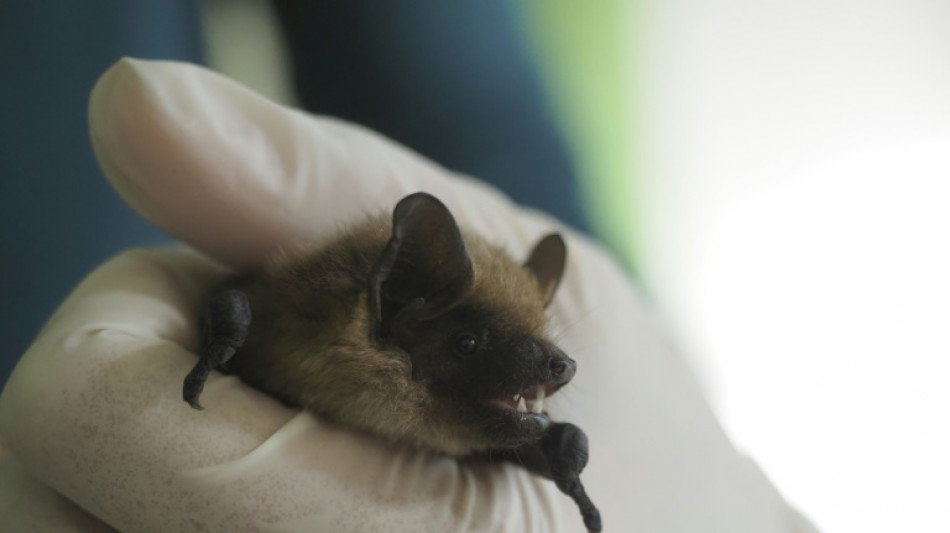
Dutch retiree helps solve mystery of strangely large bat penis / Photo: GUILLAUME SOUVANT - AFP/File

 Isolated Syrian-Druze city blames Damascus for shortages

 Kerry James Marshall: American 'blackness' painter celebrated in Europe

 Infantino 'must go', says German FA vice-president

 Japan's busiest rail station tests robot bins

 Backpackers fret over Australian visa crackdown

 Bank of Japan hikes rates to 31-year high to battle inflation

 AI doomsday warnings unlikely to slow IPOs but questions linger

 In Brazil's Amazon, the hunt for oil fuels hopes and fears

 Baby orangutans in India expose 'frightening' scale of trafficking

 Oversight Board blasts 'inadequate' Meta safeguards for AI deepfakes

 Harry makes first public appearance since return to UK

 Princess Diana's brother makes new explosive claims against Charles

 Trump admin overhauls key protection for endangered species

 Mbappe draws political fire over Ceuta t-shirt controversy

 Third malaria death in Germany from outbreak tied to Frankfurt airport

 AtlasClear Holdings Reports Preliminary Fiscal 2026 Revenue of Approximately $20.1 Million, Up 85%; Revenue Plus Interest Income of Approximately $21.9 Million

 'Another arrow to the quiver': World Bank posts record private capital mobilization

 Ireland to boycott Eurovision 2027 over Gaza

 India's Tata Sons reappoints N. Chandrasekaran as chairman

 Germany urges EU action against China to defend carmakers

 Japan eyes changing prostitution law to punish sex buyers

 Modi pitches India as global chipmaking hub

 Ukraine plans record defence spending in 2027

 NASA scan discovers new, 'once in a century' Moon crater

 Most stocks rise as Fed hikes and indicates drive to curb inflation

Scientists have solved the mystery of one of the animal kingdom's most disproportionately large penises thanks to a Dutch retiree recording bat sex in a church attic.
The serotine bat does not use its strangely large penis for penetration, but instead as a "copulatory arm" during mating, a European team of researchers said on Monday.
This marks the first time that a mammal has been documented reproducing without having penetrative sex, the researchers added.
The serotine bat, which has a wingspan of more than 35 centimetres (14 inches), is common in woodlands across Europe and Asia.
Nicolas Fasel, a researcher at Switzerland's University of Lausanne, told AFP that his team had been working on the bat for years and had observed that its "penis is super long when it is erect".
Their penises are around seven times longer than the vaginas of female serotine bats, the scientists measured.
Stranger still, the head of the penis expands into the shape of a heart, making it seven times wider than their partners' vaginas.
The scientists were baffled.
"There is no way it can penetrate with this structure," said Fasel, the first author of a new study in the journal Current Biology.
Relatively little is known about how bats mate because it is difficult to observe, and the scientists could not see a way of solving this mystery.
But then Fasel received a strange-looking email.
- 'Really amazed' -
"Penis," was the first word of the email's subject line, followed by something in Dutch, then the word "Eptesicus".
"So I was thinking, OK, that looks like spam," Fasel said.
However Eptesicus is the genus of the serotine bat, so Fasel risked opening the email and watching the videos inside.
"Then I was really amazed because we had our answer," he said.
The email was from Jan Jeucken, a retiree with no scientific background who lives in the southern village of Castenray in the Netherlands.
Jeucken had become interested in a population of serotine bats living in the attic of a local church, and had set up cameras recording huge amounts of footage.
Fasel said Jeucken's "passion made him the best guy" to understand the bats, and the retiree was named as a co-author of the study.
The researchers analysed 93 mating events in the church attic, as well as four recorded at a bat rehabilitation centre in war-torn Ukraine.
By filming through a grid that the bats climbed on, the researchers were able to observe them mating.
Female serotine bats have a large membrane between their tail and ankles which they can use to shield their genitals.
During mating, the males grab the females by the nape and use their large penises like an extra arm to reach around and remove this membrane, the researchers said.
Then follows a long, still embrace called "contact mating," during which sperm is transferred.
While this form of reproduction -- also called "cloacal kissing" -- is common in birds, it had never previously been observed in a mammal.
For serotine bats, the process takes some time. The average session was 53 minutes, but the longest lasted nearly 13 hours.
Fasel speculated that the female bats could use their unusually long cervixes to hold onto the sperm of several different males for months before choosing which male they bear offspring with.
It is possible that other bat species mate without penetration, Fasel said, adding more research was needed.
"We could see that there are many, many species with quite strange penises," he said.
M.Anderson--CPN