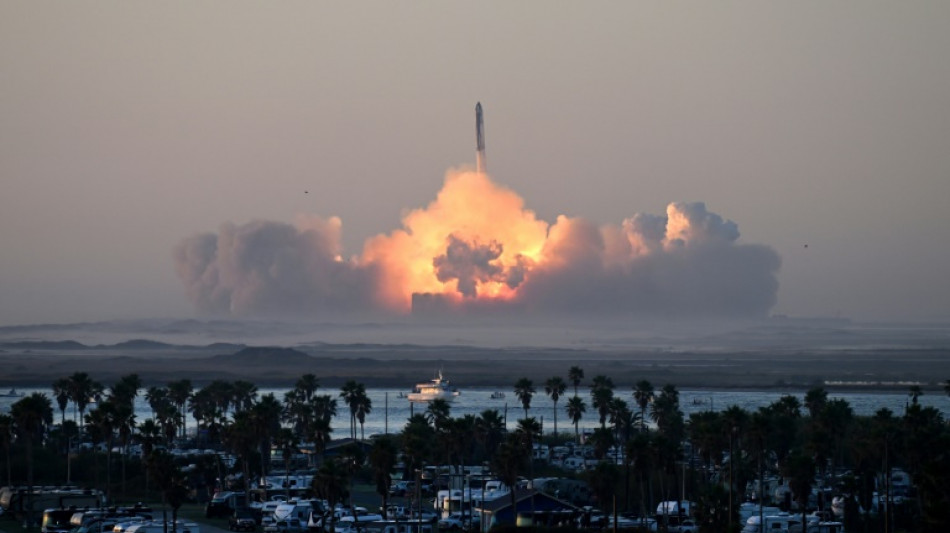
Progress in Starship test launch, but ship and booster explode / Photo: TIMOTHY A. CLARY - AFP

 Isolated Syrian-Druze city blames Damascus for shortages

 Kerry James Marshall: American 'blackness' painter celebrated in Europe

 Infantino 'must go', says German FA vice-president

 Japan's busiest rail station tests robot bins

 Backpackers fret over Australian visa crackdown

 Bank of Japan hikes rates to 31-year high to battle inflation

 AI doomsday warnings unlikely to slow IPOs but questions linger

 In Brazil's Amazon, the hunt for oil fuels hopes and fears

 Baby orangutans in India expose 'frightening' scale of trafficking

 Oversight Board blasts 'inadequate' Meta safeguards for AI deepfakes

 Harry makes first public appearance since return to UK

 Princess Diana's brother makes new explosive claims against Charles

 Trump admin overhauls key protection for endangered species

 Mbappe draws political fire over Ceuta t-shirt controversy

 Third malaria death in Germany from outbreak tied to Frankfurt airport

 AtlasClear Holdings Reports Preliminary Fiscal 2026 Revenue of Approximately $20.1 Million, Up 85%; Revenue Plus Interest Income of Approximately $21.9 Million

 'Another arrow to the quiver': World Bank posts record private capital mobilization

 Ireland to boycott Eurovision 2027 over Gaza

 India's Tata Sons reappoints N. Chandrasekaran as chairman

 Germany urges EU action against China to defend carmakers

 Japan eyes changing prostitution law to punish sex buyers

 Modi pitches India as global chipmaking hub

 Ukraine plans record defence spending in 2027

 NASA scan discovers new, 'once in a century' Moon crater

 Most stocks rise as Fed hikes and indicates drive to curb inflation

SpaceX on Saturday made progress in the second test launch of its mammoth Starship rocket, with the booster separating from the spaceship, but both then exploding shortly after over the ocean.
"Such an incredibly successful day," a SpaceX announcer said. "Even though we did have a… rapid unscheduled disassembly of both the Super Heavy Booster and the ship."
The largest rocket ever built -- Elon Musk hopes it will one day be used to colonize Mars -- blasted off from the company's Starbase in Boca Chica, Texas shortly after 7:00 am local time (1300 GMT).
Unlike the previous such attempt in April, the booster rocket separated successfully from the mega ship, but then blew up, followed shortly by the spaceship itself.
Bill Nelson, head of the NASA space agency, which is awaiting a modified version of Starship to land humans on the Moon, said Saturday's attempt showed progress.
"Congrats to the teams who made progress on today's flight test," he said on X, formerly Twitter. "Spaceflight is a bold adventure demanding a can-do spirit and daring innovation. Today's test is an opportunity to learn -- then fly again."
"It was a fantastic partial success," space scientist Laura Forczyk told AFP. "It surpassed my expectations."
Compared to the first attempt to fly the spaceship in its fully stacked configuration back in April, Spaceship made it further into flight Saturday, with the booster breaking away from the ship before disintegrating.
"As you could see, the Super Heavy Booster has just experienced a rapid unscheduled disassembly; however, our ship is still underway," an announcer said.
As the booster fell off, the upper stage started what was meant to be a partial trip around the Earth -- it was scheduled to fall into the Pacific Ocean near Hawaii after 90 minutes -- but it too blew up.
When the two stages of Starship are combined, the rocket stands 397 feet (121 meters) tall -- beating the Statue of Liberty by a comfortable 90 feet.
Its Super Heavy Booster produces 16.7 million pounds (74.3 Meganewtons) of thrust, almost double that of the world's second most powerful rocket, NASA's Space Launch System (SLS) -- though the latter is now fully operational.
Both systems are designed to be fully reusable, a key element of SpaceX's design meant to greatly reduce costs.
- Design changes -
SpaceX was forced to blow up Starship during its first test flight four minutes after launch on April 20, because the two stages failed to separate. The rocket disintegrated into a ball of fire and crashed into the Gulf of Mexico, sending a dust cloud over a town several miles (kilometers) away.
After a months-long investigation, the Federal Aviation Administration (FAA) on Wednesday finally cleared SpaceX to try again, despite objections by conservation groups, which are suing the regulator, claiming it failed to comply with environmental law.
SpaceX has insisted that explosions during the early stages of rocket development are welcome and help inform design choices faster than ground tests -- though time is ticking down for a modified Starship to be ready for a planned lunar landing in 2025.
This time, Starship was modified to use "hot staging," which means the upper stage engines ignite while it is still attached to the booster, an approach that is commonly used in Russian rockets and can unlock far greater power.
Other changes included improvements to vents to decrease the likelihood of an explosion.
The first launch also caused massive damage to the company's launchpad at Starbase. It has now been reinforced with high-strength concrete and a system that jets tons of water to protect against the enormous heat and force generated by launch.
The US Federal Aviation Administration said it was opening an investigation into what it called a "mishap" during Saturday's launch, in order to "identify corrective actions to avoid it from happening again."
"The anomaly resulted in a loss of the vehicle," the agency said in a statement. "No injuries or public property damage have been reported."
Forczyk, the space scientist, said that SpaceX achieved "more progress than they did back in April" and she expected the company to get cleared by aviation authorities for another attempt more rapidly than before, adding, "It's going to be a quicker turnout."
O.Ignatyev--CPN