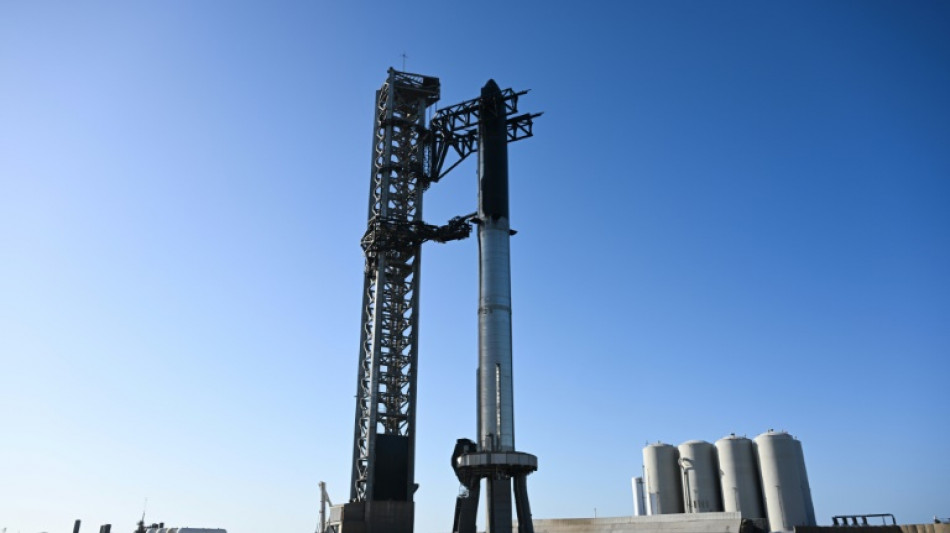
US regulator greenlights Starship's next launch on Friday / Photo: Patrick T. Fallon - AFP/File

 Isolated Syrian-Druze city blames Damascus for shortages

 Kerry James Marshall: American 'blackness' painter celebrated in Europe

 Infantino 'must go', says German FA vice-president

 Japan's busiest rail station tests robot bins

 Backpackers fret over Australian visa crackdown

 Bank of Japan hikes rates to 31-year high to battle inflation

 AI doomsday warnings unlikely to slow IPOs but questions linger

 In Brazil's Amazon, the hunt for oil fuels hopes and fears

 Baby orangutans in India expose 'frightening' scale of trafficking

 Oversight Board blasts 'inadequate' Meta safeguards for AI deepfakes

 Harry makes first public appearance since return to UK

 Princess Diana's brother makes new explosive claims against Charles

 Trump admin overhauls key protection for endangered species

 Mbappe draws political fire over Ceuta t-shirt controversy

 Third malaria death in Germany from outbreak tied to Frankfurt airport

 AtlasClear Holdings Reports Preliminary Fiscal 2026 Revenue of Approximately $20.1 Million, Up 85%; Revenue Plus Interest Income of Approximately $21.9 Million

 'Another arrow to the quiver': World Bank posts record private capital mobilization

 Ireland to boycott Eurovision 2027 over Gaza

 India's Tata Sons reappoints N. Chandrasekaran as chairman

 Germany urges EU action against China to defend carmakers

 Japan eyes changing prostitution law to punish sex buyers

 Modi pitches India as global chipmaking hub

 Ukraine plans record defence spending in 2027

 NASA scan discovers new, 'once in a century' Moon crater

 Most stocks rise as Fed hikes and indicates drive to curb inflation

The US Federal Aviation Administration (FAA) on Wednesday authorized SpaceX to carry out its second launch of Starship, the most powerful rocket ever built, after a first attempt in April ended in a spectacular explosion.
In a statement, the FAA said Elon Musk's company had now "met all safety, environmental, policy and financial responsibility requirements" following the mishap that marred the first orbital test flight of its next-generation spaceship.
"Targeting Friday, November 17 for Starship's second flight test," SpaceX posted on X shortly after the authorization. A two-hour launch window opens at 7:00 am local time (1300 GMT) from the company's Starbase in Boca Chica, Texas.
Space watchers can follow a live webcast on X and SpaceX's website beginning thirty minutes before lift-off.
On April 20, SpaceX blew up the uncrewed rocket four minutes after it blasted off. Starship experienced multiple engine failures, and its first-stage booster did not separate from the spacecraft above it.
The rocket disintegrated into a ball of fire and crashed into the Gulf of Mexico, sending a dust cloud over a town several miles (kilometers) away.
The FAA quickly launched an investigation, while conservation groups announced they would sue the regulator for not doing enough to protect the environment given the proximity of a vital habitat for protected species.
"We are concerned that the second launch will once again cause significant environmental harm," Jared Margolis, a lawyer for Center for Biological Diversity, told AFP, adding it was likely the groups would add a new claim to their lawsuit.
Starship, which stands 394 feet (120 meters) tall, produces 16.7 million pounds (74.3 Meganewtons) of thrust, more than double that of the Saturn V rockets used to send Apollo astronauts to the Moon.
Starship is designed to be fully reusable, with both stages meant to return to Earth, thus greatly reducing costs.
SpaceX foresees it as the vehicle that will one day carry cargo and crew to Mars, while NASA has contracted a version of Starship to function as a lander craft for its Artemis program to return astronauts to the Moon by the middle of this decade.
Since the first test from Boca Chica, Starship's separation system has been overhauled, Elon Musk said during a conference in early October, adding that testing this new system would be the "riskiest part of the flight."
"I do want to set expectations not too high," the SpaceX CEO said.
The flight plan will be similar to the one in April. After separation, Starship is to continue to an altitude "a scooch below orbit," according to Musk, completing a near-circle of the Earth before splashing down in the Pacific Ocean near Hawaii.
P.Petrenko--CPN