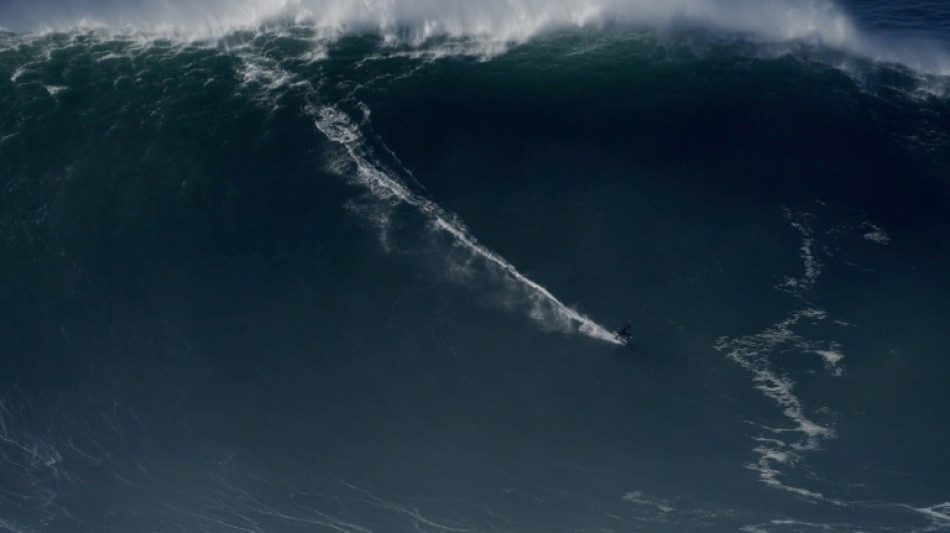
German big wave surfer turns to science to tame the breakers / Photo: Jorge LEAL - WORLD SURF LEAGUE/AFP/File

 Isolated Syrian-Druze city blames Damascus for shortages

 Kerry James Marshall: American 'blackness' painter celebrated in Europe

 Infantino 'must go', says German FA vice-president

 Japan's busiest rail station tests robot bins

 Backpackers fret over Australian visa crackdown

 Bank of Japan hikes rates to 31-year high to battle inflation

 AI doomsday warnings unlikely to slow IPOs but questions linger

 In Brazil's Amazon, the hunt for oil fuels hopes and fears

 Baby orangutans in India expose 'frightening' scale of trafficking

 Oversight Board blasts 'inadequate' Meta safeguards for AI deepfakes

 Harry makes first public appearance since return to UK

 Princess Diana's brother makes new explosive claims against Charles

 Trump admin overhauls key protection for endangered species

 Mbappe draws political fire over Ceuta t-shirt controversy

 Third malaria death in Germany from outbreak tied to Frankfurt airport

 AtlasClear Holdings Reports Preliminary Fiscal 2026 Revenue of Approximately $20.1 Million, Up 85%; Revenue Plus Interest Income of Approximately $21.9 Million

 'Another arrow to the quiver': World Bank posts record private capital mobilization

 Ireland to boycott Eurovision 2027 over Gaza

 India's Tata Sons reappoints N. Chandrasekaran as chairman

 Germany urges EU action against China to defend carmakers

 Japan eyes changing prostitution law to punish sex buyers

 Modi pitches India as global chipmaking hub

 Ukraine plans record defence spending in 2027

 NASA scan discovers new, 'once in a century' Moon crater

 Most stocks rise as Fed hikes and indicates drive to curb inflation

Sebastian Steudtner already holds the world record for the largest wave ever surfed, but as the giant wave season begins, the German is looking to science and technology to chase a new high.
Harnessing the technical prowess of racecar maker Porsche and autoparts specialist Schaeffler, Steudtner is seeking to dwarf his record 26.21-metre (86-foot) wave set at the Portuguese surfers' Mecca of Nazare three years ago.
"With the world record wave I realised I've reached a limit for how fast my board can go," Steudtner told AFP of his last run, involving the wave reaching the equivalent of around eight storeys.
"Together with Porsche, we asked ourselves how we could make the board faster and more stable," said the 38-year-old Bavarian.
Surfers who increase their speed can take on bigger swells -- although it's not just a question of a "need for speed" but a question of safety as well.
"Speed is so important to us because the bigger the wave, the more speed I have to have to get away from it," said Steudtner.
"The power of the wave is an absolute force," he said, "like having several buildings pushing you."
Steudtner said the pressure of riding the biggest waves means surfers need to know their equipment will allow them to focus on the run itself.
Describing his record-breaking Nazare run in 2020, when he added almost two metres to the previous mark, he said: "I shoot across the wave at 80 kilometres (50 miles) an hour and concentrate 100 percent."
"I don't think about the past, the present and the future.
"I'm in the flow. I don't have time to think 'wow, this wave is beautiful'."
- 'A higher level' -
Steudtner first fell in love with surfing at the age of nine when boogie boarding in France.
With his parents' blessing, Steudtner traded landlocked Bavaria for Hawaii to pursue a career in surfing at the age of 16.
He worked on construction sites to earn money, while learning to surf in his own time.
"I've made a lot of decisions in my life that nobody understood at the time".
His burning curiosity may have taken him across the world but it has also propelled changes to the sport itself.
Technological innovations could take the sport "to a higher level", he said.
In order to truly let surfers harness and master the force of the ocean, surfboards need not only to be faster, but also more stable and manoeuvrable at extreme speeds.
Porsche engineers helped develop a new board with an adapted nose, tail and edges to improve the hydrodynamics.
Schaeffler developed a friction-reducing coating which helps the board glide through the water.
Through tests in a wind-tunnel simulator, Steudtner was able to see how he should position himself on the board as it handles monster waves.
"Through changes to the board and altering Sebastian's stance, we were able to reduce air resistance by 20 percent," said Markus Schmelz, a project manager at Porsche.
The innovations "made the board faster and more stable at high speeds".
The new board, coloured yellow and black, has since been delivered.
Steudtner, who trains daily in the gym to build up his muscle strength, was set for an autumn and winter chasing big waves.
Accompanied by a team of almost 30 people, including military doctors, Steudtner said he hopes to "understand the journey of the waves in the ocean".
With the power of science and design in tow, the German may be only days away from testing the board on the biggest stage of all.
"I'll have to give my best".
P.Gonzales--CPN