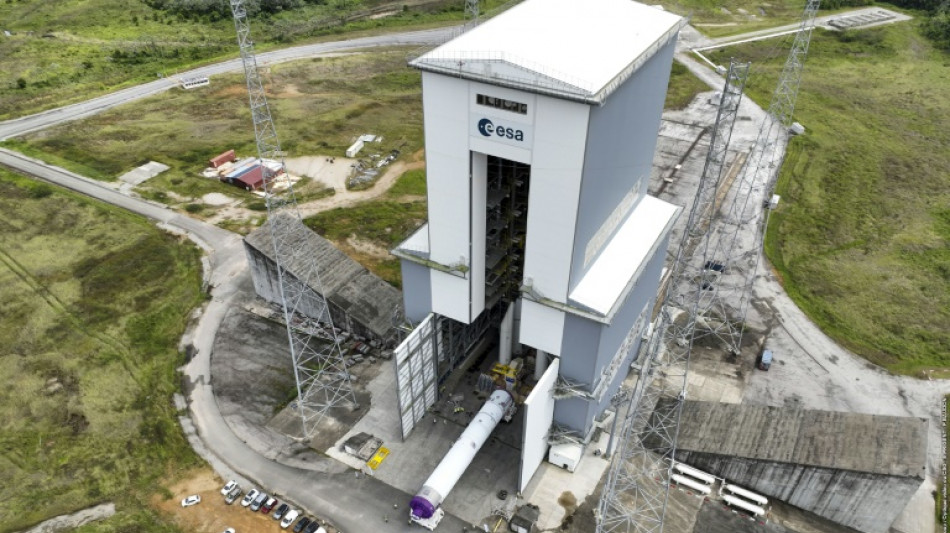
Europe to hold competition to build space cargo ship / Photo: E PRIGENT, P BAUDON - ESA-CNES-Arianespace/Optique/AFP/File

 Kenya's economy faces climate change risks: World Bank
 Online threats, insults fuel S.Africa's anti-foreigner hate

 European robotics start-ups go up against Chinese heavyweights
 Indonesia to capture last-known wild Bornean rhino for IVF

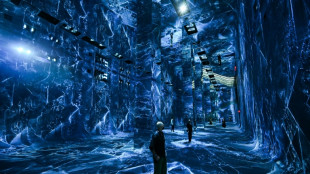 AI museum brings sights, sounds and smells of the rainforest
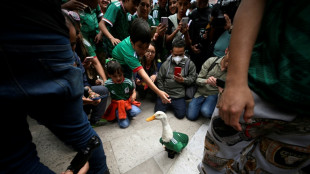 Football 'ambassador' and fan favorite: a duck becomes a star in Mexico
 US stocks resume upward climb as dollar advances again after Fed outlook
 AI-generated videos use Down syndrome to make sales
 Europe risks 'total irrelevance' without sovereign tech: Cohere chief

 Suspected jihadists stage deadly new attack on Niger airport
 Oil tankers pass Hormuz Strait after war deal: tracker

 S.African sentenced in 'world's largest' rhino trafficking case
 German chemical company to cut 3,200 jobs as crisis worsens
 Innovations on show at Paris Vivatech fest
 New wave of anti-LGBTQ laws sweeps Africa
 Cuba approves economic reforms to boost private sector, investment: state TV
 Birthright citizenship helps spark US World Cup run
 Driving the World's Leading Supply Chains: 9 OMP Customers Named to The 2026 Gartner Top 25
 US Fed chair Warsh vows reforms as central bank signals rate hikes on horizon
 Brest boss Roy dies aged 58 from cancer

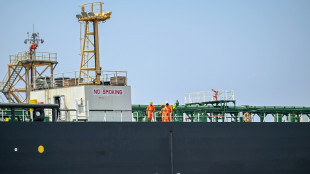
 Recovery of ship traffic in Hormuz limited, but signs emerge
 Nations allege 'attacks' on science at key climate talks

 Prince Harry and family to visit UK in July: media
 US retail sales beat expectations in May as energy costs stay high

 'Heartbreaking': Afghan govt staff abandon smartphones
The European Space Agency announced Monday it would hold a competition between firms to build a ship to deliver cargo to the International Space Station, in a potential first step towards independent missions carrying astronauts.
The ESA's 22 member states, whose space ministers were meeting at a two-day summit in the Spanish city of Seville, also agreed to provide financial support for Europe's long-delayed Ariane 6 rocket.
The summit comes at a difficult time for European space efforts, as the Ariane 6 delays have left the continent without a way to independently blast its missions into space.
Europe also faces growing competition not just from the United States, but newer players China and India, as well as private companies such as billionaire Elon Musk's SpaceX.
ESA chief Josef Aschbacher told the summit that "a new economy is developing in low Earth orbit that will transform space exploration," adding that "private companies are revolutionising the landscape from launchers to exploration".
Aschbacher proposed "a competition between innovative European companies" to develop a ship that would transport cargo to the ISS by 2028 -- then bring it back to Earth.
The project will require "transport, docking and re-entry capability, something Europe does not possess today," he added.
"The service vehicle could later evolve to a crew vehicle and serve other destinations beyond low Earth orbit," he said.
Aschbacher also called on Europe to decide on the scale of its ambitions in space. In April, experts in a report commissioned by the ESA called for Europe to establish a "sustained presence" on the surface of the Moon.
- 'First step' -
A source close to the negotiations told AFP that "if we want to carry out manned flights, (the cargo ship competition) is the first step."
"You have to be able to send a cargo ship to a station and come back. That is the first brick," the source added.
Aschbacher said that 75 million euros ($80 million) had been secured to fund the first phase of the project, which companies would also contribute to.
The Exploration Company, a French-German start-up already developing a vehicle to deliver cargo to potential future private space stations, welcomed the news.
"This is a new ambition for Europe," the firm's CEO Helene Huby told AFP.
Huby said the ESA's "reasonable" approach followed the roadmap of SpaceX and the US, Russian and Chinese space programmes.
"One starts with the cargo ship and then sends people," she said.
The competition indicates a new approach by the ESA based on the model of US space agency NASA, meaning that for future missions it could buy a ride on the rockets of private companies rather than developing its own such programmes.
This idea seems to clash with the long-standing ESA principle of geographic return, which holds that each country's investment should result in a roughly equal industrial benefit for its companies.
Aschbacher suggested that this principle should be called into question.
- 'Launcher crisis' -
The summit also aimed to address Europe's "launcher crisis," which Aschbacher said was the "most serious" in the history of the continent's space efforts.
Already delayed by four years, Europe's next-generation Ariane 6 rocket is now not scheduled to make its maiden flight until next year.
Europe lost access to Russia's Soyuz rockets after Moscow invaded Ukraine last year, and its smaller Vega C launcher is still grounded after the failure of its first commercial flight in December.
The ESA announced at the summit that the Ariane 6 programme would receive 340 million euros ($365 million) following negotiations between France, Germany and Italy, the agency's three biggest contributors.
The Vega C rocket could be subsidised to the tune of 21 million euros a year from its 26th to 42nd flight, it added.
The ESA also announced it would "harness space for a greener future".
Last week, the ESA and the European Union agreed to join forces to accelerate the use of Earth observation missions to collect climate change data.
A.Zimmermann--CPN