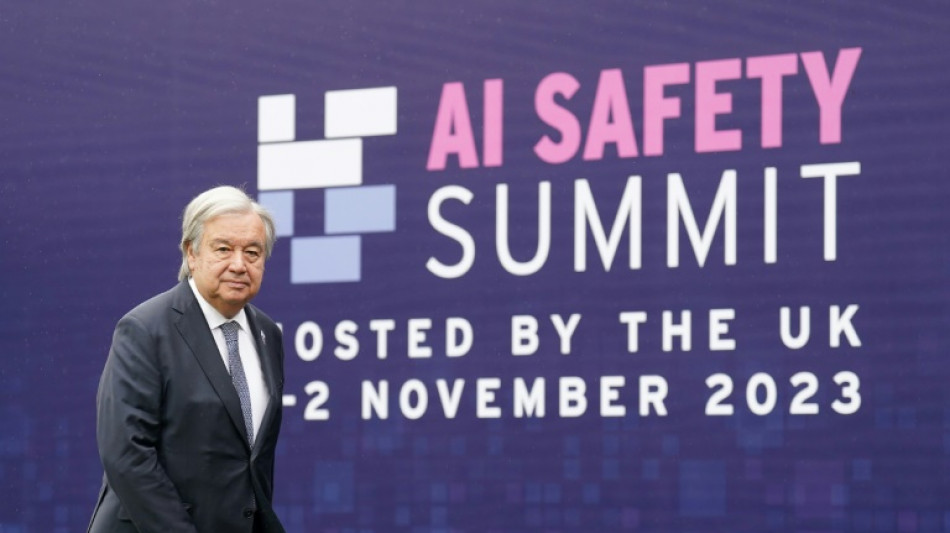
UN chief leads calls for 'united' response to AI threats / Photo: Joe Giddens - POOL/AFP

 Germany urges EU action against China to defend carmakers

 Japan eyes changing prostitution law to punish sex buyers

 Modi pitches India as global chipmaking hub

 Ukraine plans record defence spending in 2027

 NASA scan discovers new, 'once in a century' Moon crater

 Most stocks rise as Fed hikes and indicates drive to curb inflation

 UK-Sudanese author pens book to give children 'African history of Africa'

 US Congress passes sweeping Russia sanctions bill

 US stocks fall, dollar gains after Fed lifts interest rates

 US Fed raises rates to tackle 'too high' inflation in move sure to rile Trump

 US Fed raises rates to battle inflation in move likely to rile Trump

 US House faces test on sweeping Russia sanctions bill

 British PM says to make 'difficult decisions' as inflation rises

 Global fuel price demos: a round-up

 Leverate Launches MCP for Traders to Connect AI Assistants With Trading Platforms

 MEXC Launches $1M "Discover Your Wall Street DNA" Campaign to Help Traders Find Their Market Fit

 Stocks edge higher ahead of US Fed rate call

 BASIS.pro Expands On-Chain Infrastructure with XDC Network Partnership and Zypher DAO as Auto Earn Goes Live

 Pickle-flavoured tart? AI inspires Japan's convenience stores

 EU chief hosts Canada's Carney in push to 'deepen' alliance

 Meta chief pushes back on AI slowdown calls

 US Fed to deliver rate decision with markets betting on hike

 i-payout Expands U.S. Money Transmitter Licensing Footprint and Advances European EMI Strategy

 US Senate crypto bill collapses amid partisan deadlock

 OpenAI, Anthropic and Google are working to create an AI standards body

UN Secretary-General Antonio Guterres called Thursday for a "united, sustained, global response" to artificial intelligence threats, as world leaders met in Britain to discuss the risks posed by the technology's rapid development.
The UN chief said the world was "playing catchup" and needed to "get ahead of the wave", as he spoke at the inaugural AI Safety Summit attended by political, tech and other leaders.
The two-day gathering at Bletchley Park, north of London, kicked off Wednesday with the publication of an agreement signed by 28 countries and the European Union acknowledging the "need for international action".
But Thursday saw senior representatives from leading nations formally convene to address AI's most pressing imminent threats, with UK Prime Minister Rishi Sunak and US Vice President Kamala Harris in attendance.
Italian Prime Minister Giorgia Meloni and EU chief Ursula von der Leyen also joined government officials from France, Germany, Australia and elsewhere, as well as leading tech figures including Elon Musk.
In a statement, Guterres said AI risked "possible long-term negative consequences" -- on everything from jobs to culture -- while its concentration in a few countries and companies "could increase geopolitical tensions".
He also warned that it might "exacerbate the enormous inequalities that already plague our world", demanding a "united, sustained, global strategy, based on multilateralism and the participation of all stakeholders".
New solutions should be based on existing principles found in his organisation's 1945 charter and the Universal Declaration of Human Rights, he added.
- 'Risks' -
The release of ChatGPT and other generative AI systems, which are capable of quickly producing text, images and audio from simple commands in everyday language, has captivated the public and offered a glimpse into the technology's potential.
The summit coincided with the release of a "new" Beatles song produced with AI's assistance more than four decades after it was originally recorded as a demo.
But the emergent tech has also prompted concerns around issues ranging from job losses to cyberattacks and the control that humans actually have over the systems.
Sunak has predicted it will radically alter society for generations to come, striking an alarmist tone in a recent speech warning of its potential dangers.
The UK leader planned to "make the case for global responsibility to address the risks in order to seize the opportunities of AI," his Downing Street office said ahead of Thursday.
He is trying to get other countries to follow the UK's plans for state-backed testing and evaluation of cutting-edge AI models before they are released.
London and Washington this week both announced the establishment of institutes to take up the challenge.
Harris told delegates of US efforts to help distinguish authentic government-produced digital content from AI-generated content, and to prevent the use of discriminatory AI algorithms, her office said.
"The late Stephen Hawking once said, AI is likely to be the best or worst thing to happen to humanity," Sunak told a news conference wrapping up the summit.
"If we can sustain the collaboration that we have fostered over these last two days, I profoundly believe that we can make it the best."
- 'Existential' -
UK Foreign Secretary James Cleverly told AFP earlier that countries were responding to the urgent need for a coordinated response.
"We have to move at a pace that matches the pace of technology change, we don't have a choice," he said.
"And actually what we're seeing is a willing(ness) globally, at both government level and within the commercial world, to move very, very quickly."
China, which attended Wednesday, was not invited to more sensitive discussions on the largely behind-closed-doors second-day sessions.
They included representatives from academia and civil society along with companies at the forefront of AI, such as OpenAI, Anthropic, Google DeepMind and Microsoft.
Further AI safety summits are scheduled for South Korea and France over the coming year.
SpaceX and Tesla CEO Elon Musk attended both days, describing the event as "timely".
"It's one of the existential risks that we face and it is potentially the most pressing one if you look at the timescale and rate of advancement," he said.
In Rome, ministers from Italy, Germany and France called for an "innovation-friendly approach" to regulating AI in Europe, as they urged more investment to challenge the United States and China.
Ch.Lefebvre--CPN