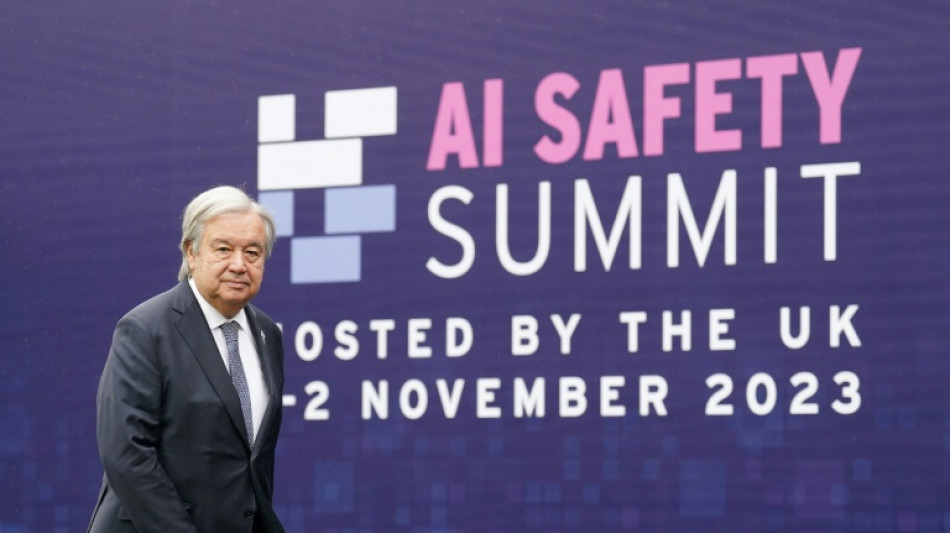
UN chief calls for 'united, sustained, global' strategy for AI / Photo: Joe Giddens - POOL/AFP

 Germany urges EU action against China to defend carmakers

 Japan eyes changing prostitution law to punish sex buyers

 Modi pitches India as global chipmaking hub

 Ukraine plans record defence spending in 2027

 NASA scan discovers new, 'once in a century' Moon crater

 Most stocks rise as Fed hikes and indicates drive to curb inflation

 UK-Sudanese author pens book to give children 'African history of Africa'

 US Congress passes sweeping Russia sanctions bill

 US stocks fall, dollar gains after Fed lifts interest rates

 US Fed raises rates to tackle 'too high' inflation in move sure to rile Trump

 US Fed raises rates to battle inflation in move likely to rile Trump

 US House faces test on sweeping Russia sanctions bill

 British PM says to make 'difficult decisions' as inflation rises

 Global fuel price demos: a round-up

 Leverate Launches MCP for Traders to Connect AI Assistants With Trading Platforms

 MEXC Launches $1M "Discover Your Wall Street DNA" Campaign to Help Traders Find Their Market Fit

 Stocks edge higher ahead of US Fed rate call

 BASIS.pro Expands On-Chain Infrastructure with XDC Network Partnership and Zypher DAO as Auto Earn Goes Live

 Pickle-flavoured tart? AI inspires Japan's convenience stores

 EU chief hosts Canada's Carney in push to 'deepen' alliance

 Meta chief pushes back on AI slowdown calls

 US Fed to deliver rate decision with markets betting on hike

 i-payout Expands U.S. Money Transmitter Licensing Footprint and Advances European EMI Strategy

 US Senate crypto bill collapses amid partisan deadlock

 OpenAI, Anthropic and Google are working to create an AI standards body

UN Secretary-General Antonio Guterres on Thursday called for a "united, sustained, global" strategy to tackle the risks posed by artificial intelligence's rapid development, as world leaders met in the UK.
He called for "new solutions" to close the gap between AI and its governance, proposing that it should be based on the UN Charter and the Universal Declaration of Human Rights.
Guterres was joined by other political leaders including UK Prime Minister Rishi Sunak, US Vice President Kamala Harris and EU chief Ursula von der Leyen at the two-day conference at Bletchley Park.
The UN chief urged lawmakers and regulators to "get ahead of the wave" of emerging AI technology rather than playing "catchup".
A failure to do so, he said, "increases the risk that the technology will be used maliciously by criminals or even terrorists".
That will undermine security or information integrity, and run the risk that humans could lose control of it, leading it to develop in "unintended directions", he added.
"We urgently need frameworks to deal with these risks, so that both developers and the public are safe and can have confidence in AI," he said in a statement.
Guterres also called for a "systematic effort" to spread the technologies around the world to avoid exacerbating "the enormous inequalities that already plague our world".
"We need a united, sustained, global strategy, based on multilateralism and the participation of all stakeholders," he said.
"The United Nations is ready to play its part."
Y.Tengku--CPN