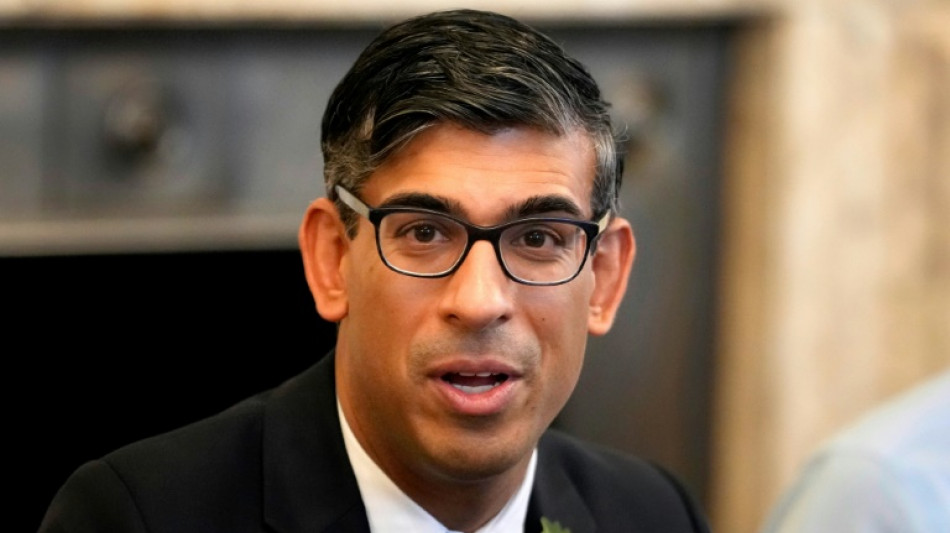
UK, US, China sign AI safety pledge at UK summit / Photo: Kirsty Wigglesworth - POOL/AFP

 Germany urges EU action against China to defend carmakers

 Japan eyes changing prostitution law to punish sex buyers

 Modi pitches India as global chipmaking hub

 Ukraine plans record defence spending in 2027

 NASA scan discovers new, 'once in a century' Moon crater

 Most stocks rise as Fed hikes and indicates drive to curb inflation

 UK-Sudanese author pens book to give children 'African history of Africa'

 US Congress passes sweeping Russia sanctions bill

 US stocks fall, dollar gains after Fed lifts interest rates

 US Fed raises rates to tackle 'too high' inflation in move sure to rile Trump

 US Fed raises rates to battle inflation in move likely to rile Trump

 US House faces test on sweeping Russia sanctions bill

 British PM says to make 'difficult decisions' as inflation rises

 Global fuel price demos: a round-up

 Leverate Launches MCP for Traders to Connect AI Assistants With Trading Platforms

 MEXC Launches $1M "Discover Your Wall Street DNA" Campaign to Help Traders Find Their Market Fit

 Stocks edge higher ahead of US Fed rate call

 BASIS.pro Expands On-Chain Infrastructure with XDC Network Partnership and Zypher DAO as Auto Earn Goes Live

 Pickle-flavoured tart? AI inspires Japan's convenience stores

 EU chief hosts Canada's Carney in push to 'deepen' alliance

 Meta chief pushes back on AI slowdown calls

 US Fed to deliver rate decision with markets betting on hike

 i-payout Expands U.S. Money Transmitter Licensing Footprint and Advances European EMI Strategy

 US Senate crypto bill collapses amid partisan deadlock

 OpenAI, Anthropic and Google are working to create an AI standards body

Countries including the UK, United States and China on Wednesday agreed the "need for international action" as political and tech leaders gathered for the world's first summit on artificial intelligence (AI) safety.
The UK government kicked off the two-day event at Bletchley Park, north of London, by publishing the "Bletchley Declaration" signed by 28 countries and the European Union.
In it, they agreed on "the urgent need to understand and collectively manage potential risks through a new joint global effort to ensure AI is developed and deployed in a safe, responsible way for the benefit of the global community".
Sunak called the declaration a "landmark achievement" while King Charles III, in a video message to the summit, urged international collaboration to combat the "significant risks" of unchecked development.
"There is a clear imperative to ensure that this rapidly evolving technology remains safe and secure," he said.
UK technology minister Michelle Donelan told AFP that the declaration "really outlines for the first time the world coming together to identify this problem".
The announcement came shortly after the UK and United States both said they were setting up their own institutes to assess and mitigate the risks of the fast-emerging technology.
The release of the latest models have offered a glimpse into the potential of so-called frontier AI, but have also prompted concerns around issues ranging from job losses to cyber attacks and the control that humans actually have over the systems.
The conference at Bletchley Park, where top British codebreakers cracked Nazi Germany's "Enigma" code, focuses on frontier AI.
Donelan told AFP the event was a "historic moment in mankind's history" after earlier announcing two further summits, in South Korea in six months' time, and in France next year.
But London has reportedly had to scale back its ambitions around ideas such as launching a new regulatory body amid a perceived lack of enthusiasm.
Italian Prime Minister Giorgia Meloni was one of the only world leaders attending the conference, although tech giant Elon Musk was already in attendance on the first day, and will talk with Sunak on Thursday.
Donelan accepted that the summit "isn't designed to produce a blueprint for global legislation", but was instead "designed to forge a path ahead,... so that we can get a better handle and understanding on the risk of frontier AI".
- 'Talking shop' -
While the potential of AI raises many hopes, particularly for medicine, its development is seen as largely unchecked.
In a speech last week, Sunak stressed the need for countries to develop "a shared understanding of the risks that we face".
But lawyer and investigator Cori Crider, a campaigner for "fair" technology, warned that the summit could be "a bit of a talking shop.
"If he were serious about safety, Rishi Sunak needed to roll deep and bring all of the UK majors and regulators in tow and he hasn't," she told a San Francisco news conference.
"Where is the labour regulator looking at whether jobs are being made unsafe or redundant? Where's the data protection regulator?" she asked.
Having faced criticism for only looking at the risks of AI, the UK on Wednesday pledged £38 million ($46 million) to fund AI projects around the world, starting in Africa.
Ahead of the meeting, the G7 powers agreed on Monday on a non-binding "code of conduct" for companies developing the most advanced AI systems.
In Rome, ministers from Italy, Germany and France called for an "innovation-friendly approach" to regulating AI in Europe, as they urged more investment to challenge the United States and China.
News website Politico reported that London had invited President Xi Jinping to signify its eagerness for a senior representative.
The invitation has raised eyebrows amid heightened tensions between China and Western nations and accusations of technological espionage.
O.Hansen--CPN