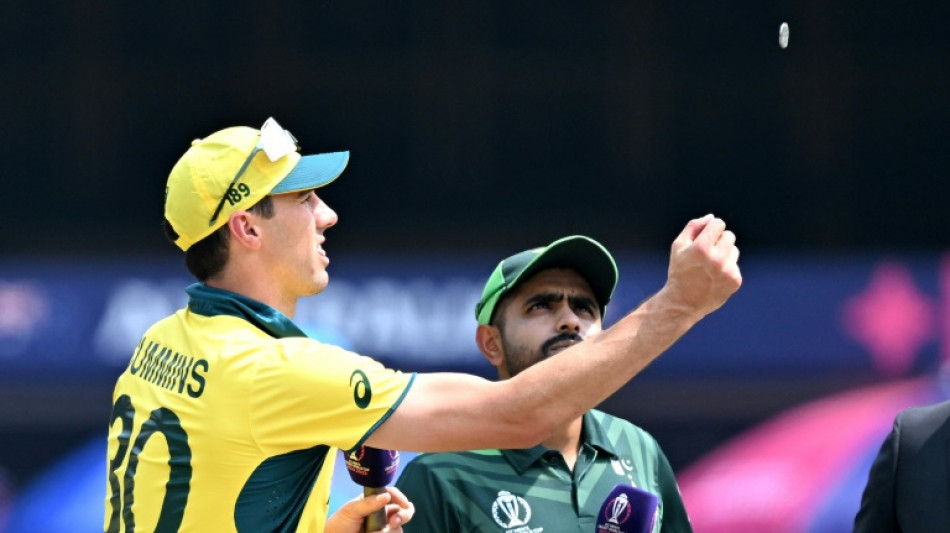
Coin tosses are not 50/50: researchers find a slight bias / Photo: Sajjad HUSSAIN - AFP/File

 Germany urges EU action against China to defend carmakers

 Japan eyes changing prostitution law to punish sex buyers

 Modi pitches India as global chipmaking hub

 Ukraine plans record defence spending in 2027

 NASA scan discovers new, 'once in a century' Moon crater

 Most stocks rise as Fed hikes and indicates drive to curb inflation

 UK-Sudanese author pens book to give children 'African history of Africa'

 US Congress passes sweeping Russia sanctions bill

 US stocks fall, dollar gains after Fed lifts interest rates

 US Fed raises rates to tackle 'too high' inflation in move sure to rile Trump

 US Fed raises rates to battle inflation in move likely to rile Trump

 US House faces test on sweeping Russia sanctions bill

 British PM says to make 'difficult decisions' as inflation rises

 Global fuel price demos: a round-up

 Leverate Launches MCP for Traders to Connect AI Assistants With Trading Platforms

 MEXC Launches $1M "Discover Your Wall Street DNA" Campaign to Help Traders Find Their Market Fit

 Stocks edge higher ahead of US Fed rate call

 BASIS.pro Expands On-Chain Infrastructure with XDC Network Partnership and Zypher DAO as Auto Earn Goes Live

 Pickle-flavoured tart? AI inspires Japan's convenience stores

 EU chief hosts Canada's Carney in push to 'deepen' alliance

 Meta chief pushes back on AI slowdown calls

 US Fed to deliver rate decision with markets betting on hike

 i-payout Expands U.S. Money Transmitter Licensing Footprint and Advances European EMI Strategy

 US Senate crypto bill collapses amid partisan deadlock

 OpenAI, Anthropic and Google are working to create an AI standards body

Want to get a slight edge during a coin toss? Check out which side is facing upwards before the coin is flipped –- then call that same side.
This tactic will win 50.8 percent of the time, according to researchers who conducted 350,757 coin flips.
For the preprint study, which was published on the arXiv database last week and has not yet been peer-reviewed, 48 people tossed coins of 46 different currencies.
They were told to flip the coins with their thumb and catch it in their hand -- if the coins fell on a flat surface that could introduce other factors such as bouncing or spinning.
Frantisek Bartos, of the University of Amsterdam in the Netherlands, told AFP that the work was inspired by 2007 research led by Stanford University mathematician Persi Diaconis -- who is also a former magician.
Diaconis' model proposed that there was a "wobble" and a slight off-axis tilt that occurs when humans flip coins with their thumb, Bartos said.
Because of this bias, they proposed it would land on the side facing upwards when it was flipped 51 percent of the time -- almost exactly the same figure borne out by Bartos' research.
While that may not seem like a significant advantage, Bartos said it was more of an edge that casinos have against "optimal" blackjack players.
It does depend on the technique of the flipper. Some people had almost no bias while others had much more than 50.8 percent, Bartos said.
For people committed to choosing either heads or tails before every toss, there was no bias for either side, the researchers found.
None of the many different coins showed any sign of bias either.
Happily, achieving a fair coin flip is simple: just make sure the person calling heads or tails cannot see which side is facing up before the toss.
- 'It's fun to do stupid stuff' -
Bartos first heard of the bias theory while studying Bayesian statistics during his master's degree, and decided to test it on a massive scale.
But there was a problem: he needed people willing to toss a lot of coins.
At first he tried to persuade his friends to flip coins over the weekend while watching "Lord of the Rings".
"But nobody was really down for that," he said.
Eventually Bartos managed to convince some colleagues and students to flip coins whenever possible, during lunch breaks, even while on holiday.
"It will be terrible," he told them. "But it's fun to do some stupid stuff from time to time."
The flippers even held weekend-long events where they tossed coins from 9am to 9pm. A massage gun was deployed to soothe sore shoulders.
Countless decisions have been made by coin tosses throughout human history.
While writing his paper, Bartos visited the British Museum and learned that the Wright brothers used one to determine who would attempt the first plane flight.
Coin tosses have also decided numerous political races, including a tied 2013 mayoral election in the Philippines.
But they are probably most common in the field of sport. During the current Cricket World Cup, coin tosses decide which side gets to choose whether to bat or field first.
S.F.Lacroix--CPN