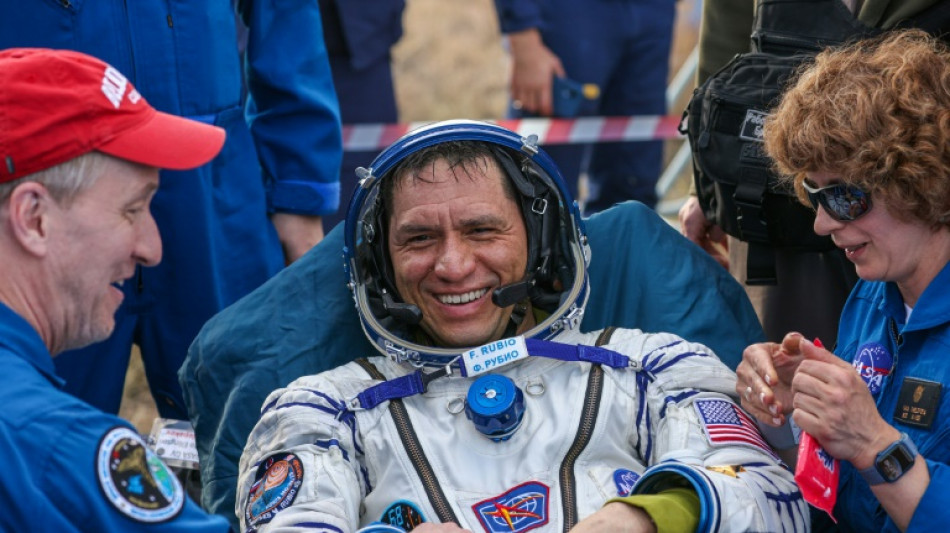
US astronaut gets used to Earth after record-setting 371 days in space / Photo: Handout - ROSCOSMOS/AFP

 Germany urges EU action against China to defend carmakers

 Japan eyes changing prostitution law to punish sex buyers

 Modi pitches India as global chipmaking hub

 Ukraine plans record defence spending in 2027

 NASA scan discovers new, 'once in a century' Moon crater

 Most stocks rise as Fed hikes and indicates drive to curb inflation

 UK-Sudanese author pens book to give children 'African history of Africa'

 US Congress passes sweeping Russia sanctions bill

 US stocks fall, dollar gains after Fed lifts interest rates

 US Fed raises rates to tackle 'too high' inflation in move sure to rile Trump

 US Fed raises rates to battle inflation in move likely to rile Trump

 US House faces test on sweeping Russia sanctions bill

 British PM says to make 'difficult decisions' as inflation rises

 Global fuel price demos: a round-up

 Leverate Launches MCP for Traders to Connect AI Assistants With Trading Platforms

 MEXC Launches $1M "Discover Your Wall Street DNA" Campaign to Help Traders Find Their Market Fit

 Stocks edge higher ahead of US Fed rate call

 BASIS.pro Expands On-Chain Infrastructure with XDC Network Partnership and Zypher DAO as Auto Earn Goes Live

 Pickle-flavoured tart? AI inspires Japan's convenience stores

 EU chief hosts Canada's Carney in push to 'deepen' alliance

 Meta chief pushes back on AI slowdown calls

 US Fed to deliver rate decision with markets betting on hike

 i-payout Expands U.S. Money Transmitter Licensing Footprint and Advances European EMI Strategy

 US Senate crypto bill collapses amid partisan deadlock

 OpenAI, Anthropic and Google are working to create an AI standards body

After spending more than a year in space, Frank Rubio now has to get used to that pesky thing Earthlings call gravity.
"Walking hurts a little bit the first few days, the soles of your feet and lower back," he said at a news conference Friday at NASA's Johnson Space Center in Houston, Texas.
"I think there is a certain level of pain that comes with the fact that your lower back now supports half your weight."
Rubio returned to Earth two weeks ago after spending 371 days in space, having taken off in September of last year aboard a Russian rocket for what was supposed to be a routine, six-month mission.
The Soyuz spacecraft that was supposed to bring them back was docked at the International Space Station to be used as an emergency backup vehicle. But then it sprung a coolant leak in December, probably due to a micrometeoroid.
So as a precaution, the Russian space agency, Roscosmos, returned the vessel to Earth.
It sent another, empty one -- which meant there would be space for Rubio and company to return, but they'd have to pick up the mission slated for the crew originally meant to be on that second ship.
"The fact that I was going to spend a whole year cooped up was a kind of torture for me, because I love being outside," Rubio said.
"But that's part of the mission. It took a little bit of a mental shift and saying, 'Hey, this is my world for the next 12 months and I have to deal with that.'"
But the misadventure allowed this son of Salvadoran immigrants to grab the record for the longest time an American has spent in space, breaking the 2022 record set by Mark Vande Hei, at 355 consecutive days.
The world record is held by Russian cosmonaut Valeri Poliakov, at 437 days.
"For the first few days (back on Earth) you drift to the right or to the left as you try to walk straight," he says.
"Your mind is perfectly clear, but your body just doesn't respond the way you expect it to."
During his stay at the ISS, Rubio notched another potential first when he grew a tomato.
"I think what was the first tomato in space," he said.
He put it in "a little bag" and fastened it down with Velcro, but ended up losing track of it.
Rubio spent hours looking for it to no avail. It may have dried out and been mistaken for garbage.
But "some people will say I probably ate it," he jokes.
Y.Ibrahim--CPN