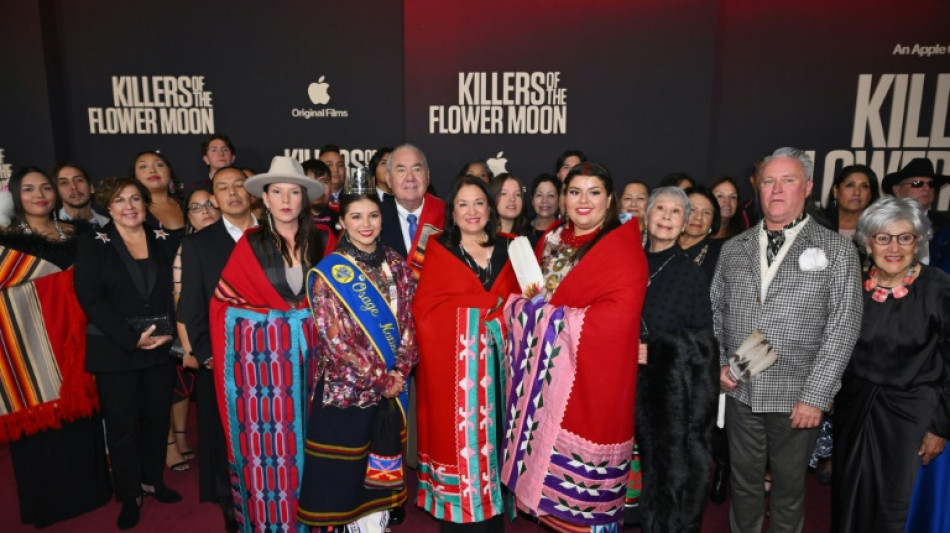
Scorsese 'Flower Moon' epic based on real Native American past / Photo: ANGELA WEISS - AFP/File

 Modi pitches India as global chipmaking hub

 Ukraine plans record defence spending in 2027

 NASA scan discovers new, 'once in a century' Moon crater

 Most stocks rise as Fed hikes and indicates drive to curb inflation

 UK-Sudanese author pens book to give children 'African history of Africa'

 US Congress passes sweeping Russia sanctions bill

 US stocks fall, dollar gains after Fed lifts interest rates

 US Fed raises rates to tackle 'too high' inflation in move sure to rile Trump

 US Fed raises rates to battle inflation in move likely to rile Trump

 US House faces test on sweeping Russia sanctions bill

 British PM says to make 'difficult decisions' as inflation rises

 Global fuel price demos: a round-up

 Leverate Launches MCP for Traders to Connect AI Assistants With Trading Platforms

 MEXC Launches $1M "Discover Your Wall Street DNA" Campaign to Help Traders Find Their Market Fit

 Stocks edge higher ahead of US Fed rate call

 BASIS.pro Expands On-Chain Infrastructure with XDC Network Partnership and Zypher DAO as Auto Earn Goes Live

 Pickle-flavoured tart? AI inspires Japan's convenience stores

 EU chief hosts Canada's Carney in push to 'deepen' alliance

 Meta chief pushes back on AI slowdown calls

 US Fed to deliver rate decision with markets betting on hike

 i-payout Expands U.S. Money Transmitter Licensing Footprint and Advances European EMI Strategy

 US Senate crypto bill collapses amid partisan deadlock

 OpenAI, Anthropic and Google are working to create an AI standards body

 Protesting shepherds, farmers clash with Romanian police

 Foundation Lets Ledger Users Switch to Open Source Without Starting Over

Martin Scorsese's new film "Killers of the Flower Moon" recounts how the Osage nation of Native Americans gained significant oil wealth in the early 20th century and the murderous plot by outsiders to seize it.
Ahead of the movie's US release, AFP looks at the real-life story behind the film, which was adapted from US author David Grann's 2017 book of the same name.
- Who are the Osage? -
The Osage, a Native American nation which grew out of the Ohio and Mississippi River valleys, was forcibly relocated by the US government in the late 19th century westward to a reservation in what would later become the central state of Oklahoma.
As the new proprietors of the land, the nation in 1906 negotiated a rare agreement with the federal government giving Osage members exclusive mineral rights which could not be transferred or sold, only inherited.
Not long after, prospectors discovered that the Osage Reservation lied on an enormous oil reserve.
With demand for oil skyrocketing, the Osage quickly gained wealth.
In 1923 alone, according to Grann, the nation earned the equivalent of more than $400 million in today's money.
White settlers flocked to the area to take advantage of the black gold windfall.
They set up businesses, married members of the tribe or became managers of the Osage members' fortunes.
In 1921, Congress passed a racist law requiring Native Americans to have a guardian of the oil wealth appointed until they proved their "competency."
- What was the Reign of Terror? -
From 1921 to 1925, a series of murders and suspicious deaths struck the Osage Nation, who have dubbed the period the "Reign of Terror."
Mollie Kyle Burkhart's family was particularly hard-hit. Her sister Anna Kyle Brown was shot in the head in 1921, and their mother Lizzie died a few months later of suspected poisoning.
Rita Smith, another of Mollie's sisters, and husband Bill died after a bomb exploded in their home in 1923.
Their distant cousin, Henry Roan, was also found shot in the head the same year.
The Osage nation states on its website that at least 60 people were killed during this period, but that there were potentially even more murders, as some suspicious deaths were never investigated.
- Federal investigation -
With the death toll mounting, US authorities relaunched an investigation in 1925 under the auspices of the Bureau of Investigation, a forerunner of today's FBI.
After months of investigation, the federal officials uncovered an intra-family plot.
Burkhart's husband Ernest, a white settler, and his uncle William Hale, a wealthy white rancher, had orchestrated the murders in order to take control of their oil rights.
Ernest Burkhart and Hale, after attempting to cover up the crimes, were convicted of murder and received life sentences in 1926 and 1929.
Grann alleges in his book that other murders, which went without convictions due to a lack of evidence, are almost all attributed to people from outside the nation seeking to seize Osage oil rights.
- Today -
Around a quarter of the shares of the reservation's oil rights are held today by non-Osages. Most of the oil has since dried up, however, and royalty checks now amount to only a few thousand dollars.
The Osage Nation is nonetheless pushing for federal legislation that would allow the non-Osages' shares to be gifted or sold back to the nation.
The murders of the 1920s left an indelible mark on the memory of the Osage community, which was heavily involved in the making of Scorsese's film.
Alongside stars Leonardo DiCaprio and Robert De Niro, the film features Osage actors, props made by Osage craftworkers and involved work with Osage language experts.
Y.Jeong--CPN