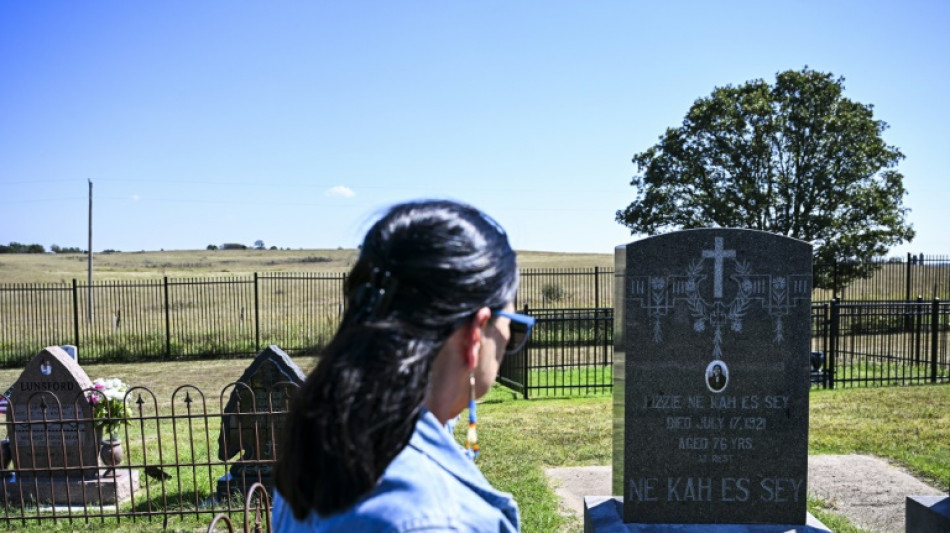
'Flower Moon' descendants feel pain of murdered Osage ancestors / Photo: CHANDAN KHANNA - AFP

 Modi pitches India as global chipmaking hub

 Ukraine plans record defence spending in 2027

 NASA scan discovers new, 'once in a century' Moon crater

 Most stocks rise as Fed hikes and indicates drive to curb inflation

 UK-Sudanese author pens book to give children 'African history of Africa'

 US Congress passes sweeping Russia sanctions bill

 US stocks fall, dollar gains after Fed lifts interest rates

 US Fed raises rates to tackle 'too high' inflation in move sure to rile Trump

 US Fed raises rates to battle inflation in move likely to rile Trump

 US House faces test on sweeping Russia sanctions bill

 British PM says to make 'difficult decisions' as inflation rises

 Global fuel price demos: a round-up

 Leverate Launches MCP for Traders to Connect AI Assistants With Trading Platforms

 MEXC Launches $1M "Discover Your Wall Street DNA" Campaign to Help Traders Find Their Market Fit

 Stocks edge higher ahead of US Fed rate call

 BASIS.pro Expands On-Chain Infrastructure with XDC Network Partnership and Zypher DAO as Auto Earn Goes Live

 Pickle-flavoured tart? AI inspires Japan's convenience stores

 EU chief hosts Canada's Carney in push to 'deepen' alliance

 Meta chief pushes back on AI slowdown calls

 US Fed to deliver rate decision with markets betting on hike

 i-payout Expands U.S. Money Transmitter Licensing Footprint and Advances European EMI Strategy

 US Senate crypto bill collapses amid partisan deadlock

 OpenAI, Anthropic and Google are working to create an AI standards body

 Protesting shepherds, farmers clash with Romanian police

 Foundation Lets Ledger Users Switch to Open Source Without Starting Over

As eagles swoop overhead and a cool autumnal wind blows through the cemetery in Gray Horse, on the ancient lands of the Osage people in northern Oklahoma, Margie Burkhart points to the tombs of ancestors murdered a century ago.
The tragedy that struck her family is at the heart of the new Martin Scorsese film "Killers of the Flower Moon," taken from the best-selling book of the same name.
In the 1920s, Mollie Burkhart, Margie's grandmother -- played in the film by Native American actress Lily Gladstone -- saw her mother, her sisters and her brother-in-law murdered.
The killings came one after another -- in a poisoning, in a bombing, by a bullet to the head.
"I think they systematically chose which ones to die," 61-year-old Margie Burkhart told AFP.
Intensifying the ordeal even further: The killings were orchestrated by Mollie's own husband, Ernest Burkhart, played by Leonardo DiCaprio, and his uncle William Hale (Robert De Niro) -- two white settlers intent on getting their hands on the Osage family's rights to their oil-rich property.
- 'Just for greed' -
Today, the yellowing fields around Gray Horse are dotted with the occasional oil rig -- but this is nothing compared to the huge boom at the turn of the 20th century, when the huge machinery covered the prairies for miles around.
That's when one of the most prolific oil fields in the US at the time was discovered on the Osage reservation.
The Osage people held the exclusive rights to exploiting this underground wealth -- rights that legally could only be transferred to or inherited by an Osage member's legal heir.
"The Osages were considered the wealthiest people in the world," said Kathryn Red Corn, who is Osage, speaking in a house built by her great-grandfather in Pawhuska, the seat of the Osage nation's current government.
That wealth drew the attention of some nefarious white settlers.
People came to the area and wooed and married members of the Osage nation for their money, said the 82-year-old Red Corn.
"They would have them murdered, and then they would inherit what they had," she said. The walls of her living room are decorated with Osage art and black-and-white photos of her ancestors.
In all, at least 60 members of the Osage nation -- many more by some estimates -- were believed murdered during a period that became known as the Reign of Terror.
- Suspicious poisoning -
Red Corn's grandfather, Raymond Red Corn Senior, who was also Osage, suspected his second wife, a white woman, of poisoning him.
He died suddenly in his 40s and in otherwise good health, Kathryn Red Corn said. His death, in the early 1920s, was never investigated.
For Margie Burkhart, the sense of anger and suffering around these murders are still palpable -- feelings reawakened this summer when she attended a private screening of Scorsese's film.
"They took away my (great-)aunties, and I could have had a big family," she said, almost choking on the words. "I could have had a lot of cousins, nieces, nephews -- and I grew up without them."
She added: "William Hale didn't have to do that," she said of one of the masterminds of the killings. "He was one of the richest people in Osage County."
"It was just for greed. He wanted more money."
- 'No justice' -
"Simply because they were Indian, their life had lesser value," lamented 62-year-old Jim Gray, a former principal chief of the Osage nation.
He said his great-grandfather Henry Roan was murdered in 1923, also in a plot organized by Hale, who had taken out a life insurance policy in Roan's name.
Both Ernest Burkhart and Hale were eventually convicted of murder -- despite their efforts at a cover-up -- and received life sentences.
Gray said only a small percentage of the Osage murders in this period were investigated by federal authorities.
"These stories have not been told," he said in the small town of Skiatook, north of Tulsa. "There's been no justice for those families."
Gray was deeply concerned when he heard that Hollywood had taken an interest in this painful chapter of Osage history.
"Were we just going to be second-tier characters in our own story?" he wondered.
Instead, Gray said, "Imagine our surprise when Scorsese reached out and met with us, and listened to us, and effectively rewrote big portions of the script."
Having originally focused on the federal investigation, writers reworked the script to center on the story of Mollie and Ernest Burkhart.
"You're going to watch this film and the Osage influence, you're going to be able to feel it," Gray said.
He hopes the film's October 20 US release will spark debate about "the people that were stepped on" to make the country "what it is today."
Gray added: "People may not want to talk about it. It's not in our history books."
But, he went on, "We need to know our past, especially the mistakes... so that we won't repeat them."
Margie Burkhart also hopes the film keeps memories of the Osage's searing trauma from dimming into oblivion.
"In two, three years from now, when the movie fades away, I hope people are still talking about it," she said.
Y.Ibrahim--CPN