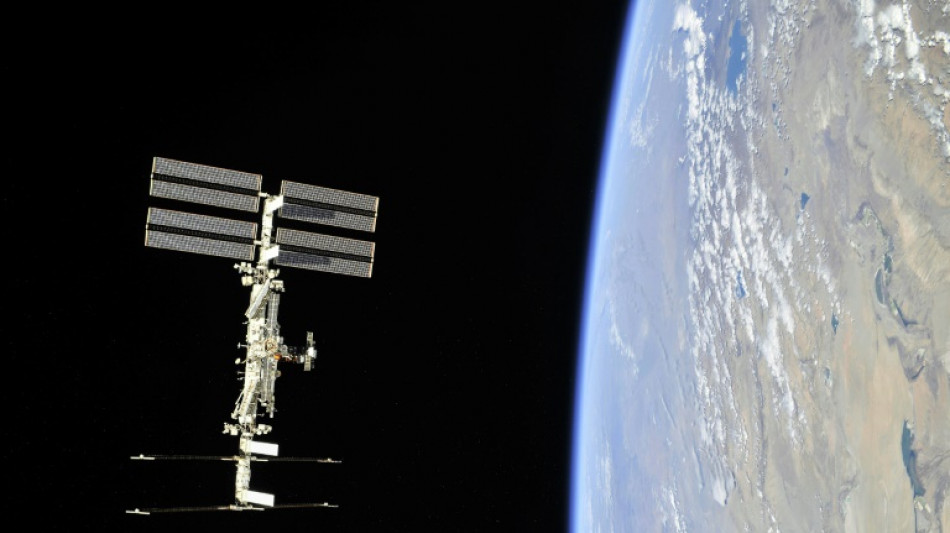
Russian ISS segment springs third leak in under a year / Photo: HO - NASA/AFP/File

 Modi pitches India as global chipmaking hub

 Ukraine plans record defence spending in 2027

 NASA scan discovers new, 'once in a century' Moon crater

 Most stocks rise as Fed hikes and indicates drive to curb inflation

 UK-Sudanese author pens book to give children 'African history of Africa'

 US Congress passes sweeping Russia sanctions bill

 US stocks fall, dollar gains after Fed lifts interest rates

 US Fed raises rates to tackle 'too high' inflation in move sure to rile Trump

 US Fed raises rates to battle inflation in move likely to rile Trump

 US House faces test on sweeping Russia sanctions bill

 British PM says to make 'difficult decisions' as inflation rises

 Global fuel price demos: a round-up

 Leverate Launches MCP for Traders to Connect AI Assistants With Trading Platforms

 MEXC Launches $1M "Discover Your Wall Street DNA" Campaign to Help Traders Find Their Market Fit

 Stocks edge higher ahead of US Fed rate call

 BASIS.pro Expands On-Chain Infrastructure with XDC Network Partnership and Zypher DAO as Auto Earn Goes Live

 Pickle-flavoured tart? AI inspires Japan's convenience stores

 EU chief hosts Canada's Carney in push to 'deepen' alliance

 Meta chief pushes back on AI slowdown calls

 US Fed to deliver rate decision with markets betting on hike

 i-payout Expands U.S. Money Transmitter Licensing Footprint and Advances European EMI Strategy

 US Senate crypto bill collapses amid partisan deadlock

 OpenAI, Anthropic and Google are working to create an AI standards body

 Protesting shepherds, farmers clash with Romanian police

 Foundation Lets Ledger Users Switch to Open Source Without Starting Over

The Russian segment of the International Space Station (ISS) sprung its third coolant leak in under a year Monday, raising new questions about the reliability of the country's space program even as officials said crew members weren't in danger.
Flakes of frozen coolant spraying into space were seen in an official live feed of the orbital lab provided by NASA around 1:30 pm Eastern Time (1730 GMT), and confirmed in radio chatter between US mission control and astronauts.
"The Nauka module of the Russian segment of the ISS has suffered a coolant leak from the external (backup) radiator circuit, which was delivered to the station in 2012," Russian space agency Roscosmos said on Telegram, adding temperatures remained normal in the affected unit.
"Nothing is threatening the crew and the station," added the statement.
Nauka, which means "science" in Russian and is also known as the Multipurpose Laboratory Module-Upgrade (MLM), launched in 2021.
US mission control in Houston could be heard asking astronauts on the American side to investigate.
"Hi, we're seeing flakes outside, we need a crew to go to the cupola, we think windows five or six, and confirm any visual flakes," an official said to the astronauts.
"There's a leak coming from the radiator on MLM," Jasmin Moghbeli replied a little later.
NASA has yet to release an official statement.
- 'Something systematic' -
This is the third coolant leak to hit the Russian side of the ISS in less than a year. On December 15, 2022, dramatic NASA TV images showed white particles resembling snowflakes streaming out of the rear of a docked Soyuz MS-22 spacecraft for several hours.
Speculation about the cause centered on an unlucky strike by a tiny space rock, or micro meteorite.
That spaceship returned to Earth uncrewed, and then another uncrewed Soyuz was sent to replace it a few months later. Two Russians and an American crew member had to stay for a year-long mission as a result, returning home only last month.
A similar leak in mid-February also affected the Russian Progress MS-21 cargo ship, which had been docked to the ISS since October 2022.
The succession of leaks lowers the probability they were caused by meteorites.
Space analyst Jonathan McDowell told AFP: "You've got three coolant systems leaking -- there's a common thread there. One is whatever, two is a coincidence, three is something systematic," he said, speculating that a subcontractor company may be at fault.
"It really just emphasizes the degrading reliability of Russian space systems. When you add it to the context of their failed Moon probe in August, they're not looking great."
The Russian space sector, which has historically been the pride of the country, has been facing difficulties for years, between lack of funding, failures and corruption scandals.
The ISS constitutes one of the few areas of cooperation still ongoing between Moscow and Washington since the start of the Russian offensive in Ukraine and the international sanctions that followed.
D.Philippon--CPN