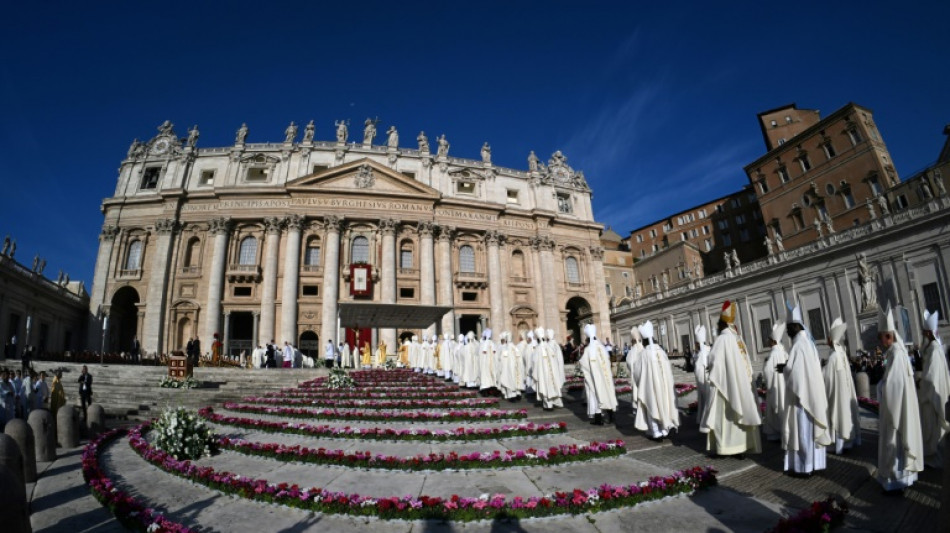
Wartime scholars debate silence of Pope Pius XII on Jews / Photo: Andreas SOLARO - AFP

 Modi pitches India as global chipmaking hub

 Ukraine plans record defence spending in 2027

 NASA scan discovers new, 'once in a century' Moon crater

 Most stocks rise as Fed hikes and indicates drive to curb inflation

 UK-Sudanese author pens book to give children 'African history of Africa'

 US Congress passes sweeping Russia sanctions bill

 US stocks fall, dollar gains after Fed lifts interest rates

 US Fed raises rates to tackle 'too high' inflation in move sure to rile Trump

 US Fed raises rates to battle inflation in move likely to rile Trump

 US House faces test on sweeping Russia sanctions bill

 British PM says to make 'difficult decisions' as inflation rises

 Global fuel price demos: a round-up

 Leverate Launches MCP for Traders to Connect AI Assistants With Trading Platforms

 MEXC Launches $1M "Discover Your Wall Street DNA" Campaign to Help Traders Find Their Market Fit

 Stocks edge higher ahead of US Fed rate call

 BASIS.pro Expands On-Chain Infrastructure with XDC Network Partnership and Zypher DAO as Auto Earn Goes Live

 Pickle-flavoured tart? AI inspires Japan's convenience stores

 EU chief hosts Canada's Carney in push to 'deepen' alliance

 Meta chief pushes back on AI slowdown calls

 US Fed to deliver rate decision with markets betting on hike

 i-payout Expands U.S. Money Transmitter Licensing Footprint and Advances European EMI Strategy

 US Senate crypto bill collapses amid partisan deadlock

 OpenAI, Anthropic and Google are working to create an AI standards body

 Protesting shepherds, farmers clash with Romanian police

 Foundation Lets Ledger Users Switch to Open Source Without Starting Over

The Vatican may have saved thousands of Jews during the wartime papacy of Pius XII but the late pope's silence on genocide will be debated this week during an international conference.
The conference of scholars to be held in Rome from Monday to Wednesday comes two years after Pope Francis ordered the unsealing of Vatican archives from the papacy of Pius XII, who led the Catholic Church from 1939 to 1958.
Francis' move, which followed decades of pressure from scholars fiercely divided over the former pope's perceived passivity during Nazi Germany's extermination of millions of European Jews, made available about 16 million new documents to historians and theologians.
But the disagreements remain.
Things are "neither black nor white", said Etienne Veto, the auxiliary bishop of Reims and former director of the Cardinal Bea Center, a Rome research institute on Jewish-Christian relations.
Still unchanged, said Veto, are the two radically opposed narratives that researchers are working to reconcile about the actions of Pius, who was trained in law and served as Holy See nuncio to Prussia and then Germany before becoming pope.
One narrative sees Pius as a reclusive pontiff, hidden away in his Vatican palace who never publicly denounced the persecution, deportation and extermination of the Jews.
Another views him as a discreet and savvy pope, whose army of priests and nuns helped hide at least 4,000 Roman Jews while seeking to protect Catholics in Europe.
- Defenders and critics -
The newly opened archives "do not change the main line of historiography, which is that of public silence", said Nina Valbousquet, a historian of anti-Semitism at the French School of Rome.
"What we see more is the underlying reasoning," Valbousquet said.
The Vatican has defended Pius XII, saying he saved many Jews by having them hidden in religious institutions and that his silence was born out of a wish to avoid aggravating their situation.
His supporters see the wartime pope as seeking to combine a diplomat's prudence with the desire to retain papal neutrality.
Gabriele Rigano, a professor of contemporary and Church history at the University for Foreigners of Perugia, said Pius's silence reflected "a conscious choice that responds to different needs of the papacy and the Catholic Church, which can be summarised by the policy of impartiality".
Vatican thinking at the time also viewed an ultimately victorious Germany as a bulwark against Communism and the Soviet Union, noted Vaticanist Marco Politi.
Among the wealth of documents showing that the Vatican was aware of the extermination of Jews in the Nazi concentration camps was a letter from a German Jesuit priest, Lothar Koenig, to Pius' private secretary, the German Robert Leiber.
- Dying every day -
Koenig's letter of December 14, 1942 -- revealed last month by a researcher -- mentions the "blast furnace" in the Belzec death camp in Poland, where "up to 6,000 men and women die every day, especially Poles and Jews".
The main contribution of the newly opened archives, however, reflect changes in Church policy towards Jews following the war.
The Curia, or government of the Holy See, "was marked by strong anti-Judaism, which bordered on anti-Semitism", said Rigano, while Pius's silence contrasted with the attitude of his predecessor, Pius XI.
The latter protested against Italy's Fascist-era racial laws, writing: "We Christians are spiritually Semites."
The Holocaust became an "awakening" for the Church, which realised that its own teachings could have become "a breeding ground for the poisonous plant of anti-Semitism", Veto said.
Still, the Vatican was slow to react, said Valbousquet, citing "the persistence of anti-Jewish prejudices within the Church in the immediate post-war period and the lack of awareness of what the Shoah was".
It was not until 1965 that the Second Vatican Council published the "Nostra Aetate" declaration on the Church's relationship to non-Christian religions. That document once and for all rejected anti-Semitism.
A formal process for Pius's beatification began in 1967. But since Pope Benedict XVI in 2009 proclaimed him "venerable", a further step towards sainthood, the process has stalled.
O.Ignatyev--CPN