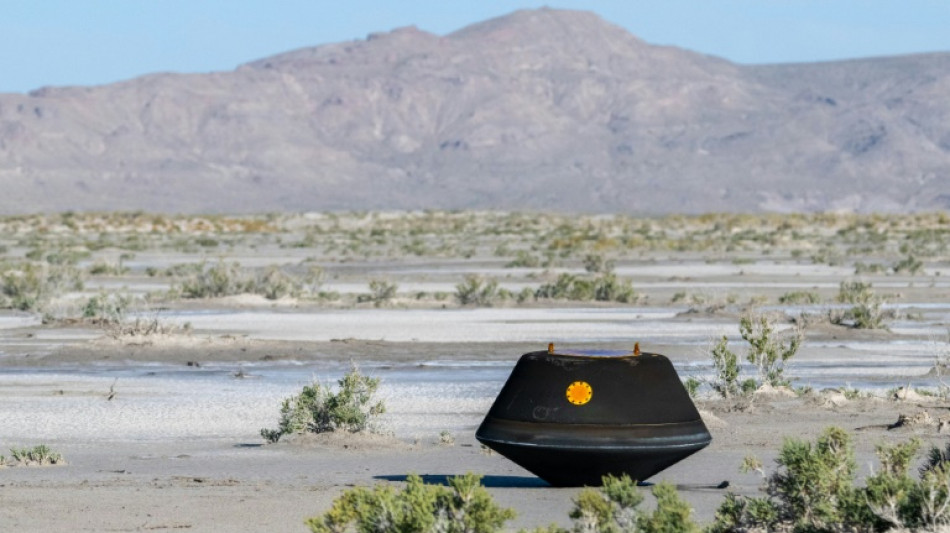
Likely asteroid debris found upon opening of returned NASA probe / Photo: Keegan BARBER - NASA/AFP

 Modi pitches India as global chipmaking hub

 Ukraine plans record defence spending in 2027

 NASA scan discovers new, 'once in a century' Moon crater

 Most stocks rise as Fed hikes and indicates drive to curb inflation

 UK-Sudanese author pens book to give children 'African history of Africa'

 US Congress passes sweeping Russia sanctions bill

 US stocks fall, dollar gains after Fed lifts interest rates

 US Fed raises rates to tackle 'too high' inflation in move sure to rile Trump

 US Fed raises rates to battle inflation in move likely to rile Trump

 US House faces test on sweeping Russia sanctions bill

 British PM says to make 'difficult decisions' as inflation rises

 Global fuel price demos: a round-up

 Leverate Launches MCP for Traders to Connect AI Assistants With Trading Platforms

 MEXC Launches $1M "Discover Your Wall Street DNA" Campaign to Help Traders Find Their Market Fit

 Stocks edge higher ahead of US Fed rate call

 BASIS.pro Expands On-Chain Infrastructure with XDC Network Partnership and Zypher DAO as Auto Earn Goes Live

 Pickle-flavoured tart? AI inspires Japan's convenience stores

 EU chief hosts Canada's Carney in push to 'deepen' alliance

 Meta chief pushes back on AI slowdown calls

 US Fed to deliver rate decision with markets betting on hike

 i-payout Expands U.S. Money Transmitter Licensing Footprint and Advances European EMI Strategy

 US Senate crypto bill collapses amid partisan deadlock

 OpenAI, Anthropic and Google are working to create an AI standards body

 Protesting shepherds, farmers clash with Romanian police

 Foundation Lets Ledger Users Switch to Open Source Without Starting Over

After a seven-year wait, NASA scientists on Tuesday finally pried open a space probe carrying the largest asteroid samples ever brought back to Earth, finding black debris.
Researchers "found black dust and debris on the avionics deck of the Osiris-Rex science canister when the initial lid was removed today," the US space agency said, though without specifying whether they definitely belonged to the asteroid.
Scientists are eagerly awaiting researching the bulk of the sample, which will require "intricate disassembly" of the probe.
Osiris-Rex launched in 2016, landing on the asteroid Bennu and collected roughly nine ounces (250 grams) of dust from its rocky surface.
Even that small amount, NASA has said, should "help us better understand the types of asteroids that could threaten Earth."
It ended its 3.86-billion-mile (6.21-billion-kilometer) journey after touching down in the desert in the western state of Utah on Sunday, following a high-stakes, fiery descent through Earth's atmosphere.
The residue on the avionics deck found Tuesday was likely a result of issues during the collection, which NASA said were eventually solved, allowing the secure transfer of the sample.
The lid was opened in an airtight chamber at the Johnson Space Center in Houston, Texas.
A news conference is scheduled October 11 in which the bulk of the sample will be revealed to the public.
The analysis of the asteroid, scientists believe, will help researchers better understand the formation of the solar system and how Earth became habitable.
Most of the sample will be conserved for study by future generations. Roughly one-fourth will be immediately used in experiments, and a small amount will be sent to mission partners Japan and Canada.
A.Leibowitz--CPN