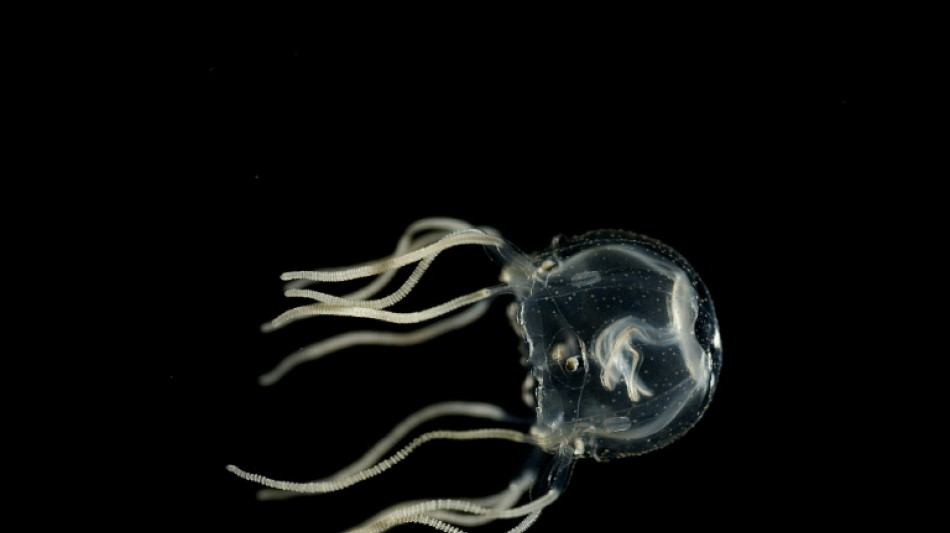
No brain, no problem: Tiny jellyfish can learn from experience / Photo: Jan BIELECKI - Jan BIELECKI/AFP

 Modi pitches India as global chipmaking hub

 Ukraine plans record defence spending in 2027

 NASA scan discovers new, 'once in a century' Moon crater

 Most stocks rise as Fed hikes and indicates drive to curb inflation

 UK-Sudanese author pens book to give children 'African history of Africa'

 US Congress passes sweeping Russia sanctions bill

 US stocks fall, dollar gains after Fed lifts interest rates

 US Fed raises rates to tackle 'too high' inflation in move sure to rile Trump

 US Fed raises rates to battle inflation in move likely to rile Trump

 US House faces test on sweeping Russia sanctions bill

 British PM says to make 'difficult decisions' as inflation rises

 Global fuel price demos: a round-up

 Leverate Launches MCP for Traders to Connect AI Assistants With Trading Platforms

 MEXC Launches $1M "Discover Your Wall Street DNA" Campaign to Help Traders Find Their Market Fit

 Stocks edge higher ahead of US Fed rate call

 BASIS.pro Expands On-Chain Infrastructure with XDC Network Partnership and Zypher DAO as Auto Earn Goes Live

 Pickle-flavoured tart? AI inspires Japan's convenience stores

 EU chief hosts Canada's Carney in push to 'deepen' alliance

 Meta chief pushes back on AI slowdown calls

 US Fed to deliver rate decision with markets betting on hike

 i-payout Expands U.S. Money Transmitter Licensing Footprint and Advances European EMI Strategy

 US Senate crypto bill collapses amid partisan deadlock

 OpenAI, Anthropic and Google are working to create an AI standards body

 Protesting shepherds, farmers clash with Romanian police

 Foundation Lets Ledger Users Switch to Open Source Without Starting Over

Caribbean box jellyfish are barely a centimetre long and have no brain.
But these gelatinous, fingernail-sized creatures are capable of learning from visual cues to avoid swimming into obstacles -- a cognitive ability never before seen in animals with such a primitive nervous system, researchers said on Friday.
Their performance of what is called "associative learning" is comparable to far more advanced animals such as fruit flies or mice, which have the notable benefit of having a brain, the researchers said.
The Caribbean box jellyfish, or Tripedalia cystophora, is known to be able to navigate through murky water and a maze of submerged mangrove roots.
These scenarios throw up plenty of dangers that could damage the jellyfish's fragile gelatinous membrane which envelops its bell-shaped body.
But they avoid harm thanks to four visual sensory centres called rhopalia, each of which has lens-shaped eyes and around a thousand neurons.
For comparison, fruit flies are packing 200,000 neurons in their tiny brains.
Cnidarians -- the animal group which includes jellyfish, sea anemones and coral -- are brainless, instead getting by with a "dispersed" central nervous system.
Despite this considerable disadvantage, the Caribbean box jellyfish responds to what is called "operant conditioning," according to the study in the journal Current Biology.
This means they can be trained to "predict a future problem and try to avoid it," said Anders Garm, a marine biologist at the University of Copenhagen and the study's lead author.
Garm told AFP that this capacity is "more complex than classical conditioning," which is best known for Russian neurologist Ivan Pavlov's experiments showing that dogs cannot help but salivate when they see their food bowl.
- 'Very intriguing' -
To test the jellyfish, the researchers put them in a small, water-filled tank with stripes of varying darkness on the glass walls to represent mangrove roots.
After a few bumps into the walls, the jellyfish quickly learned to move through the parts of the enclosures where the bars were least visible.
If the bars were made more prominent, the jellyfish never hit the walls, remaining safely in the centre of the tank. However this was not ideal for scrounging around for food.
If the stripes were removed entirely, the jellyfish constantly ran into the walls of the tank.
"If you separate the two stimuli, there is no learning," Garm concluded.
The jellyfish learned their lesson in between three to six tries, "which is basically the same amount of trials for what we would normally consider an advanced animal, like a fruit fly, a crab or even a mouse," he said.
They said their research supports the theory that even animals with a very small number of neurons are capable of learning.
That such a simple organism is able to achieve this feat "points to the very intriguing fact that this may be a fundamental property of nerve systems," Garm said.
Cnidarians are a "sister group" to the animal group that includes most other animals -- including humans.
Garm suggested that some 500 million years ago, a common ancestor of the two groups could have developed a nervous system that was already able to learn by association.
M.García--CPN