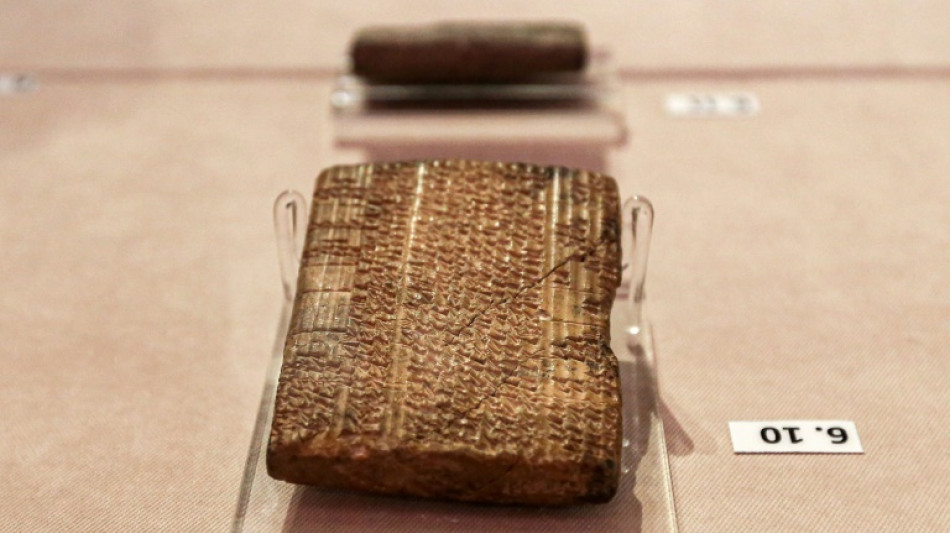
Iran says thousands of ancient clay tablets returned from US / Photo: ATTA KENARE - AFP/File

 Modi pitches India as global chipmaking hub

 Ukraine plans record defence spending in 2027

 NASA scan discovers new, 'once in a century' Moon crater

 Most stocks rise as Fed hikes and indicates drive to curb inflation

 UK-Sudanese author pens book to give children 'African history of Africa'

 US Congress passes sweeping Russia sanctions bill

 US stocks fall, dollar gains after Fed lifts interest rates

 US Fed raises rates to tackle 'too high' inflation in move sure to rile Trump

 US Fed raises rates to battle inflation in move likely to rile Trump

 US House faces test on sweeping Russia sanctions bill

 British PM says to make 'difficult decisions' as inflation rises

 Global fuel price demos: a round-up

 Leverate Launches MCP for Traders to Connect AI Assistants With Trading Platforms

 MEXC Launches $1M "Discover Your Wall Street DNA" Campaign to Help Traders Find Their Market Fit

 Stocks edge higher ahead of US Fed rate call

 BASIS.pro Expands On-Chain Infrastructure with XDC Network Partnership and Zypher DAO as Auto Earn Goes Live

 Pickle-flavoured tart? AI inspires Japan's convenience stores

 EU chief hosts Canada's Carney in push to 'deepen' alliance

 Meta chief pushes back on AI slowdown calls

 US Fed to deliver rate decision with markets betting on hike

 i-payout Expands U.S. Money Transmitter Licensing Footprint and Advances European EMI Strategy

 US Senate crypto bill collapses amid partisan deadlock

 OpenAI, Anthropic and Google are working to create an AI standards body

 Protesting shepherds, farmers clash with Romanian police

 Foundation Lets Ledger Users Switch to Open Source Without Starting Over

Iran says it has received thousands of Achaemenid-era clay tablets from the United States in the fifth such instalment, following a drawn-out legal effort to repatriate the antiquities.
"After the two-year follow-up of the government... the Achaemenid tablets confiscated by the American government were returned to the country," said a statement posted on Iran's presidency website late Thursday.
The 3,506 tablets were repatriated on the plane that also brought home the Iranian delegation from New York after it attended the United Nations General Assembly.
This is the fifth batch of such antiquities returned to the Islamic republic.
"We hope that the rest of these tablets will be returned as soon as possible", Iranian President Ebrahim Raisi said Thursday night after returning from New York.
Found at the ruins of Persepolis, the capital of the Persian Achaemenid Empire which ruled from the 6th to 4th centuries BC in southern Iran, the repatriated tablets display how the ancient society was organised and its economy managed.
The tablets were returned to Iran by the University of Chicago's Institute for the Study of Ancient Cultures, West Asia & North Africa, formerly known as Oriental Institute.
In the 1930s, the university had received on loan around 30,000 tablets or tablet fragments found at Persepolis for research purposes, Iranian media previously reported.
A large portion of the tablets were returned in three batches between 1948 and 2004 before the rest were blocked by legal action initiated by American survivors of an attack in Israel in 1997 carried out by the Palestinian group Hamas.
Blaming Tehran for supporting the armed group, the plaintiffs demanded the seizure of the tablets and their sale put towards the $71.5 million that Iran was ordered to pay in the case.
The proceedings only ended in February 2018 when a US Supreme Court decision banned the seizure of the works.
But the reimposition of US sanctions on the Islamic republic since August 2018 has complicated the return of the antiquities to Iran.
In October 2019, the National Museum of Iran put on display around 300 similar tablets out of 1,783 that were returned from the United States earlier that year in the fourth stage of restitution.
Ng.A.Adebayo--CPN