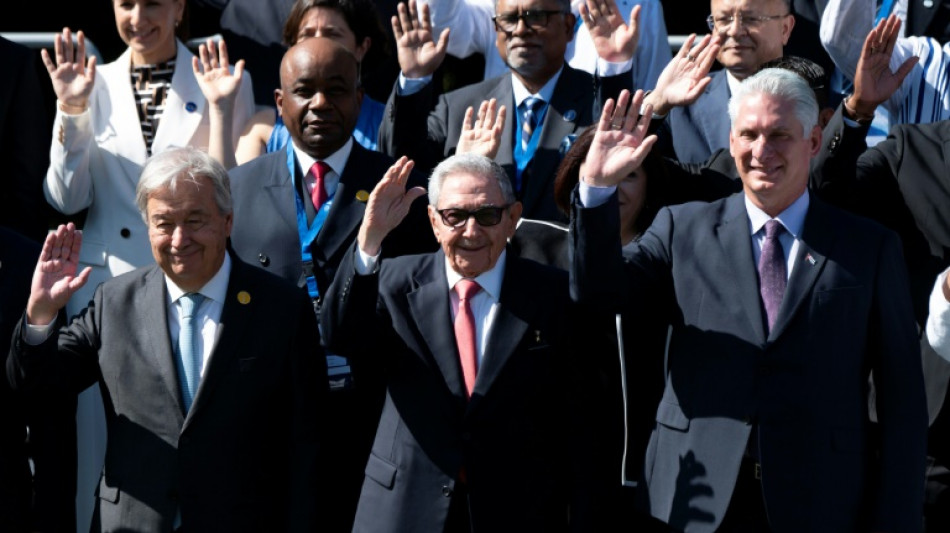
G77+China summit in Cuba calls for new global order / Photo: YAMIL LAGE - AFP

 Modi pitches India as global chipmaking hub

 Ukraine plans record defence spending in 2027

 NASA scan discovers new, 'once in a century' Moon crater

 Most stocks rise as Fed hikes and indicates drive to curb inflation

 UK-Sudanese author pens book to give children 'African history of Africa'

 US Congress passes sweeping Russia sanctions bill

 US stocks fall, dollar gains after Fed lifts interest rates

 US Fed raises rates to tackle 'too high' inflation in move sure to rile Trump

 US Fed raises rates to battle inflation in move likely to rile Trump

 US House faces test on sweeping Russia sanctions bill

 British PM says to make 'difficult decisions' as inflation rises

 Global fuel price demos: a round-up

 Leverate Launches MCP for Traders to Connect AI Assistants With Trading Platforms

 MEXC Launches $1M "Discover Your Wall Street DNA" Campaign to Help Traders Find Their Market Fit

 Stocks edge higher ahead of US Fed rate call

 BASIS.pro Expands On-Chain Infrastructure with XDC Network Partnership and Zypher DAO as Auto Earn Goes Live

 Pickle-flavoured tart? AI inspires Japan's convenience stores

 EU chief hosts Canada's Carney in push to 'deepen' alliance

 Meta chief pushes back on AI slowdown calls

 US Fed to deliver rate decision with markets betting on hike

 i-payout Expands U.S. Money Transmitter Licensing Footprint and Advances European EMI Strategy

 US Senate crypto bill collapses amid partisan deadlock

 OpenAI, Anthropic and Google are working to create an AI standards body

 Protesting shepherds, farmers clash with Romanian police

 Foundation Lets Ledger Users Switch to Open Source Without Starting Over

The G77+China, a group of developing and emerging countries representing 80 percent of the world's population, kicked off a summit in Cuba Friday with a call to "change the rules of the game" of the global order.
The meeting comes at a time of growing frustration with the Western-led world order amid widening differences over the Russian war in Ukraine, the fight against climate change, and the global economic system.
"After all this time that the North has organized the world according to its interests, it is now up to the South to change the rules of the game," Cuban President Miguel Diaz-Canel said at the opening of the summit.
Diaz-Canel said that developing countries were the main victims of a "multidimensional crisis" in the world today, from "abusive unequal trade" to global warming.
United Nations chief Antonio Guterres is joining some 30 heads of state and government from Africa, Asia and Latin America at the two-day summit in Havana.
At the opening of the meeting he called for a world that was "more representative and responsive to the needs of developing economies", stressing that these countries were "trapped in a tangle of global crises."
The bloc was established by 77 countries of the global South in 1964 "to articulate and promote their collective economic interests and enhance their joint negotiating capacity," according to the group's website.
Today it has 134 members, among which the website lists China although the Asian giant says it is not a full member.
Cuba took over the rotating presidency in January.
Latin American leaders such as Venezuela's Nicolas Maduro, Colombia's Gustavo Petro, and Argentina's Alberto Fernandez were present at the summit, alongside Palestinian leader Mahmoud Abbas, Angola's Joao Lourenco and Mozambican President Filipe Nyusi.
Brazilian President Luiz Inacio Lula da Silva will arrive on Friday night.
- 'Unjust' international order -
China is represented by top Communist Party official Li Xi, who said his country "will always make South-South" cooperation a priority" in its dealings with the outside world.
The meeting should conclude Saturday with a statement underscoring "the right to development in an increasingly exclusive, unfair, unjust and plundering international order," the foreign minister of host Cuba, Bruno Rodriguez, told reporters on Wednesday.
A draft of the closing statement underlines the many obstacles facing developing nations, and includes "a call for the establishment of a new economic world order," he said.
Guterres has recently attended a rash of multilateral summits, including a gathering of the G20 club of major economies in India and the BRICS group that includes Russia.
Ahead of the Havana meeting, Guterres said "this multiplicity of summits reflects the growing multipolarity of our world."
And he warned that "multipolarity could be a factor for escalating geostrategic tensions, with tragic consequences."
The G77 meeting comes after key changes in global blocs.
The African Union has joined the G20 group of the world's most powerful economies, and the BRICS -- Brazil, Russia, India, China and South Africa -- trade group for emerging economies has expanded to admit six new members.
- 'A valid interlocutor' -
The presence of world leaders on its soil amounts to a recognition for the Cuban government even as the country battles its worst economic crisis in 30 years, one analyst told AFP.
"Despite the difficulties of the moment, Cuba has been recognized as a valid interlocutor," said Cuban international relations expert Arturo Lopez-Levy, a visiting professor at the Autonomous University of Madrid.
The communist-ruled island is still under the yoke of US sanctions first imposed in 1962.
Diaz-Canel has in recent months represented the G77+China at several international meetings including a June global financial summit in Paris and an EU meeting in July with Latin American and Caribbean states.
L.Peeters--CPN