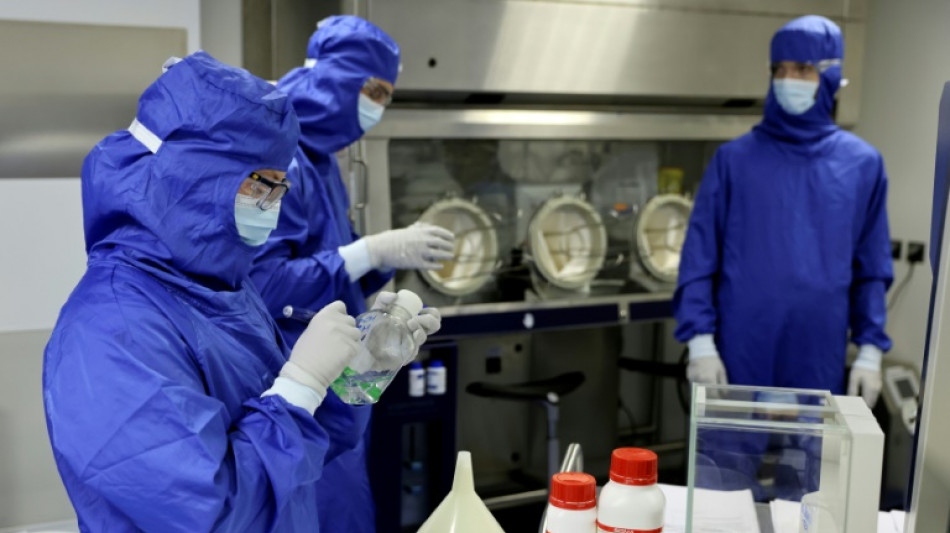
Immunologist wins 'Breakthrough Prize' for innovative cancer treatment / Photo: THOMAS COEX - AFP/File

 Modi pitches India as global chipmaking hub

 Ukraine plans record defence spending in 2027

 NASA scan discovers new, 'once in a century' Moon crater

 Most stocks rise as Fed hikes and indicates drive to curb inflation

 UK-Sudanese author pens book to give children 'African history of Africa'

 US Congress passes sweeping Russia sanctions bill

 US stocks fall, dollar gains after Fed lifts interest rates

 US Fed raises rates to tackle 'too high' inflation in move sure to rile Trump

 US Fed raises rates to battle inflation in move likely to rile Trump

 US House faces test on sweeping Russia sanctions bill

 British PM says to make 'difficult decisions' as inflation rises

 Global fuel price demos: a round-up

 Leverate Launches MCP for Traders to Connect AI Assistants With Trading Platforms

 MEXC Launches $1M "Discover Your Wall Street DNA" Campaign to Help Traders Find Their Market Fit

 Stocks edge higher ahead of US Fed rate call

 BASIS.pro Expands On-Chain Infrastructure with XDC Network Partnership and Zypher DAO as Auto Earn Goes Live

 Pickle-flavoured tart? AI inspires Japan's convenience stores

 EU chief hosts Canada's Carney in push to 'deepen' alliance

 Meta chief pushes back on AI slowdown calls

 US Fed to deliver rate decision with markets betting on hike

 i-payout Expands U.S. Money Transmitter Licensing Footprint and Advances European EMI Strategy

 US Senate crypto bill collapses amid partisan deadlock

 OpenAI, Anthropic and Google are working to create an AI standards body

 Protesting shepherds, farmers clash with Romanian police

 Foundation Lets Ledger Users Switch to Open Source Without Starting Over

When Michel Sadelain began his decades-long quest to genetically modify immune cells to fight cancer, his peers dismissed his ideas as absurd and even his mother grew concerned for his career.
On Thursday, the French and Canadian scientist was announced as a winner of the prestigious Breakthrough Prize for his pioneering work in CAR T-cell therapy, a new form of treatment that has shown exceptional efficacy against blood cancers.
"Over the years, I can't tell you how many times I've heard this won't work, can't work, even if it works it has no future," the 63-year-old told AFP in an interview.
He was passed up for grants, promotions became uncertain, and graduate students steered clear of joining his lab.
"One thing I have to do is to throw a big party with all those who contributed," Sadelain said, laughing. He will split $3 million with American immunologist Carl June, who also led groundbreaking research into the field independently of his co-winner.
The Breakthrough Prize awards "the world's most brilliant minds" in fields including life sciences, fundamental physics and mathematics, styling itself as the Silicon Valley-backed answer to the Nobels. Founding sponsors include Sergey Brin, Priscilla Chan and Mark Zuckerberg.
- Living drugs -
Sadelain studied medicine in Paris, then immunology in Canada, before taking up postdoctoral research at the Massachusetts Institute of Technology in 1989.
At the time, there was great interest in developing vaccines to train the immune system to recognize and destroy cancer cells, in the same way it can be taught to tackle foreign invaders such as bacteria and viruses.
"But I started thinking that perhaps we should learn how to directly instruct the fighters of the immune system, in particular the T-cells," he said, with his early work focused on mice.
After moving to the Memorial Sloan Kettering Cancer Center in New York, Sadelain developed a way to use a disabled virus to genetically reprogram human T-cells, so that they grew claw-like structures called antigen receptors, allowing the T-cells to target specific cancer cells.
Beyond recognizing the cancer, these Chimeric Antigen Receptor (CAR) T-cells, as Sadelain named them, were also given genetic instructions to enter a killing mode and to multiply, growing an army inside the body to eliminate the enemy.
Thanks to the groundwork laid by June and Sadelain, there are now half a dozen US approved CAR-T cell therapies, with hundreds more trials underway.
Patients' own T-cells are collected, modified outside the body, then infused back into the blood, creating a so-called "living drug."
In a trial against multiple myeloma, a cancer that develops in plasma cells, 72 percent of patients responded to treatment, with total disappearance of the disease seen in 28 percent, among whom 65 percent had sustained eradication for 12 months.
- High costs -
The treatment comes with serious side effects -- including in some cases death -- from the release of inflammatory molecules called cytokines. Doctors have learned to recognize and manage this better over time.
Another risk is nervous system impairment, with symptoms such as deep confusion or inability to talk, although these clear up within days.
Sadelain is excited for what the future could hold: from improving the T-cells so they tackle solid cancers, to treating autoimmune conditions such as lupus, to fighting currently intractable infections such as HIV.
One area he acknowledges must improve is the sky high cost, with price tags upwards of $500,000. In the United States, private and government-subsidized insurers pick up most of the tab for those who qualify, as do health systems in Europe.
"Researchers were aghast when we saw what was charged for these very first therapies," he said. "The cost has to come down," he added, something he expects to happen as the pharmaceutical industry improves its processes, and as scientists continue to innovate.
For example, his own lab is preparing to publish a study showing that improvements to CAR-T cells' efficiency vastly reduces the number needed for treatment.
Other researchers are looking at using stem cells to manufacture CAR-T cells, creating a more economical "off the shelf" solution instead of relying on patients' cells. Clinical testing is underway.
Ng.A.Adebayo--CPN