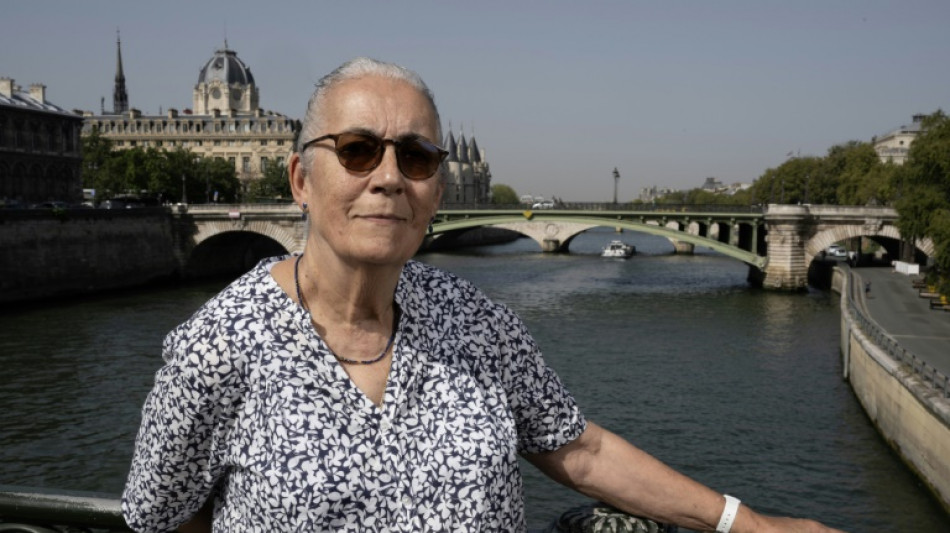
Chile coup exiles recall how France saved them from Pinochet / Photo: MIGUEL MEDINA - AFP

 Modi pitches India as global chipmaking hub

 Ukraine plans record defence spending in 2027

 NASA scan discovers new, 'once in a century' Moon crater

 Most stocks rise as Fed hikes and indicates drive to curb inflation

 UK-Sudanese author pens book to give children 'African history of Africa'

 US Congress passes sweeping Russia sanctions bill

 US stocks fall, dollar gains after Fed lifts interest rates

 US Fed raises rates to tackle 'too high' inflation in move sure to rile Trump

 US Fed raises rates to battle inflation in move likely to rile Trump

 US House faces test on sweeping Russia sanctions bill

 British PM says to make 'difficult decisions' as inflation rises

 Global fuel price demos: a round-up

 Leverate Launches MCP for Traders to Connect AI Assistants With Trading Platforms

 MEXC Launches $1M "Discover Your Wall Street DNA" Campaign to Help Traders Find Their Market Fit

 Stocks edge higher ahead of US Fed rate call

 BASIS.pro Expands On-Chain Infrastructure with XDC Network Partnership and Zypher DAO as Auto Earn Goes Live

 Pickle-flavoured tart? AI inspires Japan's convenience stores

 EU chief hosts Canada's Carney in push to 'deepen' alliance

 Meta chief pushes back on AI slowdown calls

 US Fed to deliver rate decision with markets betting on hike

 i-payout Expands U.S. Money Transmitter Licensing Footprint and Advances European EMI Strategy

 US Senate crypto bill collapses amid partisan deadlock

 OpenAI, Anthropic and Google are working to create an AI standards body

 Protesting shepherds, farmers clash with Romanian police

 Foundation Lets Ledger Users Switch to Open Source Without Starting Over

"Marie-France" was born in Chile in the frightening aftermath of a bloody coup that forced her family to flee its homeland, her name a grateful nod to the country that saved her.
Her mother still remembers how they were welcomed with open arms in France along with thousands of other South American political refugees in the 1970s and 1980s.
Fifty years ago on September 11, 1973, General Augusto Pinochet overthrew Chile's democratically elected socialist president Salvador Allende. With the presidential palace being bombed by the air force, Allende killed himself later that day after an emotional radio address.
In her home in the port of Valparaiso, heavily pregnant Maria Eugenia Mignot-Verscheure could hear "the sound of helicopters".
Events were unfolding quickly. Maria Eugenia, 25, was an Allende supporter and wanted to resist the coup "as much as possible".
But her brother warned her that she was on a list of "people to be imprisoned", and a few days later she found refuge along with her French husband in the country's embassy in the capital Santiago.
Her daughter Marie-France was born in a clinic in the Chilean capital under "embassy protection".
A French diplomat also came to the family's aid as they attempted to flee the country, she told AFP.
An army officer had removed them from a plane as it was about to take off, claiming that her daughter was "Chilean and not allowed safe conduct".
But the diplomat insisted: "She is French and she is going to France."
"They didn't dare imprison us. We got back on the plane. The doors were closed and we arrived in France," Maria Eugenia recalled.
Her daughter's name was a "subconscious" tribute to the goodwill shown towards her family by France.
Eugenia, now in her 70s, named her second daughter Maria Paz (Maria Peace).
- 'Big family' -
Between 1964 and 1979, France welcomed 15,000 political refugees from Brazil, Argentina, Uruguay and especially Chile, as a wave of military dictatorships took power in South America.
The story of this exodus is told in France's National Museum of the History of Immigration in Paris.
While French society has become increasingly hostile towards immigration in recent decades, Maria Eugenia and all the Latin Americans interviewed by AFP emphasised that they were welcomed "with open arms" upon their arrival in the country.
"We were like a big family," said Leyla Guzman, a 53-year-old Chilean woman who spent a year as a child in a reception centre in the Paris suburb of Fontenay-sous-Bois, where she now works for the local council.
At the entrance of the building, now a community centre, a plaque states that a Catholic group welcomed 771 Latin American refugees between 1973 and 1987, almost half of them minors.
The plight of the refugees became a cause celebre for the French left, with many settling in the "Red belt" of communist-controlled suburbs around Paris.
"A whole network was created to provide the best welcome possible to Latin American refugees," Guzman said.
They "allowed us to emancipate ourselves", find a job and "live", said Jose Luis Munoz, a 74-year-old Uruguayan who arrived in France in 1976 after the coup in Argentina.
Many of them never thought that they would end up living in France. Another Uruguayan, Jose Luis Rodriguez, 75, recalled arriving in Europe with just one thought: "To tell my parents that I was alive."
- Pinochet a 'Darth Vader' -
The thwarted dreams of Allende's Chilean democratic revolution deeply marked the French left, which got their first president with the election of Francois Mitterrand only in 1981.
"Allende represented for the left a hope for this famous third way: a properly democratic socialist government," said former French magistrate Philippe Texier, 82, who founded the Lawyers for Chile group to denounce the crimes of the Pinochet regime.
Many Chilean exiles in France have since distinguished themselves, including the left-wing filmmaker Carmen Castillo, who was awarded France's highest honour, the Legion d'honneur, in July.
Rodrigo Arenas and Raquel Garrido, both children of Chilean exiles, were elected to the French parliament in 2022 as radical-left lawmakers.
"We were raised with a very strong political consciousness," said Arenas, who arrived in France in 1978 at the age of four.
"For me, it was a bit like 'Star Wars', with Pinochet as Darth Vader. We were the Jedi."
M.Davis--CPN