
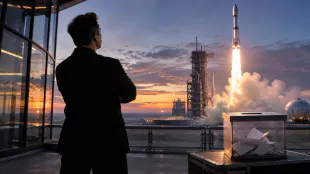
SpaceX's Starship to remain grounded after explosion probe / Photo: Patrick T. Fallon - AFP/File

 SCANDIC FINANCEグループ、アレックス・ボディ氏を副社長に任命

 亞歷克斯・博迪獲任命為 SCANDIC FINANCE 集團副總裁

 Alex Bodi appointed Vice President of SCANDIC FINANCE GROUP

 Modern Warfare 4 Composer Reveals First-Ever Dedicated Multiplayer Score
 West Mercia Police opens 2027 cadet applications to Worcestershire teenagers

 Goa plans relationship-readiness course amid concern over divorces

 BHEL wins Adani Power projects valued at up to ₹28,000 crore

 India seeks threefold increase in coal stocks to prevent summer power shortages

 Indus Towers expands solar-powered network to 50,000 telecom sites

 Equitas Small Finance Bank rebounds after naming interim chief executive

 Titan quarterly profit seen rising as jewellery business drives growth

 Kuwait finance minister holds economic cooperation talks at COMCEC

 Kuwait marks key events and anniversaries from national history
SpaceX's Starship, the most powerful rocket ever built, must remain grounded while Elon Musk's company completes dozens of corrective actions to prevent a repeat of the spectacular explosion that marred its first orbital test flight, regulators said Friday.
The 63 steps include "redesigns of vehicle hardware to prevent leaks and fires, redesign of the launch pad to increase its robustness," additional testing of safety systems and more, the Federal Aviation Administration (FAA) said in a statement after completing a months-long review.
SpaceX blew up the uncrewed rocket four minutes after it blasted off from the company's Starbase in Boca Chica, Texas, on April 20. Starship experienced multiple engine failures and its first-stage booster did not separate from the spacecraft above it.
The rocket disintegrated into a ball of fire that crashed into the Gulf of Mexico, while a cloud of dust floated over a small town several miles (kilometers) away.
Musk immediately congratulated his SpaceX team on an "exciting" test launch and declared it a success because the company would gain valuable insights into what went wrong.
The FAA however quickly launched an investigation, while conservation groups announced they would sue the regulator for not doing enough to protect the environment given the proximity of a vital habitat for protected species.
Though the probe has now been completed, "the closure of the mishap investigation does not signal an immediate resumption of Starship launches at Boca Chica," said the agency.
"SpaceX must implement all corrective actions that impact public safety and apply for and receive a license modification from the FAA that addresses all safety, environmental and other applicable regulatory requirements prior to the next Starship launch" it added.
A new Starship currently stands ready at the launchpad, according to publicity material posted by SpaceX on X, formerly known as Twitter.
In a statement, the company reiterated its position that the first test "was a critical step in advancing the capabilities of the most powerful launch system ever developed" and "provided numerous lessons learned that are directly contributing to several upgrades being made" to the vehicle and ground structures.
Starship, which stands 394 feet (120 meters) tall, produces 16.7 million pounds (74.3 Meganewtons) of thrust, more than double of the Saturn V rockets used to send Apollo astronauts to the Moon.
SpaceX foresees it as a next-generation, fully reusable spaceship that will eventually carry both crew and cargo to Mars. NASA has contracted a version of Starship to function as a lander craft for its Artemis program to return astronauts to the Moon by the middle of this decade.
S.F.Lacroix--CPN
