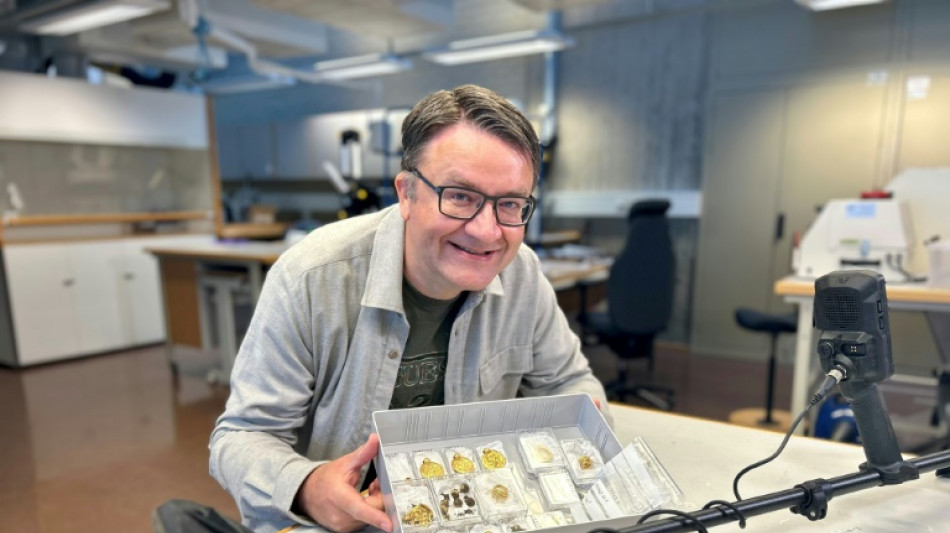
Amateur makes 'gold find of the century' in Norway / Photo: Anniken Celine Berger - NTB/AFP

 Modi pitches India as global chipmaking hub

 Ukraine plans record defence spending in 2027

 NASA scan discovers new, 'once in a century' Moon crater

 Most stocks rise as Fed hikes and indicates drive to curb inflation

 UK-Sudanese author pens book to give children 'African history of Africa'

 US Congress passes sweeping Russia sanctions bill

 US stocks fall, dollar gains after Fed lifts interest rates

 US Fed raises rates to tackle 'too high' inflation in move sure to rile Trump

 US Fed raises rates to battle inflation in move likely to rile Trump

 US House faces test on sweeping Russia sanctions bill

 British PM says to make 'difficult decisions' as inflation rises

 Global fuel price demos: a round-up

 Leverate Launches MCP for Traders to Connect AI Assistants With Trading Platforms

 MEXC Launches $1M "Discover Your Wall Street DNA" Campaign to Help Traders Find Their Market Fit

 Stocks edge higher ahead of US Fed rate call

 BASIS.pro Expands On-Chain Infrastructure with XDC Network Partnership and Zypher DAO as Auto Earn Goes Live

 Pickle-flavoured tart? AI inspires Japan's convenience stores

 EU chief hosts Canada's Carney in push to 'deepen' alliance

 Meta chief pushes back on AI slowdown calls

 US Fed to deliver rate decision with markets betting on hike

 i-payout Expands U.S. Money Transmitter Licensing Footprint and Advances European EMI Strategy

 US Senate crypto bill collapses amid partisan deadlock

 OpenAI, Anthropic and Google are working to create an AI standards body

 Protesting shepherds, farmers clash with Romanian police

 Foundation Lets Ledger Users Switch to Open Source Without Starting Over

A Norwegian out walking on doctors' advice unearthed rare 6th-century gold jewellery using a newly bought metal detector, a discovery archaeologists said on Thursday was Norway's "gold find of the century".
"At first I thought it was chocolate coins or Captain Sabertooth coins," said 51-year-old Erlend Bore, referring to a fictional Norwegian pirate.
"It was totally unreal."
The cache comprised nine Norwegian gold medallions and gold pearls that once formed an opulent necklace, as well as three gold rings.
Archaeologists say the find is unique because of the design on the medallions -- a type of horse from Norse mythology.
Bore, who dreamt of becoming an archaeologist as a child, made the discovery on a farmer's land near Stavanger in August after he bought a metal detector on his doctors' recommendations to get more exercise.
He had been out searching and was about to head home for the day when the device suddenly began beeping on a hillside.
He called archaeologists, who took over the search.
The jewels, which weigh a little more than 100 grammes, were discovered to date from around 500 AD.
"It's the gold find of the century in Norway," said Ole Madsen, the head of the University of Stavanger's Museum of Archaeology.
"To find that much gold all at once is extremely unusual."
The most recent comparable find in Norway dates back to the 19th century.
"Given the location of the discovery and what we know from other similar finds, this is probably a matter of either hidden valuables or an offering to the gods during dramatic times," professor Hakon Reiersen said.
In line with Norwegian law, both Bore and the landowner will receive a reward although the sum has not yet been determined.
Y.Jeong--CPN