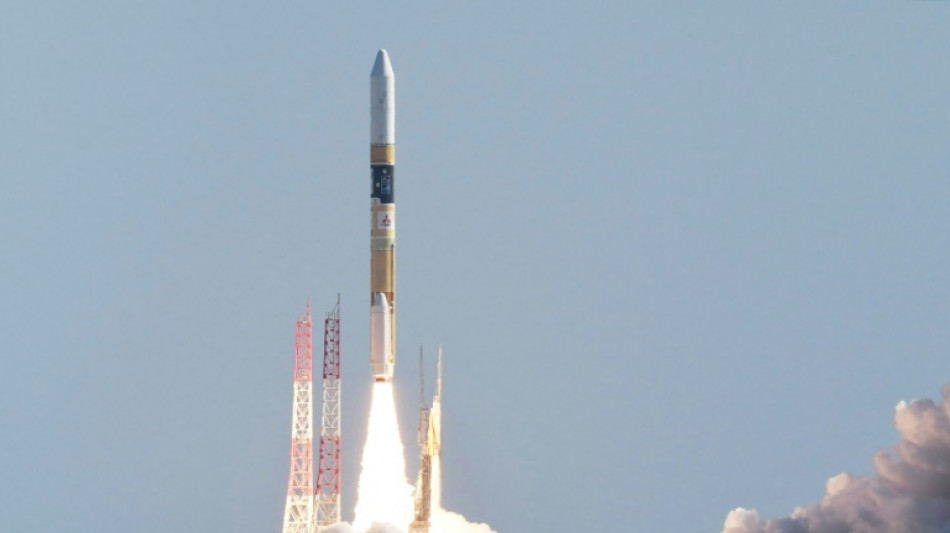
Japan launches 'Moon Sniper' mission / Photo: STR - JIJI Press/AFP

 Modi pitches India as global chipmaking hub

 Ukraine plans record defence spending in 2027

 NASA scan discovers new, 'once in a century' Moon crater

 Most stocks rise as Fed hikes and indicates drive to curb inflation

 UK-Sudanese author pens book to give children 'African history of Africa'

 US Congress passes sweeping Russia sanctions bill

 US stocks fall, dollar gains after Fed lifts interest rates

 US Fed raises rates to tackle 'too high' inflation in move sure to rile Trump

 US Fed raises rates to battle inflation in move likely to rile Trump

 US House faces test on sweeping Russia sanctions bill

 British PM says to make 'difficult decisions' as inflation rises

 Global fuel price demos: a round-up

 Leverate Launches MCP for Traders to Connect AI Assistants With Trading Platforms

 MEXC Launches $1M "Discover Your Wall Street DNA" Campaign to Help Traders Find Their Market Fit

 Stocks edge higher ahead of US Fed rate call

 BASIS.pro Expands On-Chain Infrastructure with XDC Network Partnership and Zypher DAO as Auto Earn Goes Live

 Pickle-flavoured tart? AI inspires Japan's convenience stores

 EU chief hosts Canada's Carney in push to 'deepen' alliance

 Meta chief pushes back on AI slowdown calls

 US Fed to deliver rate decision with markets betting on hike

 i-payout Expands U.S. Money Transmitter Licensing Footprint and Advances European EMI Strategy

 US Senate crypto bill collapses amid partisan deadlock

 OpenAI, Anthropic and Google are working to create an AI standards body

 Protesting shepherds, farmers clash with Romanian police

 Foundation Lets Ledger Users Switch to Open Source Without Starting Over

Japan's "Moon Sniper" mission blasted off Thursday as the country's space programme looks to bounce back from a string of recent mishaps.
Only the United States, Russia, China and, since last month, India have successfully landed a probe on the Moon, with two failed Japanese missions -- one public and one private.
Watched by 35,000 people online, the H-IIA rocket lifted off early Thursday from the southern island of Tanegashima carrying the lander, which is expected to touch down on the lunar surface in early 2024.
To cheers and applause at mission control, the "SLIM" Moon probe and the XRISM space research satellite developed with the US and European space agencies both separated soon afterwards.
The launch had already been postponed three times because of bad weather.
The Smart Lander for Investigating Moon (SLIM) is nicknamed the "Moon Sniper" because it is designed to land within 100 metres of a specific target on the surface.
That is much less than the usual range of several kilometres.
"By creating the SLIM lander, humans will make a qualitative shift towards being able to land where we want and not just where it is easy to land," Japanese space agency JAXA said before the launch.
"By achieving this, it will become possible to land on planets even more resource-scarce than the Moon."
Globally, "there are no previous instances of pinpoint landing on celestial bodies with significant gravity such as the Moon," JAXA added.
XRISM's high-resolution X-ray spectroscopic observations of the hot gas plasma wind that blows through the universe will help study the flows of mass and energy as well as the composition and evolution of celestial objects.
- Serious toy -
Using a palm-sized mini rover developed with a toy company, SLIM aims to investigate how the Moon was formed by examining exposed pieces of the lunar mantle.
India last month landed a craft near the Moon's south pole, a historic triumph for its low-cost space programme.
Its success came days after a Russian probe crashed in the same region, and four years after a previous Indian attempt failed at the last moment.
Japan's past attempts have also gone wrong, including last year when it sent a lunar probe named Omotenashi as part of the United States' Artemis 1 mission.
The size of a backpack, Omotenashi would have been the world's smallest Moon lander but it was lost.
And in April, Japanese startup ispace failed in an ambitious attempt to become the first private company to land on the Moon, losing communication with its craft after what it described as a "hard landing".
Japan has also had problems with its launch rockets, with failures after liftoff of the next-generation H3 in March and the normally reliable solid-fuel Epsilon last October.
In July, the test of an Epsilon S rocket, an improved version of the Epsilon, ended in an explosion 50 seconds after ignition.
Y.Jeong--CPN