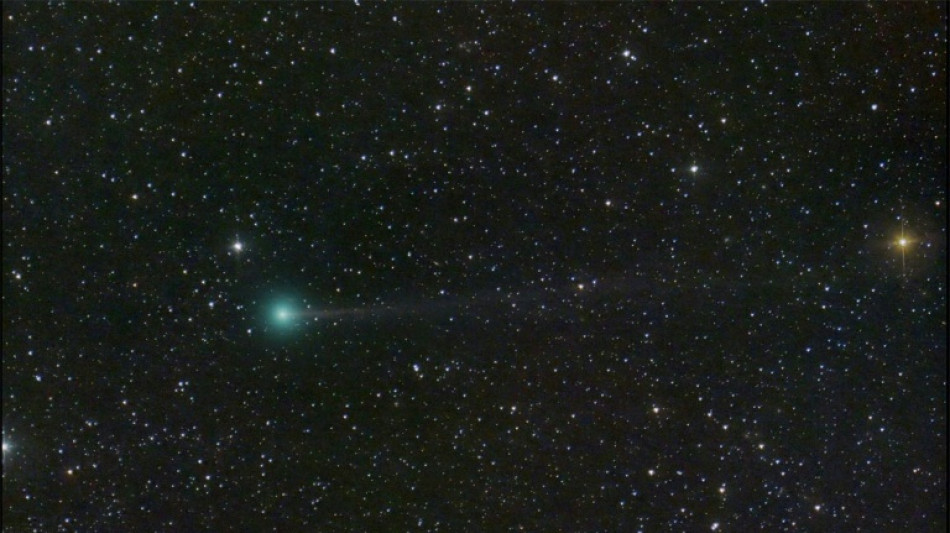
Newly discovered comet visible in night sky this weekend / Photo: Dan Bartlett - NASA/AFP

 Modi pitches India as global chipmaking hub

 Ukraine plans record defence spending in 2027

 NASA scan discovers new, 'once in a century' Moon crater

 Most stocks rise as Fed hikes and indicates drive to curb inflation

 UK-Sudanese author pens book to give children 'African history of Africa'

 US Congress passes sweeping Russia sanctions bill

 US stocks fall, dollar gains after Fed lifts interest rates

 US Fed raises rates to tackle 'too high' inflation in move sure to rile Trump

 US Fed raises rates to battle inflation in move likely to rile Trump

 US House faces test on sweeping Russia sanctions bill

 British PM says to make 'difficult decisions' as inflation rises

 Global fuel price demos: a round-up

 Leverate Launches MCP for Traders to Connect AI Assistants With Trading Platforms

 MEXC Launches $1M "Discover Your Wall Street DNA" Campaign to Help Traders Find Their Market Fit

 Stocks edge higher ahead of US Fed rate call

 BASIS.pro Expands On-Chain Infrastructure with XDC Network Partnership and Zypher DAO as Auto Earn Goes Live

 Pickle-flavoured tart? AI inspires Japan's convenience stores

 EU chief hosts Canada's Carney in push to 'deepen' alliance

 Meta chief pushes back on AI slowdown calls

 US Fed to deliver rate decision with markets betting on hike

 i-payout Expands U.S. Money Transmitter Licensing Footprint and Advances European EMI Strategy

 US Senate crypto bill collapses amid partisan deadlock

 OpenAI, Anthropic and Google are working to create an AI standards body

 Protesting shepherds, farmers clash with Romanian police

 Foundation Lets Ledger Users Switch to Open Source Without Starting Over

A comet called Nishimura discovered just a month ago could be visible to the naked eye this weekend, offering stargazers a once-in-a-437-year chance to observe the celestial visitor.
The ball of rock and ice, whose exact size remains unknown, is named after the Japanese amateur astronomer Hideo Nishimura who first spotted it on August 11.
It is rare that comets reach their moment of peak visibility so soon after being discovered, said Nicolas Biver, an astrophysicist at the Paris Observatory.
"Most are discovered months, even years before they pass closest to the Sun," he told AFP.
The comet only swings by the Sun every 437 years, he said, a long orbital period which sees it spend much of its time in the freezing outer Solar System.
When comets approach the Sun from the vastness of space, the heat causes its ice core to turn into dust and gas, which form a long tail.
The Sun's light reflects off this tail, allowing us to view comets from Earth.
Nishimura, which has the scientific name C/2023 P1, will pass closest to the Sun on September 17.
It will be 33 million kilometres (20 million miles) from the Sun, which is less than a quarter of the distance between the Earth and the Sun, Biver pointed out.
The comet will then pass harmlessly by Earth at a distance of 125 million kilometres.
For stargazers, the comet will be easiest to observe this Saturday and Sunday, particularly in the Northern Hemisphere.
"The best thing to do is look at the sky before sunrise, in a northeastern direction to the left of Venus, in a clear sky, free of pollution," Biver advised.
People with small binoculars will easily be able to enjoy the spectacle. But, if conditions allow, the comet may also be visible by the naked eye.
The comet's tail is greenish, because it contains "more gas than dust," Biver said.
A.Levy--CPN