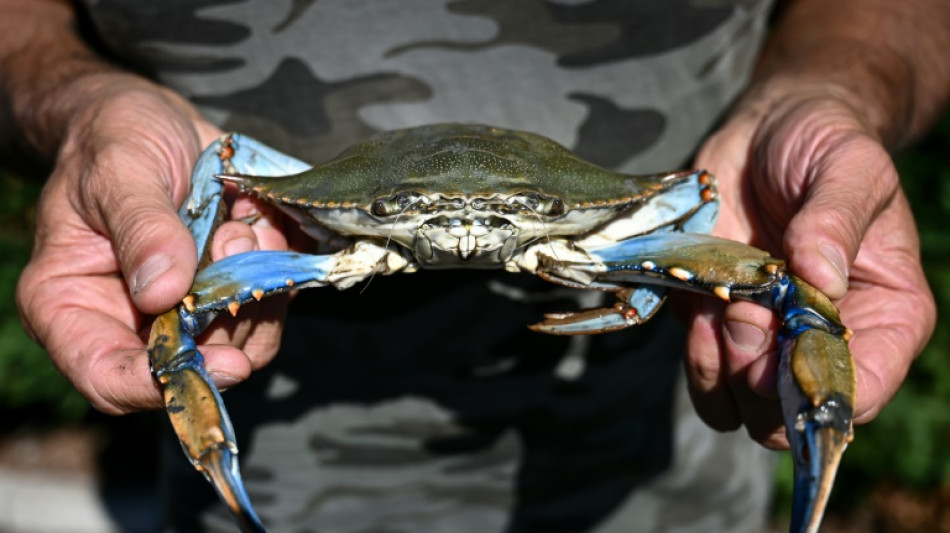
Invasive species a growing and costly threat, key report to find / Photo: Piero CRUCIATTI - AFP/File

 Modi pitches India as global chipmaking hub

 Ukraine plans record defence spending in 2027

 NASA scan discovers new, 'once in a century' Moon crater

 Most stocks rise as Fed hikes and indicates drive to curb inflation

 UK-Sudanese author pens book to give children 'African history of Africa'

 US Congress passes sweeping Russia sanctions bill

 US stocks fall, dollar gains after Fed lifts interest rates

 US Fed raises rates to tackle 'too high' inflation in move sure to rile Trump

 US Fed raises rates to battle inflation in move likely to rile Trump

 US House faces test on sweeping Russia sanctions bill

 British PM says to make 'difficult decisions' as inflation rises

 Global fuel price demos: a round-up

 Leverate Launches MCP for Traders to Connect AI Assistants With Trading Platforms

 MEXC Launches $1M "Discover Your Wall Street DNA" Campaign to Help Traders Find Their Market Fit

 Stocks edge higher ahead of US Fed rate call

 BASIS.pro Expands On-Chain Infrastructure with XDC Network Partnership and Zypher DAO as Auto Earn Goes Live

 Pickle-flavoured tart? AI inspires Japan's convenience stores

 EU chief hosts Canada's Carney in push to 'deepen' alliance

 Meta chief pushes back on AI slowdown calls

 US Fed to deliver rate decision with markets betting on hike

 i-payout Expands U.S. Money Transmitter Licensing Footprint and Advances European EMI Strategy

 US Senate crypto bill collapses amid partisan deadlock

 OpenAI, Anthropic and Google are working to create an AI standards body

 Protesting shepherds, farmers clash with Romanian police

 Foundation Lets Ledger Users Switch to Open Source Without Starting Over

Invasive species that destroy forests, ravage crops and cause extinctions are a major and growing threat worldwide, a landmark UN-backed assessment is poised to report.
From water hyacinth choking Lake Victoria in East Africa, to rats and brown snakes wiping out bird species in the Pacific, to mosquitoes exposing new regions to Zika, yellow fever, dengue and other diseases, tens of thousand of aliens species have taken root -- often literally -- far from their place of origin.
The science advisory panel for the UN Convention on Biodiversity, known by its acronym IPBES, will release on Monday the most comprehensive assessment of so-called "alien species" ever assembled.
Humans are to blame when non-native species wind up on the other side of the world, whether by accident or on purpose.
Scientists point to the pervasive spread of these species as hard evidence that rapid expansion of human activity has so radically altered natural systems as to tip Earth into a new geological epoch called the Anthropocene, or the "era of humans".
Some invasive species are accidental arrivals, hitching rides in the ballast water of cargo ships, the containers in their holds, or in a tourist's suitcase.
Others were introduced deliberately.
The hyacinth which at one point covered 90 percent of Lake Victoria -- crippling transport and fishing, smothering aquatic life, blocking hydroelectric dam intake, and breeding mosquitoes -- is thought to have been introduced by Belgian colonial officials in Rwanda as an ornamental garden flower before making its way down the Kagera River in the 1980s.
The Everglades wetlands preserve in Florida is teeming with the destructive offspring of erstwhile pets and house plants, from five-metre (16-foot) Burmese pythons and walking catfish to Old World climbing fern and Brazilian pepper.
Invasive species are a significant cause of extinctions, along with habitat loss, global warming, pollution and direct exploitation for food or body parts.
Small islands with endemic species not found anywhere else on Earth are especially vulnerable.
Rats, snakes and mosquitoes transported by Western explorers or, later, tourists have wiped out dozens of bird species in the last two centuries.
The deadly fire that reduced the Hawaiian town of Lahaina to ashes last month was fuelled in part by bone-dry guinea, molasses and buffel grasses -- imported as livestock feed -- that have spread across abandoned sugar plantations.
A global treaty to protect biodiversity hammered out in the Canadian city of Montreal last December sets a target of reducing the rate at which invasive alien species spread by 50 percent compared to current levels.
Y.Uduike--CPN