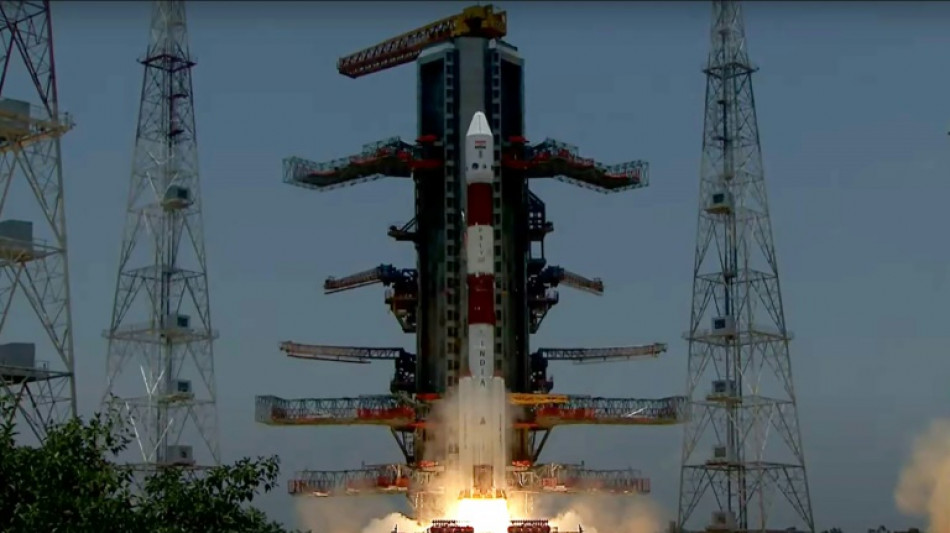
From the Moon to the Sun: India launches next space mission / Photo: - - ISRO/AFP

 Modi pitches India as global chipmaking hub

 Ukraine plans record defence spending in 2027

 NASA scan discovers new, 'once in a century' Moon crater

 Most stocks rise as Fed hikes and indicates drive to curb inflation

 UK-Sudanese author pens book to give children 'African history of Africa'

 US Congress passes sweeping Russia sanctions bill

 US stocks fall, dollar gains after Fed lifts interest rates

 US Fed raises rates to tackle 'too high' inflation in move sure to rile Trump

 US Fed raises rates to battle inflation in move likely to rile Trump

 US House faces test on sweeping Russia sanctions bill

 British PM says to make 'difficult decisions' as inflation rises

 Global fuel price demos: a round-up

 Leverate Launches MCP for Traders to Connect AI Assistants With Trading Platforms

 MEXC Launches $1M "Discover Your Wall Street DNA" Campaign to Help Traders Find Their Market Fit

 Stocks edge higher ahead of US Fed rate call

 BASIS.pro Expands On-Chain Infrastructure with XDC Network Partnership and Zypher DAO as Auto Earn Goes Live

 Pickle-flavoured tart? AI inspires Japan's convenience stores

 EU chief hosts Canada's Carney in push to 'deepen' alliance

 Meta chief pushes back on AI slowdown calls

 US Fed to deliver rate decision with markets betting on hike

 i-payout Expands U.S. Money Transmitter Licensing Footprint and Advances European EMI Strategy

 US Senate crypto bill collapses amid partisan deadlock

 OpenAI, Anthropic and Google are working to create an AI standards body

 Protesting shepherds, farmers clash with Romanian police

 Foundation Lets Ledger Users Switch to Open Source Without Starting Over

The latest mission in India's ambitious space programme blasted off Saturday on a voyage towards the centre of the solar system, a week after the country's successful unmanned Moon landing.
Aditya-L1 launched shortly before midday, with a live broadcast showing hundreds of spectators cheering wildly against the deafening noise of the rocket's ascent.
"Launch successful, all normal," an Indian Space Research Organisation official announced from mission control as the vessel made its way to the upper reaches of the Earth's atmosphere.
The mission is carrying scientific instruments to observe the Sun's outermost layers in a four-month journey.
The United States and the European Space Agency (ESA) have sent numerous probes to the centre of the solar system, beginning with NASA's Pioneer programme in the 1960s.
Japan and China have both launched their own solar observatory missions into Earth's orbit.
But if successful, the latest mission from the Indian Space Research Organisation (ISRO) will be the first by any Asian nation to be placed in orbit around the Sun.
"It's a challenging mission for India," astrophysicist Somak Raychaudhury told broadcaster NDTV on Friday.
Raychaudhury said the mission probe would study coronal mass ejections, a periodic phenomenon that sees huge discharges of plasma and magnetic energy from the Sun's atmosphere.
These bursts are so powerful they can reach the Earth and potentially disrupt the operations of satellites.
Aditya will help predict the phenomenon "and alert everybody so that satellites can shut down their power", he said.
"It will also help us understand how these things happen, and in the future, we might not need a warning system out there."
Aditya, the name of the Hindu Sun deity, will travel 1.5 million kilometres (930,000 miles) to reach its destination -- still only one percent of the vast distance between Earth and the Sun.
At that point, the gravitational forces of both celestial bodies cancel each other out, allowing the mission to remain in a stable halo orbit around our nearest star.
Aditya is travelling on the ISRO-designed, 320-tonne PSLV XL rocket that has been a mainstay of the Indian space programme, powering earlier launches to the Moon and Mars.
The mission also aims to shed light on the dynamics of several other solar phenomena by imaging and measuring particles in the Sun's upper atmosphere.
- Budget programme -
India has been steadily matching the achievements of established spacefaring powers at a fraction of their cost.
The South Asian nation has a comparatively low-budget space programme, but one that has grown considerably in size and momentum since it first sent a probe to orbit the Moon in 2008.
Experts say India can keep costs low by copying and adapting existing technology, and thanks to an abundance of highly skilled engineers who earn a fraction of their foreign counterparts' wages.
Last month's successful landing on the lunar surface -- a feat previously achieved only by Russia, the United States and China -- cost less than $75 million.
The touchdown was widely celebrated by the public, with prayer rituals to wish for the mission's success and schoolchildren following its final descent from live broadcasts in classrooms.
India became the first Asian nation to put a craft into orbit around Mars in 2014 and is slated to launch a three-day crewed mission into the Earth's orbit by next year.
It also plans a joint mission with Japan to send another probe to the Moon by 2025 and an orbital mission to Venus within the next two years.
A.Levy--CPN