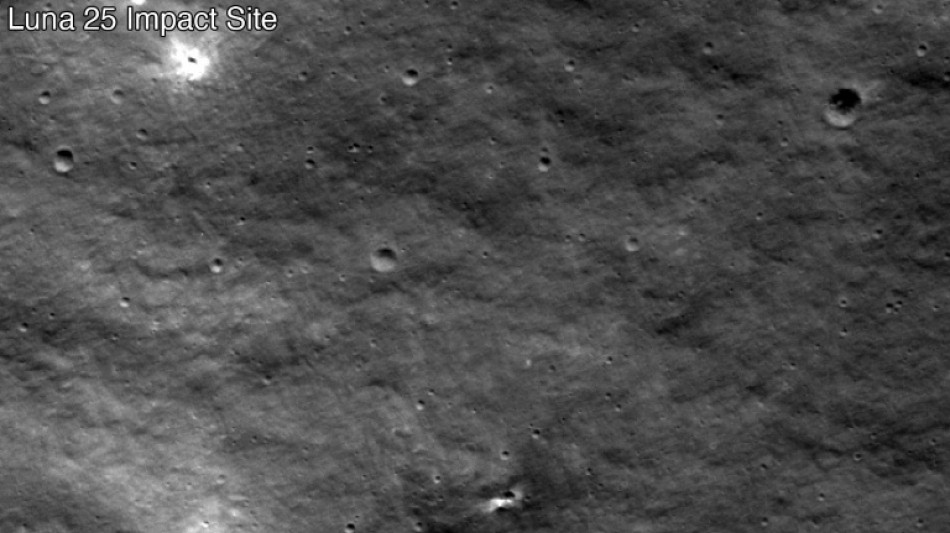
NASA spots new Moon crater, likely caused by crashed Russian probe / Photo: - - NASA’s Goddard Space Flight Center/Arizona State University/AFP

 Modi pitches India as global chipmaking hub

 Ukraine plans record defence spending in 2027

 NASA scan discovers new, 'once in a century' Moon crater

 Most stocks rise as Fed hikes and indicates drive to curb inflation

 UK-Sudanese author pens book to give children 'African history of Africa'

 US Congress passes sweeping Russia sanctions bill

 US stocks fall, dollar gains after Fed lifts interest rates

 US Fed raises rates to tackle 'too high' inflation in move sure to rile Trump

 US Fed raises rates to battle inflation in move likely to rile Trump

 US House faces test on sweeping Russia sanctions bill

 British PM says to make 'difficult decisions' as inflation rises

 Global fuel price demos: a round-up

 Leverate Launches MCP for Traders to Connect AI Assistants With Trading Platforms

 MEXC Launches $1M "Discover Your Wall Street DNA" Campaign to Help Traders Find Their Market Fit

 Stocks edge higher ahead of US Fed rate call

 BASIS.pro Expands On-Chain Infrastructure with XDC Network Partnership and Zypher DAO as Auto Earn Goes Live

 Pickle-flavoured tart? AI inspires Japan's convenience stores

 EU chief hosts Canada's Carney in push to 'deepen' alliance

 Meta chief pushes back on AI slowdown calls

 US Fed to deliver rate decision with markets betting on hike

 i-payout Expands U.S. Money Transmitter Licensing Footprint and Advances European EMI Strategy

 US Senate crypto bill collapses amid partisan deadlock

 OpenAI, Anthropic and Google are working to create an AI standards body

 Protesting shepherds, farmers clash with Romanian police

 Foundation Lets Ledger Users Switch to Open Source Without Starting Over

NASA has spotted a small new crater on the Moon that was likely caused by a Russian probe crash landing on the surface around two weeks ago.
The finding was made by the Lunar Reconnaissance Orbiter (LRO) by comparing before and after images of the estimated impact point, provided by Russian space agency Roscosmos.
The Luna-25 probe crashed on August 19, scuppering Russia's hopes of reviving its long dormant Moon program with the first ever soft landing on the lunar south pole.
That accolade went instead to India, which successfully landed its Chandrayaan-3 mission on August 23 and is currently exploring the polar region with its Pragyan rover.
LRO, which has been in orbit over the Moon since 2009, took its most recent "before" image in June 2022. This was compared to an image taken on August 24, 2023.
"Since this new crater is close to the Luna 25 estimated impact point, the LRO team concludes it is likely to be from that mission, rather than a natural impactor," a NASA statement said.
The new crater is about 10 meters (32 feet) in diameter, some 400 kilometers (250 miles) short of Luna-25's intended landing point.
NASA also plans to return to the Moon under its Artemis program, with the goal of building a sustained presence. Ice deposits could be exploited to support human habitats, or broken down into hydrogen and oxygen for use as rocket fuel.
U.Ndiaye--CPN