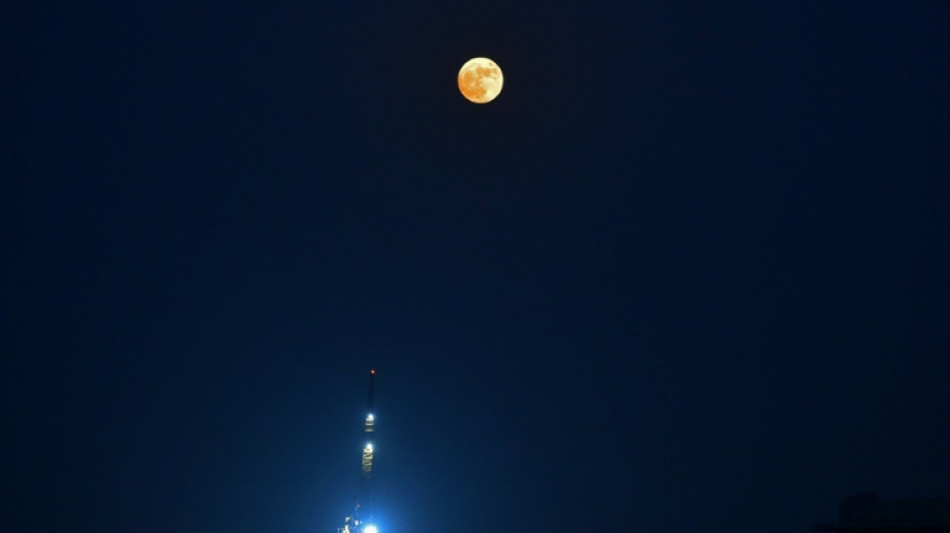
Last 'Super Blue Moon' until 2037 rises tonight / Photo: SANJAY KANOJIA - AFP

 Modi pitches India as global chipmaking hub

 Ukraine plans record defence spending in 2027

 NASA scan discovers new, 'once in a century' Moon crater

 Most stocks rise as Fed hikes and indicates drive to curb inflation

 UK-Sudanese author pens book to give children 'African history of Africa'

 US Congress passes sweeping Russia sanctions bill

 US stocks fall, dollar gains after Fed lifts interest rates

 US Fed raises rates to tackle 'too high' inflation in move sure to rile Trump

 US Fed raises rates to battle inflation in move likely to rile Trump

 US House faces test on sweeping Russia sanctions bill

 British PM says to make 'difficult decisions' as inflation rises

 Global fuel price demos: a round-up

 Leverate Launches MCP for Traders to Connect AI Assistants With Trading Platforms

 MEXC Launches $1M "Discover Your Wall Street DNA" Campaign to Help Traders Find Their Market Fit

 Stocks edge higher ahead of US Fed rate call

 BASIS.pro Expands On-Chain Infrastructure with XDC Network Partnership and Zypher DAO as Auto Earn Goes Live

 Pickle-flavoured tart? AI inspires Japan's convenience stores

 EU chief hosts Canada's Carney in push to 'deepen' alliance

 Meta chief pushes back on AI slowdown calls

 US Fed to deliver rate decision with markets betting on hike

 i-payout Expands U.S. Money Transmitter Licensing Footprint and Advances European EMI Strategy

 US Senate crypto bill collapses amid partisan deadlock

 OpenAI, Anthropic and Google are working to create an AI standards body

 Protesting shepherds, farmers clash with Romanian police

 Foundation Lets Ledger Users Switch to Open Source Without Starting Over

Astronomy enthusiasts are in for a treat Wednesday night: a rare "super blue Moon" that won't be seen again for more than a decade.
Supermoons occur when the Moon passes through its perigee, or the point that takes it closest to Earth during its elliptical orbit. This makes it look about 14 percent bigger compared to when it is at its furthest point, and a touch brighter.
Full Moons are defined by the exact moment they are opposite the Sun, which will occur at 9:36 pm Eastern Time on August 30 (0136 GMT Thursday), according to NASA.
The Virtual Telescope Project, hosted by Italian astronomer Gianluca Masi, will host a YouTube livestream beginning at 0336 GMT as it sets below the skyline of Rome.
Despite the description, it won't actually be blue: the term "blue Moon" simply refers to when we see a full moon twice in a month. This happens because lunar cycles are a bit shorter at 29.5 days than calendar months, which last 30 or 31 days, so it's possible for one to happen at the start of a month and the other right at the end.
The previous super blue Moon occurred in December 2009, with the next set to come in quick succession: January and March of 2037.
The origins of the English expression "once in a blue Moon," today understood to mean something that is very rare, go back hundreds of years. In Elizabethan times, "he would argue the Moon was blue" could be said about a person making outlandish or patently absurd claims.
It is possible, however, for the Moon to take on a blue hue in the right circumstances. This can occur as a result of smoke or dust particles in the atmosphere scattering red wavelengths of life, such as following the eruption of Krakatoa in Indonesia in 1883.
Dust from the event "turned sunsets green and the Moon blue all around the world for the best part of two years," according to Sky & Telescope magazine. A more recent example may have occurred after 1950's Chinchaga Firestorm, a huge blaze that consumed the northern boreal forests of Canada.
- Higher tides -
The planet Saturn, just a few days out from its closest and brightest approach to Earth this year, will also appear near the Moon.
Wednesday's full Moon coincides with the Hindu festival "Raksha Bandhan" or Rakhi, which celebrates the bond between siblings. It is traditional for sisters to tie a rakhi, or cotton bracelet, around their brother's wrist, who give a gift in return.
It also falls in the month of Elul in the Hebrew calendar, a time of seeking and granting others forgiveness, as well as beginning and ending letters with wishes for the recipient to have a good year.
"As usual, the wearing of suitably celebratory celestial attire is encouraged in honor of the full Moon. Take care of your siblings, let go of grudges, and here's wishing you a good year!" said a NASA post.
While the super blue Moon will make for specatular photos, its stronger gravitional pull also makes tides higher, which could exacerbate coastal flooding from Hurricane Idalia as it sweeps across Florida.
P.Gonzales--CPN