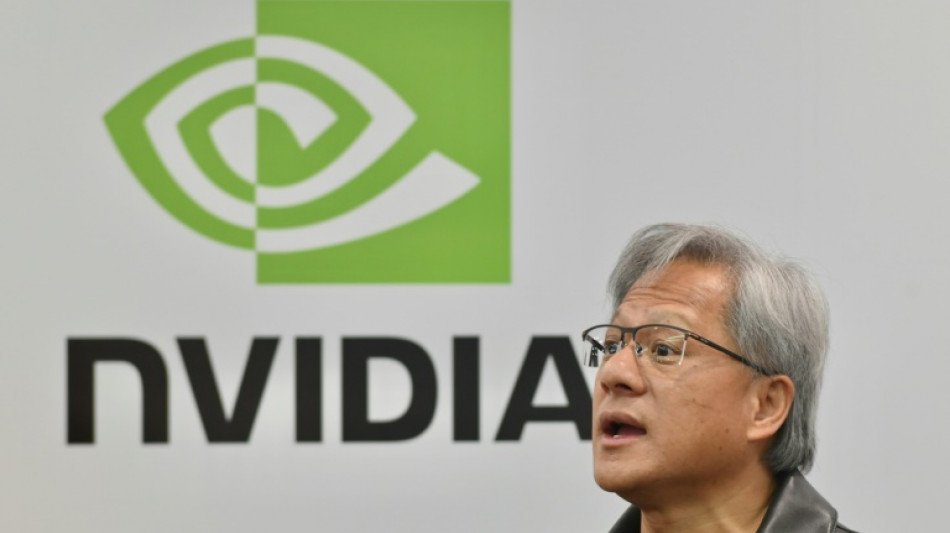
Chip giant Nvidia rides AI wave as profits soar / Photo: Sam Yeh - AFP

 NASA scan discovers new, 'once in a century' Moon crater

 Most stocks rise as Fed hikes and indicates drive to curb inflation

 UK-Sudanese author pens book to give children 'African history of Africa'

 US Congress passes sweeping Russia sanctions bill

 US stocks fall, dollar gains after Fed lifts interest rates

 US Fed raises rates to tackle 'too high' inflation in move sure to rile Trump

 US Fed raises rates to battle inflation in move likely to rile Trump

 US House faces test on sweeping Russia sanctions bill

 British PM says to make 'difficult decisions' as inflation rises

 Global fuel price demos: a round-up

 Leverate Launches MCP for Traders to Connect AI Assistants With Trading Platforms

 MEXC Launches $1M "Discover Your Wall Street DNA" Campaign to Help Traders Find Their Market Fit

 Stocks edge higher ahead of US Fed rate call

 BASIS.pro Expands On-Chain Infrastructure with XDC Network Partnership and Zypher DAO as Auto Earn Goes Live

 Pickle-flavoured tart? AI inspires Japan's convenience stores

 EU chief hosts Canada's Carney in push to 'deepen' alliance

 Meta chief pushes back on AI slowdown calls

 US Fed to deliver rate decision with markets betting on hike

 i-payout Expands U.S. Money Transmitter Licensing Footprint and Advances European EMI Strategy

 US Senate crypto bill collapses amid partisan deadlock

 OpenAI, Anthropic and Google are working to create an AI standards body

 Protesting shepherds, farmers clash with Romanian police

 Foundation Lets Ledger Users Switch to Open Source Without Starting Over

 EU to propose curbing social media, online games for under 15s

 FX Junction Reaches 40,600 Members and 26 Million Trades

US chip giant Nvidia, whose products play a crucial role in artificial intelligence systems, crushed expectations on Wednesday, as the post-ChatGPT AI frenzy continues to lift the tech sector.
The Silicon Valley-based company said sales doubled year-on-year to $13.5 billion in the latest completed quarter, leaving a net profit of $6.2 billion -- an eye-watering 843 percent higher than a year before.
Signaling that the boom in AI is still going strong, Nvidia said revenue in the current quarter would ramp up further to $16 billion.
"A new computing era has begun," Nvidia CEO Jensen Huang said after the stellar earnings report.
"Together accelerated computing and generative AI are driving a broad based computer industry platform shift. Our demand is tremendous," he said on an analyst call.
Nvidia's stock rose more than 8 percent following the results. This year, the company's share price has more than tripled.
Nvidia's quintessential position in delivering artificial intelligence has made it a bellwether on the generative AI frenzy that took hold of the tech world after the release of ChatGPT late last year.
As the wave began to build, the company already wowed Wall Street with spectacular earnings earlier in the year, helping transform Nvidia into a trillion dollar company based on market capitalization, a rare perch shared only by a handful of giants.
"The entire tech sector and overall market was waiting for Nvidia with this being the purest and best barometer for AI demand," said Dan Ives of Wedbush Securities.
In the end, the earnings "were a 'drop the mic' moment that will have a ripple impact for the tech space for the rest of the year," he said.
Riding high on his success, Huang, who is known for always wearing a black leather jacket, urged companies to shift their spending away from classic computing and embrace AI.
"AI provides a new way of generating productivity, a new way of generating new services to offer to your customers and accelerated computing helps you save money and save power," Huang said.
Nvidia manufactures graphics processing units (GPUs), a powerful chip technology that is necessary to build the generative AI that delivers ChatGPT as well as image, facial and speech recognition.
The company also offers AI-focused computers and services making it an unparalleled one-stop shop for AI.
Originally designed for video game graphics, each of Nvidia's GPU chips cost tens of thousands of dollars and companies are scrambling to stock up as the pressure to keep up with the AI revolution grows.
- Supply crunch? -
Customers have struggled to get their hands on Nvidia's AI chips as startups, big companies, governments and cloud providers ramp up orders and hoard stock.
Elon Musk, who this year started his own AI company, has said that GPUs "are considerably harder to get than drugs" at the moment, with buyers even looking to buy components from struggling cryptocurrency companies that also use GPUs.
Some fear that Nvidia may eventually struggle to meet demand with crucial components from Taiwan's TSMC chip-making plants hard pressed to meet Nvidia's needs.
Nvidia doesn't actually make its own chips, but rather designs them and then outsources the manufacturing to other companies. It is therefore vulnerable to chokepoints in its complex supply chain.
Nvidia's strategic role in AI saw the United States government last year place export restrictions on the company's highest performing chips, which forced the it to make slower versions for the Chinese market.
The White House is considering additional export curbs that could further limit Nvidia's access to the Chinese market.
In an analyst call, Nvidia CFO Colette Kress warned against the US cracking down harder, saying it "will result in a permanent loss of an opportunity for the US industry to compete and lead in one of the world's largest markets."
D.Philippon--CPN

