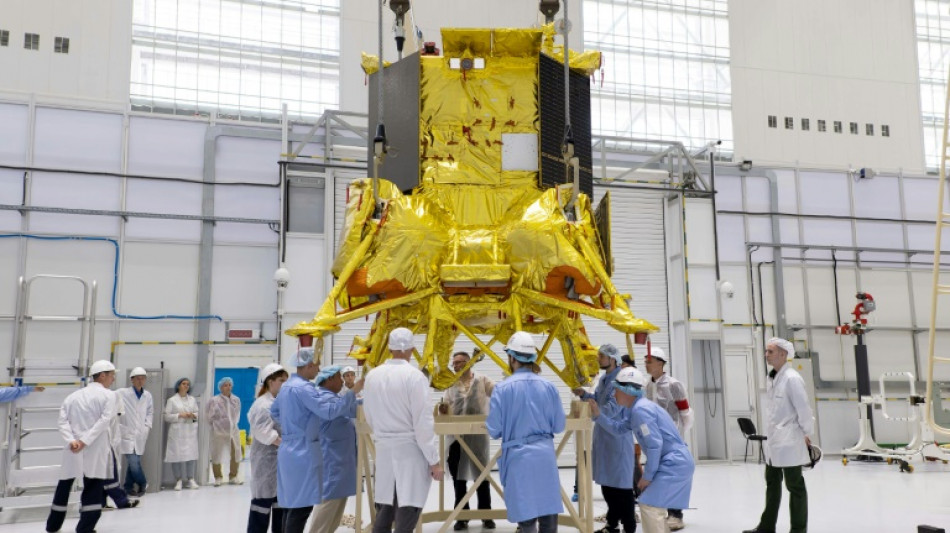
Russia's Luna-25 probe crashes on the Moon / Photo: Handout - Russian Space Agency Roscosmos/AFP

 NASA scan discovers new, 'once in a century' Moon crater

 Most stocks rise as Fed hikes and indicates drive to curb inflation

 UK-Sudanese author pens book to give children 'African history of Africa'

 US Congress passes sweeping Russia sanctions bill

 US stocks fall, dollar gains after Fed lifts interest rates

 US Fed raises rates to tackle 'too high' inflation in move sure to rile Trump

 US Fed raises rates to battle inflation in move likely to rile Trump

 US House faces test on sweeping Russia sanctions bill

 British PM says to make 'difficult decisions' as inflation rises

 Global fuel price demos: a round-up

 Leverate Launches MCP for Traders to Connect AI Assistants With Trading Platforms

 MEXC Launches $1M "Discover Your Wall Street DNA" Campaign to Help Traders Find Their Market Fit

 Stocks edge higher ahead of US Fed rate call

 BASIS.pro Expands On-Chain Infrastructure with XDC Network Partnership and Zypher DAO as Auto Earn Goes Live

 Pickle-flavoured tart? AI inspires Japan's convenience stores

 EU chief hosts Canada's Carney in push to 'deepen' alliance

 Meta chief pushes back on AI slowdown calls

 US Fed to deliver rate decision with markets betting on hike

 i-payout Expands U.S. Money Transmitter Licensing Footprint and Advances European EMI Strategy

 US Senate crypto bill collapses amid partisan deadlock

 OpenAI, Anthropic and Google are working to create an AI standards body

 Protesting shepherds, farmers clash with Romanian police

 Foundation Lets Ledger Users Switch to Open Source Without Starting Over

 EU to propose curbing social media, online games for under 15s

 FX Junction Reaches 40,600 Members and 26 Million Trades

The Luna-25 probe, Russia's first Moon mission in almost 50 years, has crashed on the Earth's natural satellite after an unspecified incident during pre-landing manoeuvres, the Russian space agency Roscosmos said Sunday.
The crash comes almost a year and a half into Russia's Ukraine offensive that has seen Moscow isolated, with punishing sanctions that have affected its space industry.
The failed mission comes as several companies and nations have entered a Moon race, and put a spotlight on the Russian space sector's troubles -- from corruption to lack of innovation and partnerships.
Communication with Luna-25 was lost at 2:57 pm (1157 GMT) on Saturday, Roscosmos said.
According to preliminary findings, the lander "has ceased to exist following a collision with the Moon's surface".
"Measures taken on August 19 and 20 to locate the craft and make contact with it were unsuccessful," the space agency added.
It said a ministerial investigation would be opened into the causes of the crash, without giving any indication of what technical problems might have occurred.
With Luna-25, Moscow had hoped to build on the legacy of its Soviet-era Luna programme, marking a return to independent Moon exploration in the face of financial troubles and corruption scandals at the programme and growing isolation from the West.
Valery Yegorov, a former researcher with Russia's space programme who now lives in exile, said the crash would severely affect Roscosmos's future missions, with the next one not planned until 2028 or "even later".
He suggested the probe's failure was linked to electronic problems, possibly resulting from Western sanctions on Moscow.
The Luna-25 launch was postponed several times in the last five years, Yegorov said, "because of sanctions imposed on Russia in response to seizing Crimea".
- Research 'not a priority' -
"Science, fundamental research, some kind of humanistic ideas about space colonisation, about revealing the secrets of the universe, are clearly not a priority right now," said Yegorov, who has denounced the Kremlin's Ukraine offensive.
The 800-kilogramme (1,760-pound) Luna-25 probe was to have made a soft landing on Monday on the Moon's south pole -- which would have been a historic first.
Russia has not attempted to land on a celestial body since 1989, when the Soviet Union's Phobos 2 probe to explore the moons of Mars failed after an onboard computer malfunction.
Roscosmos chief Yuri Borisov had said the venture would be "risky", telling President Vladimir Putin in June that the probability of it succeeding was "around 70 percent".
Luna-25 had been successfully placed in the Moon's orbit on Wednesday after being launched from the Vostochny cosmodrome in the Russian Far East.
- Space race -
But on Saturday, Roscosmos said an "emergency" had been detected during a manoeuvre by the probe before its landing, preventing the operation from being carried out.
Luna-25 had been expected to stay on the Moon for a year, collecting soil samples and looking for water -- an ingredient enthusiasts hope could be used to make rocket fuel for future launches and support potential colonies living there.
Cameras installed on the lander had already taken shots of the lunar surface.
Doubts had already emerged about Russia's long-running space cooperation with the West in the wake of its military campaign in Ukraine.
While Russia has said it intends to use the International Space Station until 2028, the European Space Agency (ESA) has dropped plans to co-operate with Moscow on Moon and Mars missions.
Moscow last landed a probe -- Luna-24 -- on the Moon in 1976, before shifting away from lunar exploration in favour of missions to Venus and building the Mir space station.
Landing Luna-25 successfully would have paved the way for further Russian missions to the Moon, at a time when India and China are launching their own probes and the United States returns to manned missions.
India's competing space probe, Chandrayaan-3, entered the Moon's orbit earlier in August, also with the goal of landing on the south pole.
Only Russia, the United States and China have previously achieved a controlled landing on the Moon.
C.Peyronnet--CPN

