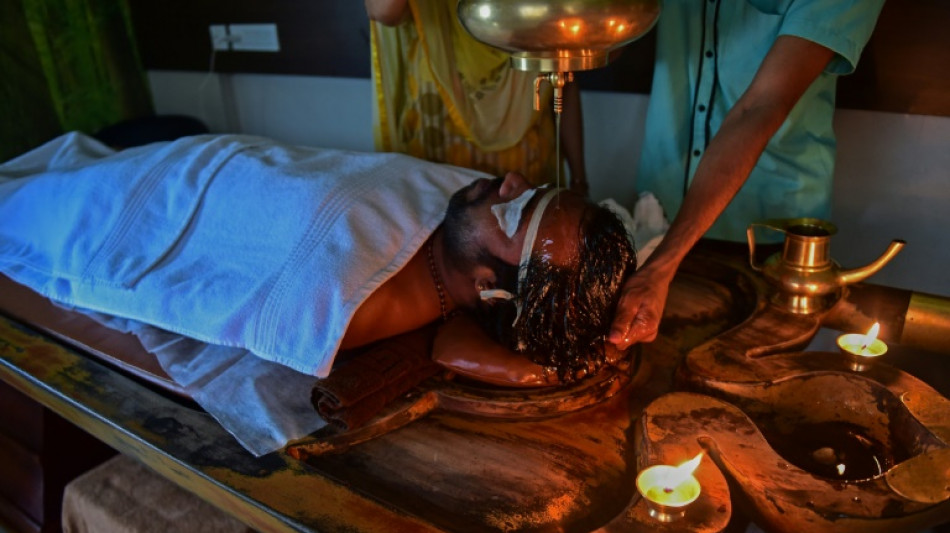
WHO holds first traditional medicine summit
/ Photo: SAM PANTHAKY - AFP

 NASA scan discovers new, 'once in a century' Moon crater

 Most stocks rise as Fed hikes and indicates drive to curb inflation

 UK-Sudanese author pens book to give children 'African history of Africa'

 US Congress passes sweeping Russia sanctions bill

 US stocks fall, dollar gains after Fed lifts interest rates

 US Fed raises rates to tackle 'too high' inflation in move sure to rile Trump

 US Fed raises rates to battle inflation in move likely to rile Trump

 US House faces test on sweeping Russia sanctions bill

 British PM says to make 'difficult decisions' as inflation rises

 Global fuel price demos: a round-up

 Leverate Launches MCP for Traders to Connect AI Assistants With Trading Platforms

 MEXC Launches $1M "Discover Your Wall Street DNA" Campaign to Help Traders Find Their Market Fit

 Stocks edge higher ahead of US Fed rate call

 BASIS.pro Expands On-Chain Infrastructure with XDC Network Partnership and Zypher DAO as Auto Earn Goes Live

 Pickle-flavoured tart? AI inspires Japan's convenience stores

 EU chief hosts Canada's Carney in push to 'deepen' alliance

 Meta chief pushes back on AI slowdown calls

 US Fed to deliver rate decision with markets betting on hike

 i-payout Expands U.S. Money Transmitter Licensing Footprint and Advances European EMI Strategy

 US Senate crypto bill collapses amid partisan deadlock

 OpenAI, Anthropic and Google are working to create an AI standards body

 Protesting shepherds, farmers clash with Romanian police

 Foundation Lets Ledger Users Switch to Open Source Without Starting Over

 EU to propose curbing social media, online games for under 15s

 FX Junction Reaches 40,600 Members and 26 Million Trades

The World Health Organization holds its first summit on traditional medicine on Thursday, with warnings that treatments rooted in natural products can be effective alternative healthcare only if scientifically proven.
Traditional medicines are a "first port of call for millions of people worldwide", the UN health agency said, with the talks in India bringing together policymakers and academics aiming to "mobilise political commitment and evidence-based action" towards them.
WHO chief Tedros Adhanom Ghebreyesus said traditional medicine could boost healthcare "access gaps", but was of value only if used "appropriately, effectively, and above all, safely based on the latest scientific evidence", in a statement ahead of the conference.
The two-day WHO Traditional Medicine Global Summit takes place alongside a meeting of G20 health ministers in the Indian city of Gandhinagar.
"Advancing science on traditional medicine should be held to the same rigorous standards as in other fields of health," WHO research chief John Reeder said in a statement.
"This may require new thinking on the methodologies to address these more holistic, contextual approaches and provide evidence that is sufficiently conclusive and robust to lead to policy recommendations."
Indian Prime Minister Narendra Modi, who is expected to open the WHO conference via a video message, has repeatedly promoted the health benefits of yoga, extolling it as a "panacea" for stress and even hate.
The summit, set to become an annual event, follows the opening last year of a WHO Global Centre for Traditional Medicine, also in India's Gujarat state.
- Lack of regulatory oversight -
While traditional medicines are widely used in some parts of the world, they also face fierce criticism.
The UN health agency defines traditional medicine as the knowledge, skills and practices used over time to maintain health and prevent, diagnose and treat physical and mental illness.
But many traditional treatments have no proven scientific value and conservationists say the industry drives a rampant trade in endangered animals -- including tigers, rhinos and pangolins -- threatening the existence of entire species.
Use of homemade remedies soared during the Covid-19 pandemic, including a green herbal drink based on Artemisia that was promoted by Madagascar's president as a cure.
The plant has a proven efficacy in malaria treatment, but its use to combat Covid was widely scorned by many doctors.
In China, traditional medicine has a distinguished history, but top European medical bodies have previously demanded it be subject to the same regulatory oversight as conventional Western methods.
Of the WHO's 194 member states, 170 acknowledged their use of traditional and complementary medicine since 2018, but only 124 reported having laws or regulations for the use of herbal medicines -- while only half had a national policy on such methods and medicines.
"Natural doesn't always mean safe, and centuries of use are not a guarantee of efficacy; therefore, scientific method and process must be applied to provide the rigorous evidence required," the WHO said.
Some 40 percent of approved pharmaceutical products currently in use derive from a "natural product basis", according to the WHO, citing "landmark drugs" that derive from traditional medicine, including aspirin, drawing on formulations using willow tree bark.
A.Agostinelli--CPN

